Boost AI Brand Presence by 35%: 2026 Guide for Marketers

Digital marketers face a critical visibility crisis. AI models like ChatGPT, Gemini, and Claude now answer millions of buyer queries daily, yet most brands have zero insight into when or how often they appear in those responses. Manual tracking through spreadsheets and screenshots is tedious, inconsistent, and fails to capture the full picture. This guide delivers a systematic, tool-driven approach to monitor, optimize, and amplify your brand’s presence in AI-generated answers, giving you the competitive edge needed in 2026’s AI-first search landscape.
Table of Contents
- Prerequisites And Tools For AI Brand Presence Monitoring
- Content Optimization Strategies For AI Presence
- Implementing AI Visibility Testing And Analysis
- Using AI Visibility Scores And Competitive Benchmarking
- Common Mistakes And Troubleshooting In AI Brand Presence
- Advanced Techniques: AB Testing And Iterative Optimization
- Alternative Approaches And Strategic Tradeoffs
- Expected Outcomes And Benchmarks
- Enhance Your AI Brand Presence With RankPirate
- FAQ
Key Takeaways
| Point | Details |
|---|---|
| Automate AI visibility monitoring | Replace manual tracking with specialized tools to gain accurate, scalable insights. |
| Optimize content semantically | Align copy with AI prompt structures and buyer journey stages to increase mentions. |
| Use prompt-based testing | Simulate real buyer questions to identify and fix visibility drop-off points. |
| Benchmark competitor visibility | Track AI presence scores against rivals to prioritize strategic improvements. |
| Avoid traditional SEO reliance | AI models require distinct optimization strategies beyond conventional search tactics. |
Prerequisites and Tools for AI Brand Presence Monitoring
Manual monitoring wastes time and produces unreliable data. You need automation to track how AI models mention your brand across thousands of prompt variations. Automated tools improve monitoring speed by over 80% compared to manual methods, freeing your team to focus on strategic adjustments rather than tedious data collection.
AI visibility scoring quantifies your brand’s presence. The GVS™ (AI Visibility Score) aggregates performance across discovery, comparison, and validation prompts, giving you a single metric that reflects stable, long-term visibility instead of fleeting snapshots. This score becomes your north star for measuring progress and diagnosing weak spots.
RankPirate automates the entire monitoring workflow. It runs repeated prompt tests across ChatGPT, Gemini, and Claude, tracking where your brand appears, where it drops out, and how consistently you show up compared to competitors. The platform eliminates guesswork by delivering actionable insights in a dashboard you can review daily or weekly.
Before you start, ensure you have:
- Access to an AI visibility monitoring tool RankPirate or similar platform
- Understanding of how AI models generate answers from training data
- Analytics capacity to interpret visibility trends and competitor benchmarks
- Content management workflows to implement rapid optimizations
| Tool Type | Primary Function | Time Savings |
|---|---|---|
| Automated Monitoring | Tracks AI brand mentions across models | 80%+ |
| Prompt Testing | Simulates buyer journey queries | 70%+ |
| Competitor Benchmarking | Compares visibility scores | 60%+ |
Pro Tip: Set up alerts for major AI model updates. When ChatGPT or Gemini releases a new version, your visibility can shift overnight. Immediate testing helps you adapt before competitors catch on.
Content Optimization Strategies for AI Presence
AI models prioritize semantically rich, prompt-aligned content. Traditional keyword stuffing fails because these systems understand context, intent, and topical authority. Your content must directly answer the questions buyers ask at each stage of their journey.

Match your content to buyer journey prompts. Discovery stage content should address broad awareness questions. Comparison stage content needs direct feature evaluations and alternatives. Validation stage content must tackle specific concerns, pricing, and implementation details. Each stage requires distinct messaging that aligns with how AI models parse intent.
Optimizing content for AI models requires semantic-rich, prompt-aligned copy that matches user intent and AI training data context, improving AI-generated brand mentions by up to 35%. This means rewriting product pages, blog posts, and landing pages to directly mirror the phrasing and structure of common buyer queries.
Use keyword clusters that AI models recognize. Instead of isolated terms, build topic clusters around core concepts. If you sell marketing automation, create interconnected content covering email workflows, lead scoring, CRM integration, and analytics dashboards. AI models connect these dots and recognize your authority across the cluster.
Key optimization tactics include:
- Writing clear, definitive answers to common buyer questions
- Structuring content with FAQ sections AI models can extract
- Including comparative data AI uses for recommendation logic
- Updating content regularly to reflect current trends and data
- Embedding entity-rich copy that signals topical expertise
Pro Tip: Perform quarterly AI content optimization strategies audits. Review your top 20 pages for freshness, prompt alignment, and semantic depth. Refresh outdated stats and add new buyer journey angles to maintain AI model relevance.
Implementing AI Visibility Testing and Analysis
Running prompt-based tests simulates real buyer behavior. You feed AI models the exact questions your prospects ask, then analyze whether your brand appears in the response. Repeating this process across dozens or hundreds of prompts reveals patterns: where you consistently show up, where you occasionally appear, and where you’re invisible.
Follow this testing workflow:
- Identify 50-100 buyer journey prompts across discovery, comparison, and validation stages.
- Run each prompt through ChatGPT, Gemini, and Claude using your AI visibility testing with RankPirate platform.
- Record brand mention frequency, placement, and context for each prompt.
- Analyze drop-off points where your brand disappears from AI answers.
- Adjust messaging, content depth, and semantic signals in underperforming areas.
- Retest after 2-4 weeks to measure improvement.
Running repeated prompt-based tests simulating buyer journey questions improves presence consistency by 25%. Consistency matters more than occasional high visibility because buyers interact with AI models multiple times before making decisions.
| Testing Phase | Brand Mention Rate | Avg. Placement | Visibility Score |
|---|---|---|---|
| Pre-Optimization | 42% | 4.2 | 38/100 |
| Post-Optimization | 67% | 2.1 | 71/100 |
Identify specific content gaps causing drop-offs. If AI models mention competitors but not you when buyers ask about pricing transparency, your pricing page likely lacks the semantic depth models need. Add comparison tables, clear tier breakdowns, and ROI calculators to fill that gap.
Iterate testing after every content update and AI model release. What works today may fail next month when models retrain on new data. Automated AI prompt testing keeps you ahead of these shifts without manual overhead.
Using AI Visibility Scores and Competitive Benchmarking
Your AI visibility score distills thousands of data points into a single metric. A score of 70/100 means you appear consistently across most buyer journey prompts with strong placement. A score of 30/100 signals major gaps requiring immediate attention. Use this score to track progress month over month.
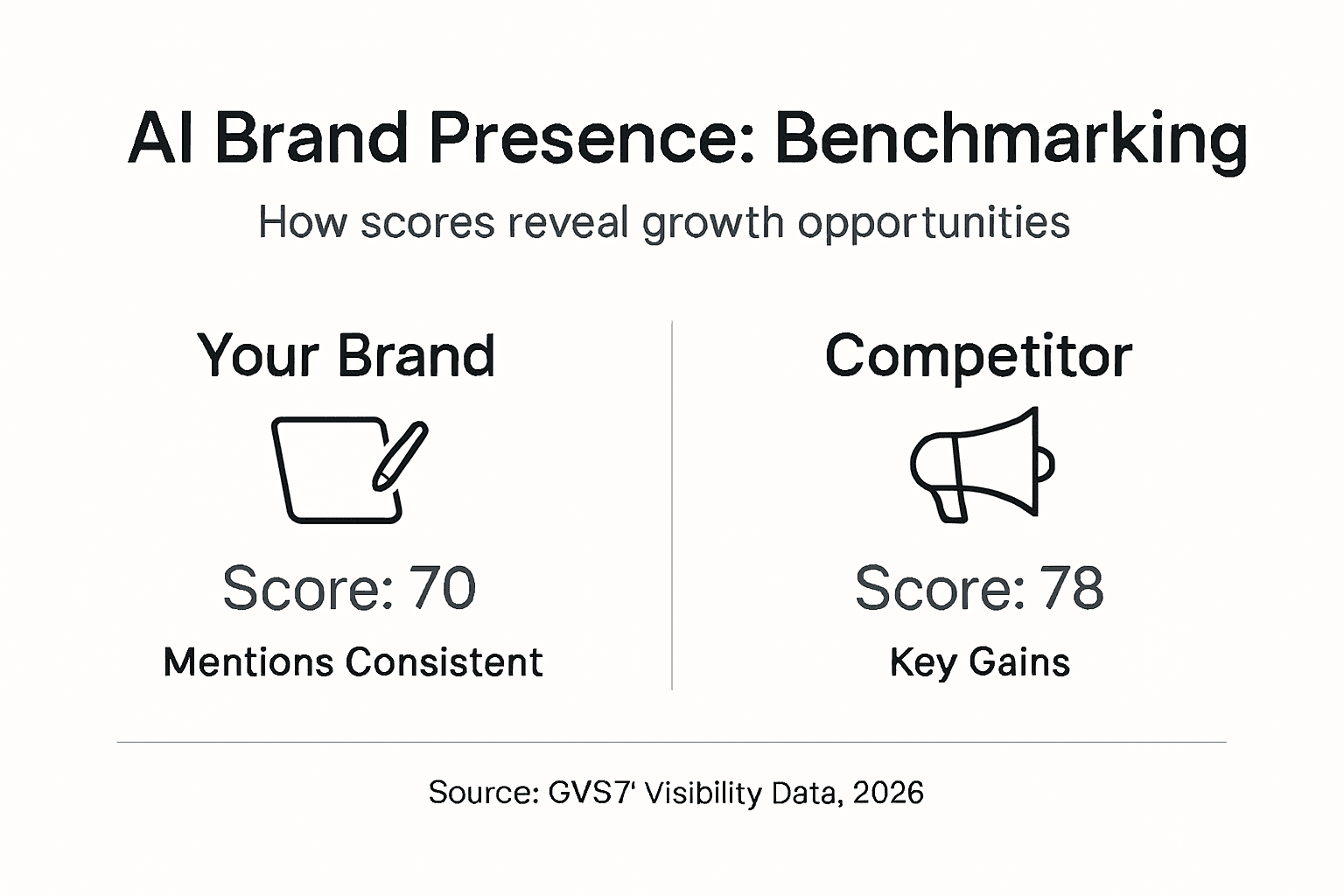
Competitor benchmarking reveals strategic opportunities. If your score is 55 and your top rival sits at 78, you know exactly how much ground to gain. Drill into specific prompt categories to see where competitors dominate. Maybe they own comparison stage prompts while you excel at discovery. Adjust your content strategy accordingly.
Track trends over time rather than obsessing over daily fluctuations. AI models update frequently, causing temporary visibility shifts. A 4-week rolling average smooths out noise and shows true trajectory. If your score climbs from 50 to 65 over three months, your strategy is working.
Key benchmarking actions:
- Monitor top 5 competitors’ visibility scores weekly
- Identify prompt categories where competitors outperform you
- Analyze competitor content that drives their AI mentions
- Adapt successful tactics while maintaining your unique positioning
- Set quarterly score improvement targets based on competitive gaps
Avoid the trap of ignoring competitive data. Some brands optimize in isolation, only to discover competitors have leapfrogged them. Regular benchmarking keeps your strategy grounded in market reality.
Common Mistakes and Troubleshooting in AI Brand Presence
The biggest mistake is assuming traditional SEO tactics transfer directly to AI visibility. They don’t. Search engines index pages and rank keywords. AI models synthesize training data and generate contextual answers. You need distinct strategies for each channel.
Neglecting continuous prompt testing guarantees inconsistent mentions. Brands that test once and move on miss model updates, competitor shifts, and evolving buyer language. Research shows 40% of brands relying solely on traditional SEO methods fail to appear in AI-generated answers, losing ground to competitors who prioritize AI-specific optimization.
Ignoring AI model updates causes visibility crashes. When OpenAI releases GPT-5 or Google updates Gemini, your brand’s training data representation changes. What worked yesterday may fail today. Immediate retesting after updates prevents prolonged invisibility.
Common pitfalls include:
- Treating AI visibility as a one-time project instead of ongoing optimization
- Writing content for search engines rather than conversational AI context
- Failing to align content with specific buyer journey prompt types
- Skipping competitor benchmarking and operating in a vacuum
- Overlooking semantic depth in favor of keyword density
Brands that ignore AI model updates experience average visibility drops of 30-40% within weeks of major releases, losing critical buyer touchpoints during the most volatile periods.
Fix these issues by adopting agile monitoring. Set up automated AI prompt testing that runs weekly, flags drops immediately, and alerts your team to act. Pair this with quarterly content audits focused on semantic alignment and prompt relevance.
Advanced Techniques: AB Testing and Iterative Optimization
Experiment-driven optimization accelerates gains. AB testing different prompt formulations helps you discover which phrasing triggers higher brand mentions. Test variations like “best marketing automation tools” versus “top platforms for email marketing automation” to see which yields better visibility.
Run structured AB tests:
- Select a high-value prompt category where visibility is inconsistent.
- Create two content variants with different semantic structures and buyer journey alignment.
- Deploy both variants and run prompt tests weekly for 4 weeks.
- Measure brand mention frequency, placement, and context quality for each variant.
- Scale the winning variant across similar content and retire the underperformer.
AB testing with AI prompts yields up to 30% lift in brand mentions versus non-experimental approaches. This incremental gain compounds when applied across dozens of content pieces, driving substantial visibility improvements over quarters.
Iterate content based on real-time feedback. If a variant improves mentions but placement drops, add more comparative data or tighten semantic focus. If mentions rise but context becomes generic, strengthen unique value propositions and differentiation signals.
Pro Tip: Use testing data to refine buyer journey content alignment. AI prompt AB testing benefits extend beyond mentions to reveal which journey stages need deeper content investment. Discovery prompts may need broader awareness angles while validation prompts require granular implementation guides.
Alternative Approaches and Strategic Tradeoffs
Organic content optimization delivers sustainable results but requires patience. You’ll invest 3-6 months building semantic depth, aligning prompts, and iterating based on tests. Cost is moderate, complexity is manageable, and results last as long as you maintain content quality. This approach suits brands with tight budgets and long-term growth horizons.
Influencer AI campaigns accelerate visibility by leveraging high-authority voices AI models recognize. Partner with industry experts to create co-branded content, interviews, and thought leadership pieces. AI models pick up these authority signals faster, boosting mentions within weeks. However, costs run higher and coordination complexity increases. Best for brands needing rapid market entry or launching new categories.
Conversational AI plugins integrate your brand directly into AI-generated dialogues. Tools like custom GPTs or API integrations let you control messaging when users ask relevant questions. This offers precise brand control and immediate visibility but requires technical implementation and ongoing maintenance. Ideal for SaaS brands with developer resources and specific use cases.
| Approach | Cost | Speed | Complexity | Sustainability |
|---|---|---|---|---|
| Organic Content Optimization | Low | Moderate | Low | High |
| Influencer AI Campaigns | High | Fast | Moderate | Moderate |
| Conversational AI Plugins | Moderate | Fast | High | Moderate |
| Hybrid Strategy | Moderate | Moderate | Moderate | High |
Choose based on your brand size, budget, and urgency. Startups often start with organic optimization, then layer influencer campaigns as funding allows. Enterprise brands may deploy all three simultaneously for comprehensive coverage.
Expected Outcomes and Benchmarks
Realistic timelines matter. Most brands see measurable improvements within 6 to 12 weeks of implementing prompt-aligned content and automated monitoring. Early wins include 15-20% visibility score lifts in high-priority prompt categories. Sustained optimization drives 25-35% overall improvement by month six.
Quantifiable metrics to track:
- AI Visibility Score increases from baseline to target range
- Brand mention frequency across discovery, comparison, validation prompts
- Average placement position in AI-generated answer lists
- Competitive rank improvements relative to top 5 rivals
- Prompt category coverage expanding from 40% to 70%+ of buyer journey
Expect initial experimentation periods where tests reveal gaps. Your first month focuses on establishing baselines and identifying low-hanging fruit. Months two and three involve rapid content iteration and retesting. By month four, you’ve established patterns and can predict which optimizations drive the most impact.
Competitive rank improvements typically hit 15-20% within 3 months for brands executing comprehensive strategies. If you start at position 6 among competitors, you can realistically climb to position 4 or 5 by quarter’s end. Continued effort pushes you toward top 3 positioning by month nine.
Regular review cycles maintain momentum. Monthly dashboard reviews catch declining trends early. Quarterly strategy sessions realign content priorities with competitive shifts and model updates. Annual audits assess whether your AI visibility strategy still serves business goals as markets evolve.
Enhance Your AI Brand Presence with RankPirate
You’ve learned the strategies. Now deploy them at scale. RankPirate AI visibility platform automates every step: prompt testing, competitive benchmarking, trend tracking, and actionable recommendations. The platform runs hundreds of buyer journey simulations weekly, aggregating results into your GVS™ score and highlighting exactly where to optimize next. No spreadsheets, no manual testing, no guessing.
Digital marketers use RankPirate to monitor ChatGPT, Gemini, and Claude simultaneously, catching visibility drops before they impact pipeline. Competitor tracking shows you where rivals gain ground so you can respond strategically. Automated alerts notify your team when AI model updates shift your visibility, enabling rapid content adjustments.
Start boosting your AI presence today. RankPirate delivers the insights you need to climb from invisible to indispensable in AI-generated answers.
FAQ
How do AI visibility monitoring tools improve brand tracking?
AI visibility monitoring with RankPirate automates tracking of AI-generated brand mentions, reducing manual errors and speeding insight collection by over 80%. These tools run repeated prompt tests across multiple AI models simultaneously, aggregating data into actionable dashboards that show exactly where your brand appears and where it drops out.
What timeline is typical for seeing AI brand presence improvements?
Most brands see measurable improvements within 6 to 12 weeks of applying recommended strategies, with early wins appearing in high-priority prompt categories by week 4. Sustained optimization drives 25-35% overall visibility gains by month six as content alignment and testing iterations compound.
Can traditional SEO alone boost AI brand presence effectively?
No, traditional SEO lacks alignment with AI prompt understanding and misses essential AI-specific signals, limiting AI brand visibility. Search engines index pages while AI models synthesize training data contextually, requiring distinct semantic optimization and prompt-based testing strategies.
How does AB testing improve AI brand mentions?
AB testing helps identify the most effective prompt variants and messaging that drive higher brand mentions in AI responses, yielding up to 30% lift versus non-experimental approaches. Testing reveals which semantic structures, buyer journey angles, and content depths resonate most with AI model logic, enabling data-driven scaling of winning variants.