Content optimization for AI answers: 2026 guide

Getting your content surfaced in AI-generated answers feels like shooting in the dark. Traditional SEO tactics don’t translate directly to AI search engines like ChatGPT, Gemini, and Claude. These platforms prioritize different signals, favor specific content types, and respond unpredictably to phrasing variations. This guide walks you through preparation, execution, and verification strategies to optimize your content for AI answers in 2026, helping you gain consistent visibility across the entire buyer journey.
Table of Contents
- Preparing Your Content Strategy For AI Answer Optimization
- Step-By-Step Execution: Optimizing Content For AI-Generated Answers
- Verification And Troubleshooting Common Pitfalls In AI Answer Optimization
- Unlock Expert Tools For AI Answer Content Optimization
Key takeaways
| Point | Details |
|---|---|
| AI search favors earned media | Third-party authoritative sources dominate AI answers over brand-owned content |
| Phrasing sensitivity matters | Different AI engines respond differently to question structures and keyword choices |
| Preparation drives results | Content audits, authority signals, and buyer journey mapping improve AI visibility |
| Verification enables iteration | Monitoring placements and troubleshooting errors ensures sustained optimization success |
Preparing your content strategy for AI answer optimization
Before diving into tactical optimization, you need a solid foundation. Start by mapping your content to specific buyer journey stages: discovery, comparison, and validation. Each stage requires different content approaches and messaging angles. Discovery content answers broad questions, comparison content highlights differentiators, and validation content builds trust through proof points.
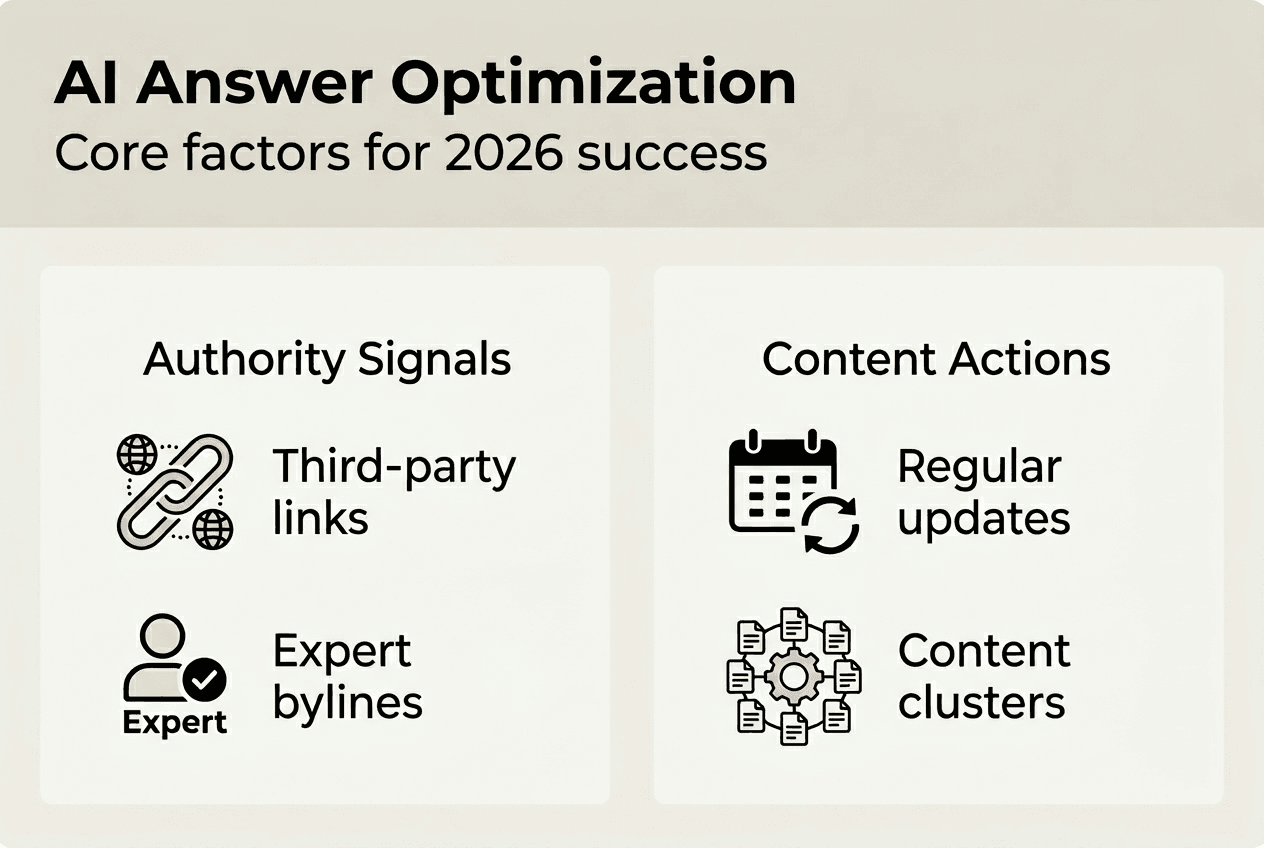
Conduct a thorough audit of your existing content library. Focus on identifying pieces with strong credibility signals like expert citations, data sources, and authoritative backlinks. AI search exhibits systematic bias toward earned media over brand-owned and social content, so prioritize content that already has third-party validation. Look for gaps where you lack authoritative backing and plan to fill them.
Set measurable goals aligned with AI search visibility benchmarks. Instead of targeting generic “increased traffic,” aim for specific outcomes like appearing in 40% of discovery-stage prompts or ranking in the top three sources for comparison queries. These concrete targets help you evaluate progress and adjust tactics. Understanding why AI search matters for brand visibility in 2026 provides crucial context for goal setting.
Recognize that AI search engines behave differently from one another. Some prioritize fresh content, others emphasize domain diversity, and all show varying sensitivity to how questions are phrased. This variability means you can’t optimize once and forget it. Your strategy must account for multiple AI platforms and their unique preferences.
Pro Tip: Create a content inventory spreadsheet tracking authority signals for each piece. Include columns for third-party citations, publication date, backlink count, and current AI answer presence. This baseline helps you prioritize optimization efforts on high-potential content.
Step-by-step execution: optimizing content for AI-generated answers
Executing effective AI answer optimization requires systematic attention to multiple factors. Follow these steps to maximize your content’s chances of appearing in AI-generated responses.
-
Refine your phrasing and structure. AI search services show significant sensitivity to phrasing, meaning small wording changes can dramatically impact visibility. Use natural language that mirrors how real people ask questions. Avoid jargon unless your audience specifically searches with technical terms. Structure content with clear H2 and H3 headings that directly answer common questions.
-
Incorporate authoritative third-party citations throughout your content. Link to peer-reviewed research, industry reports, and recognized expert sources. These citations signal credibility to AI engines and increase the likelihood they’ll surface your content. Place citations naturally within sentences, linking the specific claim rather than using referential phrases.
-
Optimize for content freshness strategically. Update publication dates when you make substantial revisions, not minor tweaks. Add new data points, recent examples, and current year references to demonstrate relevance. AI engines favor content that reflects the latest information, especially for time-sensitive topics.
-
Leverage metadata and schema markup to enhance AI readability. Include descriptive meta titles and descriptions that clearly state what questions your content answers. Implement schema types like FAQPage, HowTo, and Article to provide structured data AI engines can easily parse.
-
Follow a comprehensive checklist to ensure you’ve covered all optimization factors. A detailed AI search optimization checklist helps you avoid missing critical elements. Track completion across multiple content pieces to maintain consistency.
Core optimization factors comparison:
| Factor | Traditional SEO | AI Answer Optimization |
|---|---|---|
| Primary signal | Keywords and backlinks | Authority and earned media |
| Content freshness | Moderate importance | High importance |
| Phrasing sensitivity | Low | Very high |
| Domain diversity | Not prioritized | Actively prioritized |
Break your optimization into manageable phases. Start with your highest-traffic pages and those targeting high-intent buyer journey stages. Test variations of phrasing and structure on a subset of content before rolling out changes broadly. Monitor which approaches yield better AI answer placements.

Pro Tip: Create content clusters around core topics rather than isolated articles. AI engines favor comprehensive topic coverage, so linking related pieces strengthens your overall authority and increases the chances multiple articles appear in different query contexts.
For step-by-step AI answer optimization guidance, detailed workflows help you systematically improve content performance across all major AI platforms.
Verification and troubleshooting common pitfalls in AI answer optimization
Optimization without measurement leaves you guessing about effectiveness. Establish a verification process to track AI answer placements and identify improvement opportunities. Use analytics tools that monitor when and where your content appears in AI-generated responses. Track metrics like mention frequency, position within answers, and competitor comparison rates.
Identify and fix common issues systematically. Low authority signals often stem from insufficient third-party citations or weak backlink profiles. Add more expert quotes, link to authoritative research, and earn mentions from respected industry publications. Outdated content hurts visibility, so schedule regular reviews to refresh statistics, examples, and time-sensitive references.
Adjust phrasing and metadata based on performance data. If certain questions consistently exclude your content, test alternative phrasings that more closely match natural language patterns. AI search services differ in phrasing sensitivity, so what works for ChatGPT might need adjustment for Gemini or Claude. Update meta descriptions to more explicitly state the questions your content answers.
Common errors marketers make include:
- Ignoring the AI bias toward earned media and focusing solely on brand-owned content
- Neglecting content freshness updates, allowing competitors with newer information to dominate
- Using overly promotional language that AI engines filter out as less authoritative
- Failing to test content across multiple AI platforms and buyer journey stages
- Overlooking the importance of natural phrasing that matches actual user queries
“The key to sustained AI answer visibility is continuous iteration. AI algorithms evolve, competitor content improves, and user query patterns shift. What works today may underperform tomorrow without regular refinement.”
Build feedback loops into your workflow. Review AI answer performance monthly, noting which content pieces consistently appear and which drop off. Investigate why certain articles succeed while similar ones fail. Often the difference lies in subtle phrasing choices, citation quality, or structural elements.
Use a comprehensive optimization checklist to systematically troubleshoot underperforming content. Work through each factor methodically rather than making random changes. Document what adjustments improve results so you can replicate success across other content.
Pro Tip: Set up alerts for when competitors appear in AI answers for your target queries. Analyze their content to identify what authority signals, phrasing patterns, or structural elements they use that you might be missing. Competitive intelligence accelerates your optimization learning curve.
Unlock expert tools for AI answer content optimization
Optimizing content for AI answers requires specialized tools and proven frameworks. RankPirate streamlines this process by providing real-world performance data and actionable insights that eliminate guesswork. Our free AI visibility checker shows how AI answers mention your brand today; RankPirate’s weekly tracking across discovery, comparison, and validation stages then shows which brands appear and how consistently.
Access comprehensive checklists that have helped marketers boost AI answer visibility by 35% through systematic optimization. These frameworks cover everything from authority signal enhancement to phrasing refinement, ensuring you address all critical factors. Track your progress across multiple AI platforms and buyer journey stages with automated monitoring that replaces manual testing.
RankPirate’s GVS™ scoring system provides a single, reliable metric for measuring your AI visibility over time. Instead of relying on inconsistent manual checks, you get stable, long-term performance data that reveals trends and optimization opportunities. Discover where you’re winning, where competitors dominate, and what content adjustments drive the biggest improvements. Explore RankPirate’s solutions to accelerate your AI answer optimization success.
FAQ
What is the main difference between AI search and traditional search?
AI search prioritizes authoritative earned media and adapts results based on domain diversity, freshness, and phrasing sensitivity, unlike traditional keyword-based search. Traditional search relies heavily on backlinks and keyword matching, while AI search evaluates content quality, source authority, and natural language comprehension. AI engines also show more variability in results based on slight query phrasing changes, requiring broader optimization approaches.
How can brands increase their chances of being featured in AI-generated answers?
Brands should enhance authority signals by earning third-party citations, update content regularly, and optimize phrasing for AI comprehension. AI search favors earned media over brand-owned content, so securing mentions in authoritative publications and expert endorsements significantly improves visibility. Understanding why AI search matters for brand visibility helps prioritize these efforts effectively.
What are common mistakes to avoid in AI answer content optimization?
Avoid neglecting earned media signals, ignoring content updates, and poor phrasing that confuses AI understanding. Many marketers focus exclusively on brand-owned content without building third-party authority, which limits AI answer presence. AI search services show sensitivity to phrasing and freshness, so outdated content and unnatural language patterns significantly reduce visibility. Following step-by-step optimization guidance helps avoid these pitfalls systematically.
How often should content be updated for optimal AI search performance?
Update content whenever substantial new information becomes available or at minimum quarterly for time-sensitive topics. Minor tweaks don’t warrant republishing, but adding new data points, recent examples, or current year references signals freshness to AI engines. High-priority content targeting competitive queries benefits from monthly reviews to maintain edge over competitors who may update more frequently.
Can small brands compete with large enterprises in AI-generated answers?
Yes, small brands can compete effectively by focusing on niche expertise and building strong earned media signals. AI engines prioritize authority and relevance over brand size, so demonstrating deep knowledge in specific areas and earning citations from respected sources levels the playing field. Smaller brands often move faster to update content and optimize phrasing, providing competitive advantages over slower-moving enterprises.