What Is AI Content Discovery? 60%+ Searches Now Zero-Click

AI-generated answers now dominate mobile search, with up to 75% of searches ending without clicks. This seismic shift challenges every assumption digital marketers held about SEO and brand visibility. Traditional keyword rankings mean less when AI models synthesize answers from multiple sources, delivering information directly to users. This guide reveals how AI content discovery actually works, exposes common misconceptions, and provides actionable strategies to maintain your brand’s visibility in this new landscape.
Table of Contents
- Understanding AI Content Discovery: Mechanisms and Advantages
- Shift in Visibility Paradigms: From Traditional SEO to AI-Driven Retrieval
- Content Hub Strategies to Enhance AI Visibility
- Common Misconceptions about AI Content Discovery
- Practical Tools for Monitoring and Optimizing AI Content Discovery
- Optimize Your AI Visibility with RankPirate
- Frequently Asked Questions about AI Content Discovery
Key Takeaways
| Point | Details |
|---|---|
| AI prioritizes semantic intent over keywords | Traditional keyword matching gives way to contextual understanding and trust signals in AI retrieval. |
| Zero-click searches reduce traffic but increase upstream visibility | Brands appear in AI answers without users visiting sites, shifting metrics from clicks to mentions. |
| Content hub architecture enhances AI recognition | Interconnected topical clusters provide context that AI models favor for authoritative citations. |
| Automated monitoring tools enable data-driven optimization | Platforms track AI visibility across prompts and journey stages to identify improvement opportunities. |
Understanding AI Content Discovery: Mechanisms and Advantages
AI content discovery fundamentally differs from traditional search by interpreting meaning rather than matching words. Semantic search understands user intent and context, enabling AI to generate conversational responses that directly address queries. This shift eliminates the need for users to click through multiple links, fundamentally changing how brands gain visibility.
The mechanics behind this transformation involve sophisticated language models analyzing content across the web. AI systems preserve conversation context across exchanges, refining answers based on follow-up questions. This dynamic dialogue capability means AI can personalize responses by considering behavioral signals and user history, moving beyond static keyword lists to deliver exactly what users need.
“AI content discovery replaces traditional keyword lists with semantic understanding to interpret user intent and context, enabling real-time dialogue and more accurate, upfront answers with less unnecessary clicks.”
The advantages for users are clear:
- Direct answers eliminate clicking through irrelevant pages
- Conversational interfaces feel more natural than scanning search results
- Personalized responses adapt to individual needs and contexts
- Multimodal discovery includes voice, images, and text simultaneously
For marketers, this creates both challenges and opportunities. Your content must be structured for AI comprehension, not just human readers. AI visibility monitoring becomes essential because traditional analytics miss how AI models cite and synthesize your content. The goal shifts from ranking first to being included in composite answers that AI generates.
Pro Tip: Structure your content with clear, labeled sections and concise definitions. AI models parse well-organized information more effectively, increasing your chances of citation in generated answers.
Shift in Visibility Paradigms: From Traditional SEO to AI-Driven Retrieval
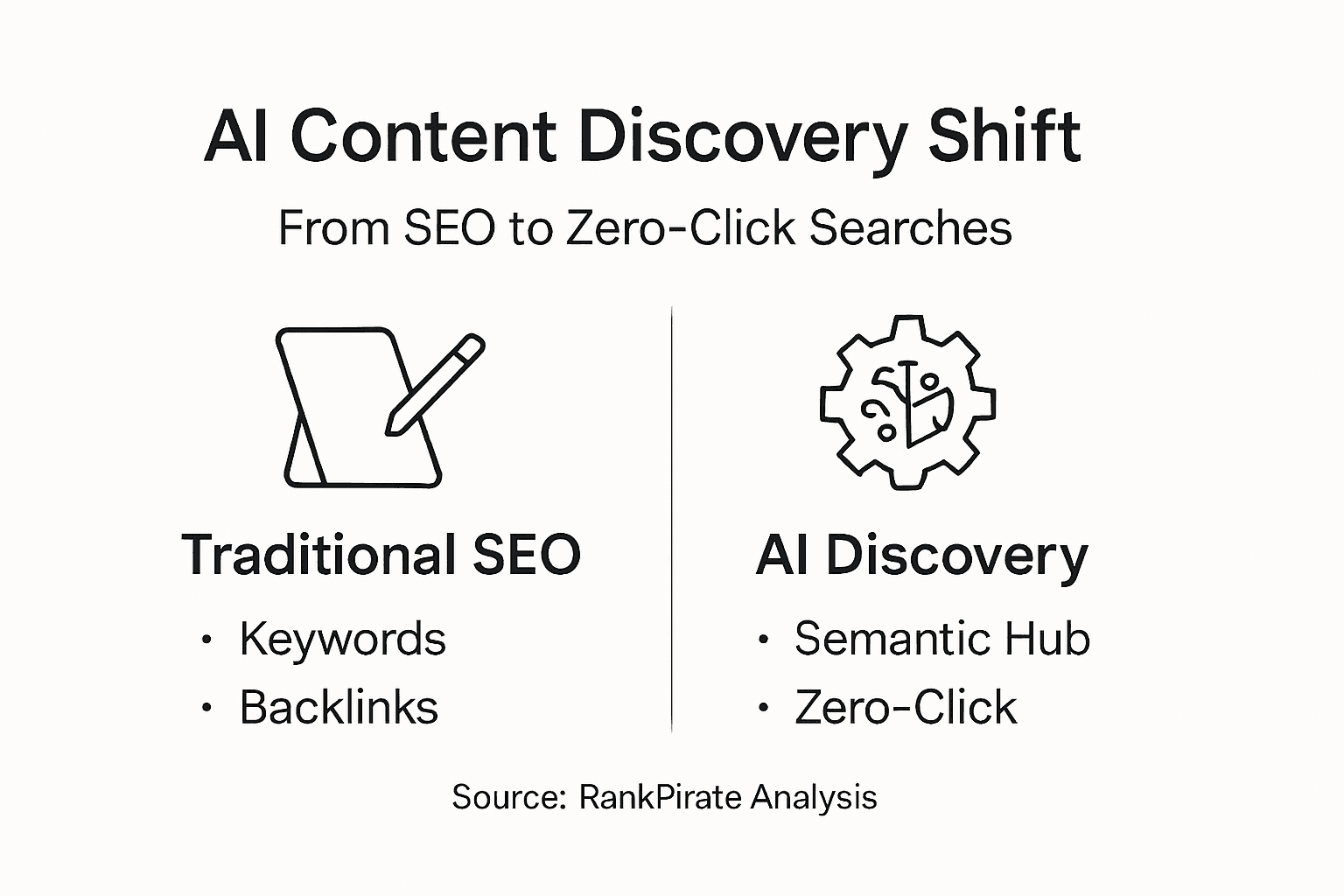
Traditional SEO built visibility through keyword optimization, backlink profiles, and page authority scores. AI-driven retrieval operates differently, synthesizing information from multiple sources to create comprehensive answers. This means zero-click outcomes now exceed 60% on mobile, fundamentally altering what visibility means.

The paradigm shift centers on how AI selects and combines information. Rather than ranking pages, AI models evaluate trustworthiness, relevance, and comprehensibility across content sources. Your brand might appear in an AI answer alongside competitors, with no clear “first position” to claim.
| Traditional SEO | AI-Driven Retrieval |
|---|---|
| Keyword density matters | Semantic relevance determines inclusion |
| Backlinks signal authority | Content structure and clarity enable parsing |
| Page rank determines position | Answer quality determines citation |
| Click-through rates measure success | Brand mentions indicate visibility |
| Static rankings persist | Dynamic synthesis changes per query |
This evolution demands new strategies:
- Optimize for comprehensibility, not just keywords
- Build topical authority through interconnected content
- Structure information for easy AI extraction
- Establish trust signals beyond traditional backlinks
The visibility metric shifts from traffic volume to brand presence in AI-generated content. You need to monitor your AI visibility across different prompts and buying stages because appearing once doesn’t guarantee consistent inclusion. AI models make real-time decisions about which sources to cite based on query context.
Pro Tip: Create definitive resources on specific topics rather than thin content across many keywords. AI models favor authoritative, comprehensive sources when synthesizing answers.
Content Hub Strategies to Enhance AI Visibility
Content hubs provide the topical depth and structural clarity that AI models seek when generating answers. A hub consists of a pillar page covering a broad topic, with interconnected spoke pages addressing specific subtopics. This architecture signals authority and provides the contextual relationships AI uses to understand your expertise.
The hub model works because AI models analyze content relationships to assess credibility. When multiple pages on your site link coherently around a topic, AI recognizes comprehensive coverage. This interconnected structure helps AI understand which sources to cite for specific aspects of complex queries.
Implementing effective content hubs requires strategic planning:
- Identify core topics aligned with your expertise and audience needs
- Create comprehensive pillar content covering topic fundamentals
- Develop spoke content addressing specific subtopics in depth
- Interlink strategically to show topical relationships
- Update regularly to maintain freshness and relevance
Case studies demonstrate measurable impact. Brands that restructured existing content into hub architectures saw increased mentions in AI-generated answers within months. The key is making topic relationships explicit through internal linking and consistent terminology.
Tracking AI content visibility helps you measure hub effectiveness. Monitor which spoke pages AI cites most frequently, revealing where your topical authority resonates. This data informs where to deepen coverage or adjust messaging to better align with how AI interprets user intent.
Pro Tip: Use consistent terminology across your content hub. AI models recognize semantic relationships more easily when you use the same key phrases, making your topical authority clearer.
Common Misconceptions about AI Content Discovery
Many marketers assume AI content discovery is simply keyword optimization with a new name. This misconception leads to strategies that fail because AI prioritizes semantic relevance and trustworthiness over keyword density. Understanding what AI content discovery actually involves prevents wasted effort on outdated tactics.
Let’s address the most persistent myths:
Misconception: AI content discovery increases website traffic. Reality: Up to 75% of mobile searches end without clicks because AI provides direct answers. Visibility happens upstream, before users ever consider visiting sites.
Misconception: Keyword optimization remains central. Reality: AI understands semantic meaning and context. Forcing keywords damages readability without improving AI citations.
Misconception: Discovery happens only through text. Reality: AI incorporates voice queries, image recognition, and conversational interfaces across modalities.
Misconception: Once visible, always visible. Reality: AI models update continuously, changing which sources they cite based on freshness, relevance, and query context.
Misconception: Traditional SEO metrics still apply. Reality: Click-through rates and bounce rates matter less when users never reach your site but still encounter your brand in AI answers.
“AI prioritizes semantic relevance, content structure, and trustworthiness over keyword matching; zero-click search rates are high but do not negatively impact visibility.”
Understanding these realities helps you set appropriate goals. Success in AI content discovery means consistent brand mentions across varied prompts, not traffic spikes. You optimize for AI comprehension and trust signals, not keyword rankings. This fundamental shift requires new measurement approaches and different optimization tactics than traditional SEO demanded.
Practical Tools for Monitoring and Optimizing AI Content Discovery
Measuring AI visibility requires purpose-built tools because traditional analytics miss how AI models cite content. Manual testing proves unreliable, inconsistent results make it impossible to identify trends or measure improvement. Automated platforms solve this by running systematic checks across AI models and prompt variations.
RankPirate aggregates prompt-based visibility checks into a comprehensive AI Visibility Score that reflects stable, long-term presence. This approach accounts for natural variation in AI responses, focusing on consistent patterns rather than isolated mentions. The platform tests across different buying journey stages, from initial discovery through comparison to final validation.
Key features that enable effective optimization:
- Multi-model testing: Checks visibility across ChatGPT, Gemini, and Claude simultaneously
- Journey stage mapping: Tests prompts representing discovery, comparison, and validation phases
- Competitor tracking: Monitors where competitors appear to identify positioning opportunities
- Trend analysis: Reveals visibility changes over time to measure optimization impact
- Actionable insights: Highlights specific content gaps and messaging adjustments needed
| Metric | Traditional Analytics | AI Visibility Platforms |
|---|---|---|
| Primary measure | Page views, clicks | Brand mentions, citation frequency |
| Data source | Website traffic logs | AI model responses |
| Update frequency | Real-time | Scheduled prompt testing |
| Competitive insight | Limited to shared keywords | Direct competitor appearance tracking |
The GVS™ score provides a single number summarizing complex visibility data, making it easy to track progress. This aggregation matters because individual AI responses vary, but patterns emerge across repeated testing. You identify where your brand consistently appears and where visibility drops, informing targeted content improvements.
Automated AI content visibility monitoring replaces manual spreadsheet tracking and unreliable screenshots. The systematic approach delivers scalable, interpretable results that support data-driven optimization decisions. Continuous monitoring ensures you maintain visibility as AI models evolve and competitor strategies shift.
Pro Tip: Test visibility across different question phrasings addressing the same intent. AI models may cite different sources depending on query wording, revealing opportunities to optimize for varied user expressions.
Optimize Your AI Visibility with RankPirate
Your brand’s presence in AI-generated content determines visibility in 2026’s search landscape. Manual testing can’t keep pace with how quickly AI models evolve or how many prompt variations matter across the buyer journey. RankPirate’s AI visibility platform automates comprehensive monitoring, delivering the insights digital marketers need to optimize strategically.
The GVS™ score cuts through complexity, providing a clear metric that reflects your brand’s stable, long-term visibility across AI models. You discover exactly where competitors outperform you, which content gaps reduce your citations, and what messaging adjustments will enhance presence. The platform tracks trends over time, revealing whether optimization efforts actually improve AI visibility or need refinement.
Automated AI content monitoring transforms guesswork into data-driven strategy. You stop wondering if AI cites your brand and start optimizing based on evidence. The result is sustained competitive advantage in an environment where AI-generated answers increasingly mediate brand discovery. Try RankPirate to ensure your content strategy aligns with how users actually find information in 2026.
Frequently Asked Questions about AI Content Discovery
What is the main difference between traditional SEO and AI content discovery?
Traditional SEO optimizes for keyword rankings and click-through rates on search engine results pages. AI content discovery focuses on semantic relevance and content structure that enables AI models to extract and synthesize information for direct answers. The goal shifts from ranking first to being cited consistently across varied AI-generated responses.
How can brands measure their AI content visibility effectively?
Brands need specialized platforms that test visibility across multiple AI models and prompt variations systematically. Automated tools like RankPirate aggregate results into comprehensive scores reflecting stable visibility patterns. Manual testing proves unreliable because AI responses vary, making automated, repeated testing essential for accurate measurement.
Does AI content discovery affect website traffic negatively?
Zero-click searches reduce direct website visits because AI provides answers without requiring users to click through. However, brand visibility in AI-generated content increases upstream awareness and positions brands as authorities. The metric shifts from traffic volume to brand mentions and presence in AI answers that reach users directly.
What role does content structure play in AI visibility?
Content structure directly impacts how easily AI models parse and extract information for answer synthesis. Clear headings, logical organization, concise definitions, and labeled sections help AI understand content meaning and relationships. Well-structured content gets cited more frequently because AI can reliably extract accurate information.
Are AI content discovery techniques applicable across all industries?
Yes, AI content discovery principles apply universally because all industries face the same shift toward AI-mediated information access. Specific tactics may vary based on technical complexity and audience needs, but semantic optimization, content hubs, and visibility monitoring benefit any brand seeking presence in AI-generated content. The strategies scale across B2B, B2C, and specialized domains.