AI prompt testing: boost brand visibility by 78% in 2026

Most marketers believe AI prompt testing means randomly firing questions at ChatGPT and hoping for good results. That approach wastes up to 70% of your time and delivers inconsistent brand visibility. Strategic AI prompt testing is a data-driven method that systematically evaluates how AI models respond across buyer journey stages, enabling you to build stable, competitive AI presence that drives trust and conversions.
Table of Contents
- Understanding AI Prompt Testing: Definition And Mechanics
- Why Prompt Testing Matters: Role In Buyer Journey And Brand Visibility
- Automating AI Prompt Testing: Benefits Over Manual Methods
- How To Measure AI Visibility: Metrics And Scoring Frameworks
- Common Misconceptions And Pitfalls In AI Prompt Testing
- Leveraging Insights From AI Prompt Testing To Optimize Content And Messaging
- Explore RankPirate AI Prompt Testing Solutions
- Frequently Asked Questions
Key takeaways
| Point | Details |
|---|---|
| Strategic testing reveals gaps | AI prompt testing evaluates brand presence by running varied prompts across discovery, comparison, and validation stages. |
| Buyer journey alignment matters | Prompt design aligned with buyer journey stages uncovers visibility gaps that manual testing misses. |
| Automation beats manual methods | Automated prompt testing offers scalable, reliable insights versus error-prone spreadsheets and screenshots. |
| Visibility scores quantify presence | AI Visibility Scores quantify stable brand appearances over time, not isolated mentions. |
| Testing drives optimization | Effective testing guides targeted content and messaging improvements where they impact results most. |
Understanding AI prompt testing: definition and mechanics
AI prompt testing repeatedly runs varied prompts to measure brand presence in AI-generated content from models like ChatGPT, Gemini, and Claude. Unlike random queries, strategic prompt testing uses carefully designed prompts targeting specific personas and buyer journey stages to elicit meaningful brand-related responses for evaluation.
Prompts are tailored to different buyer journey stages and customer personas for actionable insights. Discovery prompts assess early-stage awareness, comparison prompts evaluate consideration mentions, and validation prompts test decision-stage visibility. Each prompt type reveals different aspects of your AI brand presence.
Results aggregate into AI Visibility Scores that reflect consistency, not isolated mentions. A single positive mention means nothing if AI models fail to include your brand 80% of the time. Aggregated scores reveal true visibility patterns across hundreds of prompt variations.
This continuous feedback loop enables marketers to track and improve AI visibility over time:
- Run prompt variations across multiple AI platforms simultaneously
- Aggregate responses into quantifiable visibility metrics
- Identify drop-off points by buyer journey stage
- Test content updates to improve scores
- Monitor trends and competitive benchmarks monthly
You can run a quick scan with the free AI visibility checker to see how AI answers mention your brand today.
Why prompt testing matters: role in buyer journey and brand visibility
Brand visibility fluctuates significantly across discovery, comparison, and validation stages. Your brand might appear in 70% of discovery prompts but drop to 15% during validation when prospects need you most. These gaps kill conversions.
Prompt quality strongly influences whether AI responses feature your brand relevantly at each stage. Generic prompts like “best marketing tools” miss nuanced buyer needs, while targeted prompts like “marketing analytics platform for B2B SaaS teams” reveal true competitive positioning.
Identifying visibility drop-offs informs where to improve content or messaging to sustain brand presence. When testing reveals validation-stage weakness, you know to strengthen case studies, comparison content, and proof points that AI models pull from.
Understanding buyer journey alignment leads to more precise, stable AI brand representation:
- Map your prompts to specific journey stages
- Test variations within each stage to find patterns
- Measure where visibility drops below competitive benchmarks
- Prioritize content gaps causing the biggest visibility losses
- Retest after updates to validate improvements
Learn more about optimizing for different stages in our AI visibility explained guide.
Automating AI prompt testing: benefits over manual methods
Manual prompt testing is labor-intensive, error-prone, and offers inconsistent data. Copying prompts into ChatGPT, screenshotting responses, and tracking results in spreadsheets consumes hours while producing unreliable snapshots that miss temporal variations.
Automation enables continuous testing across multiple AI platforms at scale. Instead of manually testing 10 prompts weekly, automated platforms run hundreds of variations daily across ChatGPT, Gemini, Claude, and other models simultaneously.

Automated platforms aggregate data into AI Visibility Scores and uncover trends reliably. They detect patterns humans miss, like time-of-day variations or model-specific biases that affect brand mentions. Statistical aggregation eliminates the noise of individual responses.
Automation frees marketers to focus on strategy, not tedious monitoring. You spend time analyzing insights and optimizing content instead of copying prompts and updating spreadsheets.
Key automation advantages include:
- Running 100+ prompt variations daily versus 10 weekly manual tests
- Testing across multiple AI models simultaneously
- Detecting temporal patterns and anomalies automatically
- Producing statistically valid visibility scores
- Tracking competitor mentions alongside your brand
- Generating actionable reports without manual analysis
Pro Tip: Combine automated testing with strategic prompt design for maximum impact. Automation handles scale and consistency, while your expertise ensures prompts align with actual customer language and intent.
Implement these principles using our AI search optimization checklist for practical steps.
How to measure AI visibility: metrics and scoring frameworks
The GVS™ AI Visibility Score aggregates repeated prompt results for robust measurement. Rather than celebrating a single positive mention, GVS tracks consistency across hundreds of prompt variations to reveal stable visibility patterns.
Scores reflect long-term, stable brand visibility rather than one-off mentions. A brand appearing in 65% of prompts over 30 days demonstrates genuine AI presence, while sporadic mentions indicate weak, unreliable visibility.
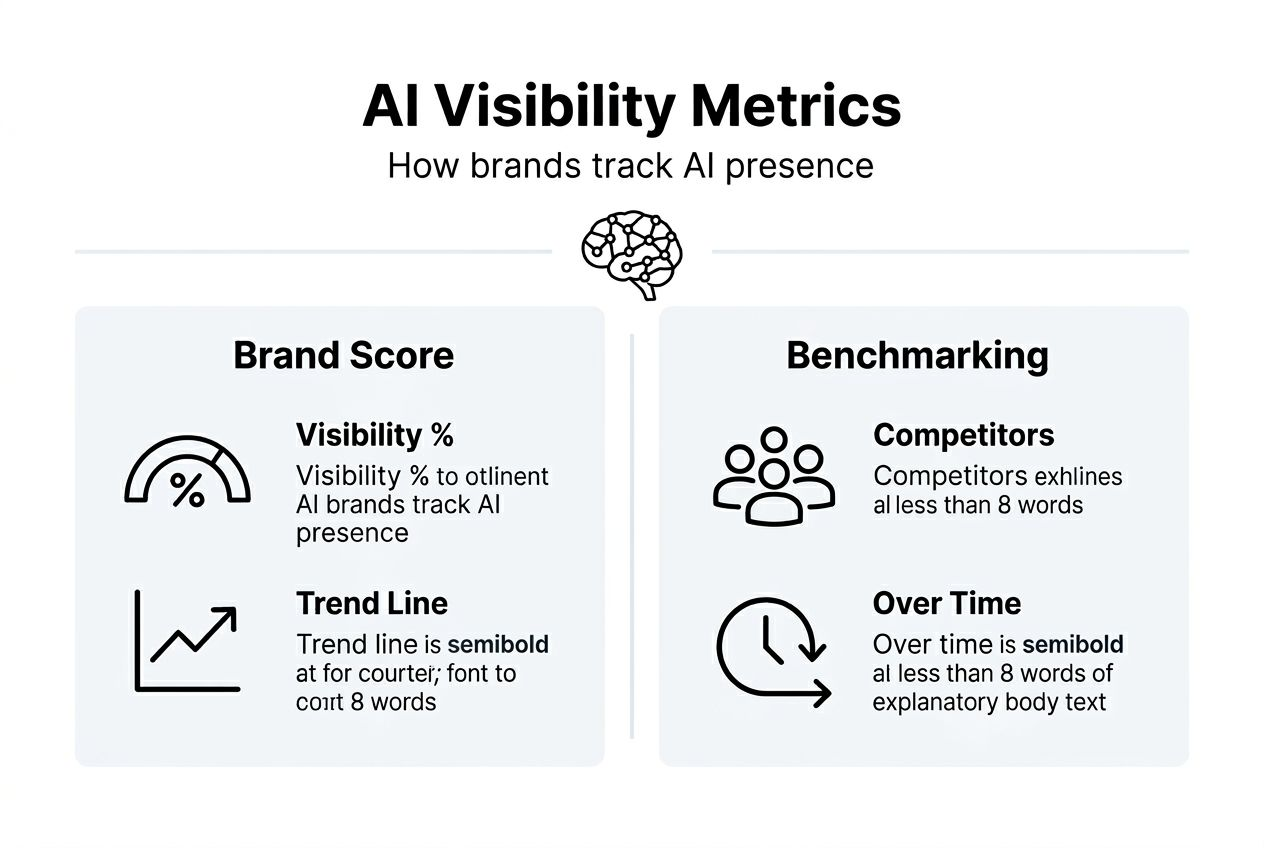
Metrics enable benchmarking against competitors and monitoring trends over time. You can see whether your 65% visibility outperforms competitors at 40% or lags behind leaders at 85%, informing strategic priorities.
| Metric | Purpose | Typical Range |
|---|---|---|
| GVS™ AI Visibility Score | Overall brand presence consistency | 0-100% |
| Stage-specific visibility | Performance by buyer journey phase | Varies by stage |
| Mention rank | Position within AI responses | 1-10+ |
| Competitor share | Relative visibility vs. competitors | Percentage |
| Trend velocity | Rate of visibility change | +/- % monthly |
Clear visibility scores support objective marketing decisions and optimization prioritization. When validation-stage visibility scores 30 points below discovery, you know exactly where to focus content improvements.
Dive deeper into AI visibility scoring methodology and interpretation.
Common misconceptions and pitfalls in AI prompt testing
Not all prompt testing means random or ad-hoc queries; strategic prompt design is essential. Many marketers type whatever questions come to mind, producing scattered data that reveals nothing about systematic visibility patterns.
Common pitfalls include generic prompts, relying on spreadsheets and manual tracking, ignoring journey stages, and one-off testing. Generic prompts fail to match customer language. Spreadsheets introduce errors and limit scale. Ignoring journey stages misses critical drop-offs. One-off testing catches anomalies, not patterns.
78% of AI project failures arise from poor human-AI communication through prompts.
Wasted effort on ineffective prompts causes huge productivity losses. Studies show misguided prompt testing leads to 60-70% wasted time on reformulating ineffective prompts rather than analyzing results and optimizing content.
Avoid these specific mistakes:
- Testing without defining target personas or journey stages first
- Using vague prompts that don’t match real customer queries
- Treating all AI models identically without platform-specific testing
- Ignoring negative results instead of investigating root causes
- Failing to version and document prompt variations
- Testing once and assuming results stay constant
Pro Tip: Align prompt design closely with marketing goals and customer personas. Start with actual customer questions from sales calls, support tickets, and search data rather than guessing.
Understand the broader context in AI search brand visibility.
Leveraging insights from AI prompt testing to optimize content and messaging
Analyze prompt testing results to locate visibility drop-off by buyer journey stage. When validation prompts show 40% lower visibility than discovery prompts, you’ve identified a critical content gap affecting conversions.
Use competitive benchmarking from scores to identify content gaps. If competitors rank higher in comparison-stage prompts, analyze what content types AI models pull from their sites versus yours.
Test new messaging prompts to improve brand presence and consistency. After publishing updated comparison content, run the same prompts again to measure visibility improvements and validate your content strategy.
| Approach | Update Cycle | Data Quality | Resource Cost |
|---|---|---|---|
| Traditional content updates | Monthly/quarterly | Subjective feedback | High manual effort |
| AI prompt testing cycles | Weekly/continuous | Quantified visibility scores | Low (automated) |
Pro Tip: Prioritize updates where visibility drops are highest for best ROI. A 40-point visibility gap in validation prompts matters more than a 5-point gap in discovery.
Brands optimizing through AI prompt testing see improved consistency in AI-generated answers, leading to stronger brand recognition and trust. Better AI visibility correlates directly with increased consideration and conversions.
Practical optimization steps:
- Map visibility scores to specific content pages and topics
- Identify which competitor content AI models prefer
- Update weak content with formats AI models favor
- Add missing information gaps revealed by prompts
- Test messaging variations before full content rewrites
Start with the free AI visibility checker and follow our AI brand presence guide for implementation details. Apply these insights using the AI search optimization checklist.
Explore RankPirate AI prompt testing solutions
Mastering AI prompt testing requires the right tools and systematic approach. RankPirate offers an automated AI prompt testing platform with robust visibility scoring and competitor benchmarking, eliminating manual spreadsheet work while delivering statistically valid insights.
Access real performance data through RankPirate to refine your marketing strategies across buyer journey stages. See what actually works instead of guessing.
Comprehensive guides and checklists help marketers boost AI brand presence effectively in 2026. Follow our AI brand presence guide for strategic frameworks and use the AI search optimization checklist for tactical implementation steps.
Frequently asked questions
What is AI prompt testing?
AI prompt testing is the systematic process of evaluating how AI models like ChatGPT, Gemini, and Claude respond to varied prompts to assess brand visibility and messaging consistency. Unlike random queries, strategic testing uses designed prompts aligned with buyer journey stages and customer personas to produce actionable insights about where and how your brand appears in AI-generated content.
Why does AI prompt testing matter for marketing?
Prompt testing reveals critical visibility gaps across discovery, comparison, and validation stages that directly impact conversions. Brands often appear strongly in early-stage discovery prompts but disappear during validation when prospects make purchase decisions. Testing identifies these drop-offs so you can strengthen content and messaging where it matters most for revenue.
How does automated testing compare to manual methods?
Automated platforms run hundreds of prompt variations daily across multiple AI models, aggregating results into statistically valid visibility scores. Manual testing using spreadsheets and screenshots limits you to perhaps 10 prompts weekly, produces inconsistent data, and wastes 60-70% of marketer time on reformulation instead of optimization. Automation delivers reliable insights at scale while freeing you to focus on strategy.
What is an AI Visibility Score?
The GVS™ AI Visibility Score quantifies how consistently your brand appears in AI-generated responses across repeated prompt testing. Instead of celebrating isolated positive mentions, the score reflects stable, long-term visibility patterns by aggregating hundreds of test results. Scores enable objective benchmarking against competitors and tracking trends over time to measure content optimization impact.
What are common AI prompt testing mistakes?
Major mistakes include treating testing as random queries without marketing goal alignment, using generic prompts that don’t match customer language, relying on manual spreadsheet tracking, ignoring buyer journey stage segmentation, and testing once without continuous monitoring. These errors waste resources and produce misleading insights that hurt rather than help optimization decisions.
How do I use prompt testing to improve content?
Analyze testing results to identify visibility drop-offs by buyer journey stage and topic, then prioritize content updates where gaps are largest. Test new messaging variations before full rewrites to validate approaches. After publishing updates, retest the same prompts to measure visibility improvements and confirm your content strategy works. This continuous testing and optimization cycle accelerates results while reducing wasted effort.