AI prompt coverage: boost brand visibility 2026

Many brands assume AI visibility is random luck, or that simply creating more content guarantees AI mentions. The truth? AI prompt coverage determines whether your brand appears when prospects ask questions that matter. Understanding how AI models recognize and surface your brand across diverse prompts transforms visibility from guesswork into strategic advantage. This guide reveals how to analyze, optimize, and dominate AI-driven brand presence through systematic prompt coverage analysis.
Table of Contents
- What Is AI Prompt Coverage And Why It Matters
- How Automated AI Prompt Coverage Analysis Works
- Comparing Prompt Coverage: Frameworks And Best Practices
- Applying AI Prompt Coverage Insights To Boost Brand Visibility
- Enhance Your AI Prompt Strategy With RankPirate
- Frequently Asked Questions
Key takeaways
| Point | Details |
|——-|———||
| AI prompt coverage directly impacts brand visibility | The extent to which AI models recognize and surface your brand across relevant prompts determines your competitive position in AI-driven search. |
| Automated analysis reveals actionable insights | Modern tools measure prompt coverage percentage, gaps, and performance variance to pinpoint exactly where optimization efforts deliver maximum returns. |
| Strategic frameworks enable smarter decisions | Coverage breadth, depth analysis, and gap mapping provide structured approaches to evaluate and prioritize prompt optimization investments. |
| Continuous optimization compounds visibility gains | Regular prompt coverage assessment aligned with AI model updates and campaign launches creates sustained competitive advantages in AI-generated answers. |
What is AI prompt coverage and why it matters
AI prompt coverage measures how consistently and prominently your brand appears when users pose questions or prompts to AI models like ChatGPT, Gemini, and Claude. Think of it as your brand’s recognition footprint across the vast landscape of potential customer queries. AI prompt coverage directly affects how AI platforms surface your brand during discovery, comparison, and validation stages of the buying journey.
The stakes are substantial. When AI models overlook your brand in response to relevant prompts, you lose opportunities to influence purchase decisions at critical moments. Conversely, consistent prompt coverage positions your brand as the authoritative answer, driving awareness and consideration without traditional ad spend.
Several misconceptions plague marketers approaching AI prompt coverage:
- Automatic coverage assumption: Many believe AI models naturally discover and cite all relevant brands equally. Reality shows dramatic coverage disparities based on content structure, authority signals, and prompt alignment.
- Quantity over quality: Flooding AI training data with generic brand mentions rarely improves coverage. Targeted, contextually rich content in response to specific prompt patterns delivers superior results.
- Set and forget mentality: AI models evolve constantly. Yesterday’s coverage wins erode without ongoing optimization and monitoring.
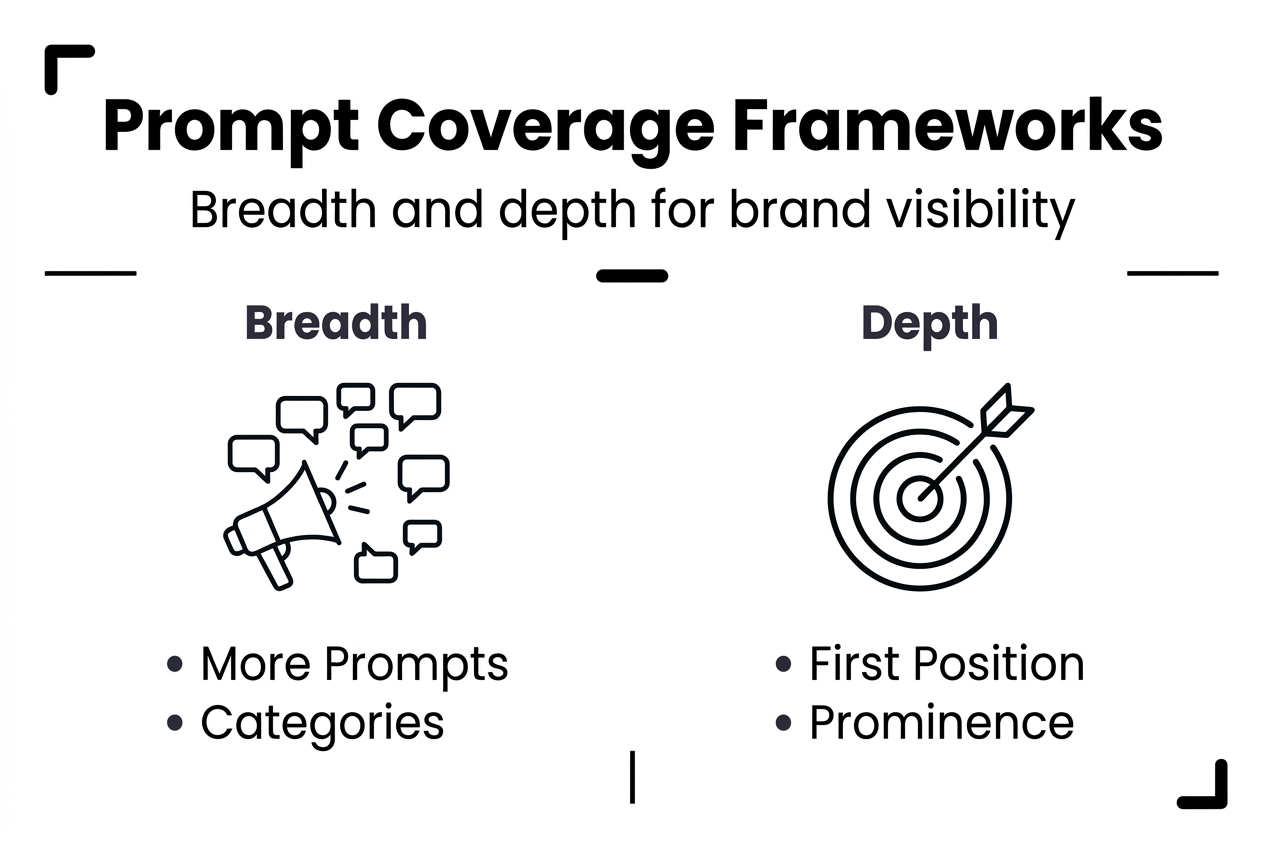
Effective prompt coverage requires both breadth (appearing across diverse relevant prompts) and depth (prominent, authoritative positioning within responses). Balancing these dimensions separates brands that dominate AI visibility from those struggling for scraps.
How automated AI prompt coverage analysis works
Automated systems revolutionize prompt coverage evaluation by replacing manual spreadsheet tracking with scalable, data-driven insights. These platforms systematically test how AI models respond to hundreds or thousands of prompts, identifying exactly where your brand appears, disappears, or faces competitive displacement.
Automated prompt coverage analysis operates through several coordinated processes. Analysis engines submit carefully curated prompts spanning your target customer journey to major AI platforms. Advanced parsing algorithms then scan responses, detecting brand mentions, positioning, sentiment, and competitive context. This happens continuously, building longitudinal data that reveals trends invisible in spot checks.
Key metrics transform raw data into actionable intelligence:
- Coverage percentage: The proportion of relevant prompts where your brand appears in AI responses, benchmarked against competitors and industry standards.
- Prompt overlap: Identifies redundant prompts targeting identical concepts, revealing wasted analysis effort and optimization opportunities.
- Performance variance: Measures consistency across AI platforms and prompt variations, highlighting stability or fragility in your coverage.
- Gap mapping: Pinpoints high-value prompt categories where competitors dominate while your brand remains absent.
Visualization tools like coverage heatmaps display performance across prompt categories at a glance. Trend dashboards track coverage trajectory over weeks and months, correlating changes with content updates or algorithm shifts. AI answer optimization strategies become dramatically more effective when informed by comprehensive automated analysis.

Pro Tip: Schedule automated analysis immediately after publishing major content updates or when competitors launch campaigns. These moments create coverage fluctuations that manual monitoring typically misses, but automated systems capture precisely.
The acceleration factor matters enormously. What once required days of manual testing now happens in minutes, freeing marketers to focus on strategic optimization rather than data collection drudgery.
Comparing prompt coverage: frameworks and best practices
Evaluating AI prompt coverage effectively requires structured frameworks that transform data into strategic priorities. Different analytical lenses reveal distinct optimization opportunities, and savvy marketers combine multiple approaches for comprehensive visibility.
Coverage breadth analysis examines how many unique prompt categories trigger your brand mentions. Breadth indicates market presence across the full customer journey, from initial awareness questions to detailed comparison prompts. Brands with narrow breadth risk invisibility outside their comfort zone.
Coverage depth analysis assesses positioning quality within responses. Does your brand appear first, buried in the middle, or tagged at the end? Depth correlates strongly with click-through and consideration rates. Superior depth often matters more than appearing in more prompts.
Relevance scoring weights coverage by business impact. A mention in a high-intent purchase decision prompt delivers exponentially more value than appearing in tangential informational queries. Relevance frameworks help allocate optimization resources toward prompts that drive revenue.
Gap mapping identifies blind spots where competitors dominate while your brand remains invisible. These gaps represent immediate growth opportunities, especially when analysis reveals prompt categories with high search volume and commercial intent.
| Framework | Strengths | Limitations | Best Application |
|---|---|---|---|
| Coverage Breadth | Reveals market presence span | Ignores positioning quality | Initial competitive benchmarking |
| Coverage Depth | Measures influence strength | Requires manual response analysis | Optimizing existing coverage |
| Relevance Scoring | Aligns effort with business impact | Demands accurate intent classification | Resource allocation decisions |
| Gap Mapping | Uncovers growth opportunities | May highlight low-value gaps | Competitive displacement strategies |
Frameworks such as coverage breadth enable systematic evaluation rather than reactive, intuition-driven decisions. The best practices that maximize framework value include:
- Prioritize high-impact prompts: Focus optimization efforts on prompts with documented business outcomes rather than vanity metrics.
- Monitor prompt decay: Track how coverage erodes over time as AI models retrain and competitors optimize, triggering proactive refresh cycles.
- Update coverage libraries regularly: New product launches, market shifts, and emerging customer questions demand continuous prompt inventory expansion.
Pro Tip: Most marketers overlook prompt overlap analysis, causing wasted effort testing semantically identical prompts. Deduplicate your prompt library quarterly, reallocating resources toward underserved categories.
Framework selection depends on your current visibility maturity. Brands starting from zero benefit from breadth analysis identifying quick wins. Established players extract more value from depth and relevance optimization, fine-tuning existing coverage for maximum conversion impact.
Applying AI prompt coverage insights to boost brand visibility
Translating prompt coverage data into measurable visibility gains requires systematic execution. The following optimization process transforms analysis into results:
-
Assess current coverage baseline: Run comprehensive prompt testing across all relevant customer journey stages, documenting coverage percentage, positioning, and competitive context. Establish clear metrics for tracking improvement.
-
Identify high-value gaps: Prioritize prompt categories where competitors appear consistently while your brand remains absent, filtering for commercial intent and search volume. These represent your fastest path to visibility gains.
-
Develop targeted content: Create authoritative content specifically addressing gap prompts, incorporating exact phrasing and semantic variations AI models recognize. Structure content for easy parsing, with clear answers to specific questions.
-
Optimize existing coverage: Refresh content for prompts where you appear but rank poorly, strengthening authority signals, adding specificity, and improving contextual relevance.
-
Test and validate: Rerun automated analysis after content updates, measuring coverage improvements and position changes. A/B test different content approaches for ambiguous prompts.
-
Monitor competitive displacement: Track whether optimization lifts your coverage or simply shifts mentions from competitors, indicating zero-sum dynamics requiring different strategies.
-
Iterate continuously: Establish monthly or quarterly review cycles, adjusting priorities based on performance data and emerging prompt trends.
Real-world applications demonstrate substantial returns. One B2B software company increased AI-driven brand mentions by 43% within 90 days by systematically addressing the 20 highest-value prompt gaps identified through automated analysis. A consumer brand improved average positioning from fifth to second mention across key comparison prompts, correlating with a 28% lift in consideration metrics.
Effective application of prompt coverage insights compounds over time as improved visibility creates self-reinforcing authority signals. Integration with broader strategies amplifies results. Coordinate prompt optimization with traditional SEO, ensuring consistency between how search engines and AI models understand your positioning. Align prompt testing programs with product launches and campaign timing, capitalizing on heightened market attention.
The continuous improvement mindset separates sustained visibility leaders from one-hit wonders. AI models evolve rapidly, competitor tactics shift, and customer language changes. What works today requires refinement tomorrow. Brands treating prompt coverage as an ongoing strategic discipline rather than a project consistently outperform those seeking quick fixes.
Enhance your AI prompt strategy with RankPirate
Mastering AI prompt coverage requires more than understanding concepts. You need reliable data, efficient analysis, and clear priorities. RankPirate eliminates the guesswork by automating prompt testing across ChatGPT, Gemini, and Claude, revealing exactly where your brand appears and where competitors dominate.
RankPirate’s weekly tracking covers real-world prompts with performance data, helping you identify high-value optimization targets immediately. The GVS™ scoring system consolidates complex coverage data into a single metric tracking your visibility trajectory over time. Stop relying on manual spreadsheets and unreliable spot checks. Explore our 2026 AI brand presence guide and discover how automated prompt testing transforms visibility from mystery to strategic advantage.
Frequently asked questions
What determines effective AI prompt coverage?
Effective coverage combines breadth across relevant prompt categories with strong positioning within individual responses. Quality matters more than quantity. Brands appearing prominently in 50 high-intent prompts typically outperform those with weak mentions across 200 low-value queries. Authority signals, content specificity, and semantic alignment with how customers actually phrase questions drive effectiveness.
How often should I analyze AI prompt coverage for my brand?
Analysis frequency depends on your market dynamics and resource capacity. Minimum recommendation: quarterly reviews aligned with content planning cycles. High-growth brands and competitive markets benefit from monthly analysis, especially following major content updates or competitor campaigns. Schedule immediate analysis after algorithm updates announced by major AI platforms, as these often trigger coverage fluctuations.
Can AI prompt coverage replace traditional SEO strategies?
No, AI prompt coverage complements rather than replaces SEO. Both disciplines target visibility, but through different mechanisms and user behaviors. Traditional SEO optimizes for search engine result pages, while prompt coverage focuses on AI-generated answers. The most successful brands integrate both approaches, ensuring consistency across all discovery channels. Content optimized for both search engines and AI models delivers compounding returns.
What common mistakes should marketers avoid when optimizing AI prompt coverage?
The biggest mistake is prioritizing prompt quantity over strategic quality, testing hundreds of irrelevant prompts while ignoring high-value gaps. Neglecting prompt overlap wastes resources on redundant testing. Many brands also fail to update prompt libraries as customer language evolves, optimizing for yesterday’s questions. Finally, treating coverage as a one-time project rather than ongoing discipline guarantees declining results as AI models and competitors evolve.