Examples of AI-generated answers to boost your marketing

Generative AI is rewriting the rules of how brands appear in search results. Digital marketers now face a new challenge: optimizing content not just for traditional search engines, but for AI models that generate direct answers to user queries. With 693% increases in AI-driven traffic reported by brands using Answer Engine Optimization, understanding how to evaluate and leverage AI-generated answers has become essential for maintaining competitive visibility and driving meaningful business results.
Table of Contents
- Key takeaways
- How to evaluate AI-generated answers for marketing
- Top examples of AI-generated answers in marketing content
- Comparing AI-generated answer models and their impact
- How brands improve visibility with AI-generated answers
- Enhance your AI answer strategy with RankPirate
- Frequently asked questions about AI-generated answers
Key Takeaways
| Point | Details |
|---|---|
| Prompt engineering | Systematic prompt frameworks significantly improve AI output quality and alignment with brand objectives. |
| Safety alignment | Assess models for safety alignment to avoid excessive refusals that stall content production. |
| E E A T signals | Prioritize structured formatting, credible data points, and E E A T signals to boost AI answer rankings. |
| Human oversight | Despite automation, human review remains essential to verify accuracy and maintain brand voice. |
How to evaluate AI-generated answers for marketing
Selecting effective AI-generated answers requires a systematic evaluation framework. Start by assessing accuracy and relevance to your target audience’s specific questions. Content must align precisely with search intent while maintaining your brand’s distinctive voice and messaging standards.
Prompt engineering frameworks significantly improve output quality through techniques like few-shot learning and chain-of-thought reasoning. These approaches guide AI models to produce responses that match your content standards and strategic objectives. Testing different prompt structures reveals which configurations deliver the most useful marketing content for your specific needs.
Evaluate each model’s safety alignment carefully. Some AI systems over-refuse legitimate marketing queries, mistakenly flagging standard promotional content as problematic. This behavior wastes time and limits your content production capabilities. Balance is essential: you want appropriate safety guardrails without excessive false positives that block normal business communications.
Prioritize outputs that feature structured formatting, clear entity references, and alignment with E-E-A-T principles. AI search systems favor content demonstrating expertise, experience, authoritativeness, and trustworthiness. Include specific data points, expert citations, and practical examples that establish credibility. Schema markup and FAQ formats further enhance your content’s chances of being selected for AI-generated answers.
Human review remains non-negotiable despite automation benefits. Assign team members to verify factual accuracy, ensure brand voice consistency, and catch subtle errors AI systems miss. This quality control step separates professional marketing content from generic AI outputs that damage brand reputation.
Pro Tip: Create a scoring rubric with weighted criteria (accuracy 30%, brand voice 25%, E-E-A-T signals 25%, formatting 20%) to standardize your AI content evaluation process and track improvements over time.
Implementing these evaluation criteria helps you boost AI brand presence systematically rather than relying on guesswork or inconsistent manual reviews.
Top examples of AI-generated answers in marketing content
Digital marketers are deploying AI-generated answers across multiple content formats with measurable success. Understanding these practical applications reveals opportunities to enhance your own marketing operations.
SEO content briefs represent one of the highest-impact use cases. Generative models produce drafts 5-10x faster than manual creation, allowing content teams to scale output dramatically. These AI-generated briefs include keyword clusters, semantic topic suggestions, competitor analysis summaries, and structured outlines that writers can execute efficiently. The speed advantage lets brands cover more search opportunities and respond faster to trending topics.
Campaign copywriting benefits substantially from AI assistance. Models like GPT-4o and Claude generate multiple variations of ad copy, email subject lines, and social media posts in seconds. Marketers can test dozens of messaging angles quickly, selecting the strongest options for A/B testing. This iterative approach uncovers high-performing copy combinations that might never emerge from traditional brainstorming sessions.
FAQ generation addresses AI search intent directly. By analyzing common customer questions and generating comprehensive answers, brands create content specifically designed for AI citation. These FAQs incorporate natural language patterns matching how users phrase voice queries, increasing the likelihood of appearing in AI-generated responses across ChatGPT, Perplexity, and similar platforms.
Entity-rich product descriptions enhance brand visibility in AI-driven search environments. AI tools generate detailed specifications, use cases, and comparison points that establish clear product differentiation. This structured information helps AI models understand exactly what your product offers and when to recommend it in response to user queries.
“Structured prompts that specify format, tone, audience, and key points consistently produce marketing content requiring minimal editing. The quality difference between generic prompts and engineered prompts is dramatic.”
Key applications driving results:
- Blog post outlines with semantic keyword integration and competitive gap analysis
- Social media content calendars with platform-specific formatting and hashtag recommendations
- Email nurture sequences personalized by customer segment and buying stage
- Landing page copy variations optimized for different traffic sources and user intents
- Video script drafts with hook formulas and call-to-action frameworks
These examples demonstrate how AI-generated answers accelerate content creation while maintaining strategic focus. The SEO checklist for AI answers provides additional optimization tactics to maximize visibility across AI platforms.
Comparing AI-generated answer models and their impact
Selecting the right AI model for marketing content requires understanding each platform’s strengths and limitations. Performance varies significantly across different content types and use cases.
GPT-4o excels at creative marketing copy and long-form content generation. Its broad training data enables nuanced brand voice matching and sophisticated reasoning about audience psychology. The model handles complex multi-step prompts effectively, making it ideal for comprehensive content briefs and strategic planning documents. However, it occasionally produces overly verbose outputs requiring editing for conciseness.

Claude demonstrates superior performance on analytical tasks and structured content formats. Its constitutional AI training reduces harmful outputs while maintaining utility for legitimate business content. Marketing teams value Claude’s ability to maintain consistency across long documents and its reliable adherence to detailed formatting instructions. The model sometimes exhibits conservative refusal behavior on promotional content, requiring prompt refinement.
Jasper and Copy.ai offer marketing-specific optimizations with pre-built templates for common content types. These platforms streamline workflow for teams focused primarily on advertising copy, social media posts, and email campaigns. Their specialized training produces outputs requiring less editing for marketing contexts, though they offer less flexibility for custom content formats.
LLM performance varies widely on expert tasks, but marketing content generation represents a well-established use case where current models deliver reliable results. The key differentiator is matching model capabilities to your specific content requirements and workflow preferences.
| Model | Best Marketing Uses | Key Strengths | Limitations |
|---|---|---|---|
| GPT-4o | Blog posts, strategic content, creative campaigns | Nuanced voice matching, complex reasoning | Occasional verbosity |
| Claude | Analytical content, structured formats, reports | Consistency, formatting adherence | Conservative refusals |
| Jasper | Ad copy, social posts, email campaigns | Marketing-specific templates, quick outputs | Less format flexibility |
| Gemini | Multimodal content, visual integration | Real-time data access, image understanding | Newer, evolving capabilities |
Pro Tip: Run parallel tests with your top two model candidates using identical prompts on representative content samples. Compare outputs on accuracy, brand voice alignment, and required editing time to make data-driven selection decisions.
Understanding these distinctions helps you allocate AI tools strategically across your content calendar. Complex thought leadership pieces might route to GPT-4o, while high-volume social content leverages Jasper’s speed. This AI answer ranking knowledge ensures you deploy the right tool for each marketing objective.
How brands improve visibility with AI-generated answers
Forward-thinking brands are implementing specific tactics to maximize their presence in AI-generated responses, driving measurable business outcomes through Answer Engine Optimization and Generative Engine Optimization strategies.
Answer Engine Optimization focuses on structuring content to appear directly in AI-generated answers. This requires creating comprehensive, entity-rich content that AI models can parse and cite confidently. Implement detailed FAQ sections addressing specific customer questions with authoritative, concise answers. Use schema markup to help AI systems understand your content structure and extract relevant information accurately.
Generative Engine Optimization extends beyond direct answers to improve citation frequency across AI platforms. Brands report gaining +120% revenue increases and +693% AI traffic growth by optimizing for generative search engines. This involves building strong entity signals through consistent brand mentions, expert author profiles, and authoritative backlinks that AI models recognize as trust indicators.
E-E-A-T principles directly influence AI answer rankings. Demonstrate expertise through detailed, accurate content backed by data and research. Show experience via case studies, customer testimonials, and practical implementation guides. Establish authoritativeness with expert author bios, industry credentials, and third-party recognition. Build trustworthiness through transparent sourcing, regular content updates, and secure website infrastructure.
Structured content formats significantly improve AI visibility. Create comparison tables, step-by-step guides, and numbered lists that AI models can easily parse and present to users. These formats match how AI systems organize and deliver information, increasing your citation probability.
| Metric | Before AI Optimization | After AI Optimization | Improvement |
|---|---|---|---|
| AI-driven traffic | 2,400 monthly visits | 19,032 monthly visits | +693% |
| Revenue from AI sources | $48,000 annually | $105,600 annually | +120% |
| Brand mentions in AI answers | 12% visibility rate | 47% visibility rate | +292% |
| Qualified leads from AI | 180 monthly | 520 monthly | +189% |
Actionable tactics to implement immediately:
- Develop comprehensive FAQ pages addressing every common customer question with 2-3 sentence answers optimized for featured snippets
- Create entity-rich content mentioning your brand, products, key personnel, and industry context in natural, informative ways
- Implement schema markup for articles, FAQs, products, and organization details to help AI systems parse your content accurately
- Build authoritative backlinks from industry publications and expert sources that AI models recognize as credible
- Update existing content regularly with current data, statistics, and examples to maintain freshness signals
- Develop detailed comparison content positioning your offerings against alternatives with objective criteria
These strategies work because they align with how AI models evaluate and select content for citations. Understanding why AI search matters for brand visibility helps prioritize optimization efforts for maximum impact. The 2026 guide to boost AI brand presence provides additional implementation frameworks for scaling these tactics across your content portfolio.
Enhance your AI answer strategy with RankPirate
RankPirate transforms how brands monitor and optimize their presence in AI-generated answers across ChatGPT, Gemini, Claude, and emerging AI platforms. The platform automates prompt testing at scale, revealing exactly where your brand appears, where it drops out, and what content adjustments drive visibility improvements.
Start with the free AI visibility checker for a quick snapshot of how AI answers mention your brand, then use RankPirate to replace spreadsheets and screenshots with reliable, scalable measurement. The GVS™ (AI Visibility Score) aggregates data across multiple prompts and buying journey stages, providing a single metric that reflects stable, long-term visibility rather than isolated moments.
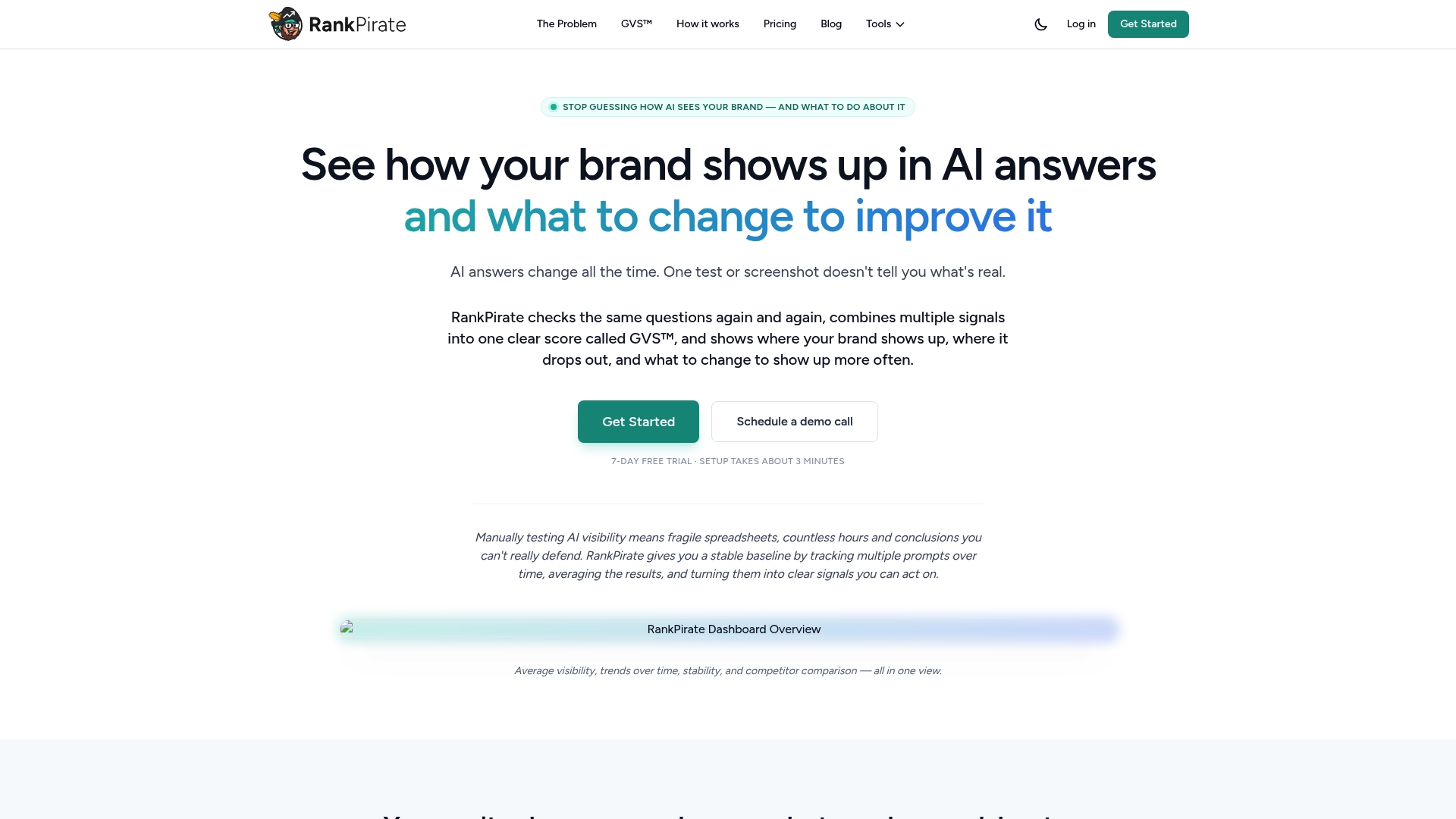
Track competitor performance alongside your own brand, identifying content gaps and strategic opportunities to increase AI citations. RankPirate delivers actionable recommendations for content improvements, messaging adjustments, and entity optimization based on what actually drives AI visibility in your industry. The SEO checklist for AI answers integrates directly with platform insights, creating a complete optimization workflow.
Pro Tip: Combine RankPirate’s automated monitoring with human content review to maintain brand voice while maximizing AI visibility. The platform identifies opportunities; your team executes improvements that align with strategic positioning.
Get started at RankPirate.io to see exactly how your brand performs in AI-generated answers and receive specific recommendations for improvement.
Frequently asked questions about AI-generated answers
What are AI-generated answers and how do they differ from traditional SEO content?
AI-generated answers are direct responses produced by language models like ChatGPT and Claude when users ask questions, bypassing traditional search results pages entirely. Unlike SEO content optimized for search engine rankings, AI-generated answers prioritize concise, authoritative information that AI models can parse and cite confidently. This requires structured formatting, clear entity signals, and E-E-A-T alignment rather than just keyword optimization.
How can I ensure AI-generated content maintains my brand’s voice and accuracy?
Implement detailed prompt engineering with specific voice guidelines, tone examples, and brand terminology requirements in every prompt. Create a content review checklist covering factual accuracy, brand alignment, and messaging consistency that human editors apply before publication. Test outputs from multiple AI models to identify which best matches your brand voice naturally, then standardize on that platform for consistency.
Which AI models deliver the best marketing content currently?
GPT-4o excels at creative marketing copy and long-form content with nuanced brand voice matching. Claude performs better on analytical content and structured formats with reliable formatting adherence. Jasper and Copy.ai offer marketing-specific optimizations with pre-built templates for advertising and social content. Your ideal choice depends on specific content types, required editing time, and workflow integration needs.
How does AI visibility impact website traffic and lead generation?
Brands optimizing for AI visibility report 693% increases in AI-driven traffic and 120% revenue growth from AI sources. When your brand appears consistently in AI-generated answers, users discover your solutions earlier in their research process, leading to higher-quality leads with better conversion rates. AI citations build credibility and awareness even when users don’t immediately click through, creating compound visibility benefits over time.
What are safe practices for balancing AI automation with human review?
Establish clear workflows where AI generates initial drafts but humans verify factual accuracy, ensure brand voice consistency, and add strategic insights AI cannot provide. Create approval gates for high-stakes content like legal disclaimers, pricing information, and executive communications. Use AI for scalable tasks like FAQ generation and social posts while reserving strategic content like thought leadership for human-led creation with AI assistance. The step-by-step AI answer optimization guide provides detailed workflows balancing automation with quality control.