Top types of AI-generated content for marketing success

Digital marketers face a dizzying array of AI-generated content options, from automated blog posts to personalized video ads. Choosing the right types can mean the difference between campaigns that resonate and those that fall flat. This guide breaks down the most effective AI-generated content types, explains how to evaluate them against your marketing goals, and shows you how hybrid AI-human workflows deliver the strongest ROI and engagement. You’ll learn which content formats drive traffic, boost conversions, and enhance brand visibility in AI-driven search environments.
Table of Contents
- Key takeaways
- Criteria for evaluating AI-generated content types
- Top types of AI-generated content for marketing success
- Comparing AI-generated content types: impact and limitations
- Choosing the right AI-generated content types for your marketing strategy
- Optimize your AI-generated content strategy with RankPirate
- Frequently asked questions
Key Takeaways
| Point | Details |
|---|---|
| Hybrid workflows boost ROI | Hybrid AI human workflows deliver stronger ROI and engagement by balancing automation with human oversight. |
| Evaluate ROI and engagement | Assess content by ROI, organic traffic, CTR, conversions, and audience engagement to choose formats that align with goals. |
| Pilot campaigns first | Test each AI content type with a small pilot campaign for at least 30 days to gather meaningful performance data. |
| Align with marketing goals | Measure effectiveness against brand awareness, lead generation, and education to ensure alignment with strategic objectives. |
| Different formats offer benefits | Text based, visual, and audio content each bring unique advantages and challenges that require tailored approaches. |
Criteria for evaluating AI-generated content types
Before diving into specific content formats, you need a systematic framework to assess which AI-generated content types will deliver the best results for your marketing campaigns. Start by examining content effectiveness, which measures how well each format achieves your specific goals, whether that’s brand awareness, lead generation, or customer education. Cost efficiency matters too, as different AI content types require varying levels of investment in tools, human oversight, and production time.
The integration of human expertise with AI capabilities stands as perhaps the most critical evaluation criterion. Hybrid workflows prioritize human oversight for safety, authenticity, and strategic depth, ensuring your content resonates emotionally while maintaining factual accuracy. Pure AI content often lacks the nuance and cultural awareness that human editors provide, leading to lower engagement rates and potential brand risks.
When evaluating AI content types, track these essential metrics:
- Return on investment (ROI) comparing production costs to revenue generated
- Organic traffic increases from search engines and AI-powered answer engines
- Click-through rates (CTR) on calls-to-action embedded in content
- Conversion rates showing how effectively content moves prospects through your funnel
- Audience engagement metrics including time on page, social shares, and comments
SEO impact deserves special attention when choosing AI content types. Some formats naturally perform better in traditional search engines, while others excel at appearing in AI-generated answers from ChatGPT, Gemini, and Claude. Analyzing AI trends for insights helps you understand which content formats AI models prefer to cite and recommend, directly affecting your brand’s visibility in this emerging channel.
Pro Tip: Test each AI content type with a small pilot campaign before scaling up. Measure performance against your established criteria for at least 30 days to gather meaningful data on what works for your specific audience and industry.
Top types of AI-generated content for marketing success
Text-based AI content forms the foundation of most digital marketing strategies. AI content types include blog articles that educate prospects, ad copy that drives clicks, email sequences that nurture leads, and social media posts that build community. Language models excel at generating these formats quickly, allowing you to maintain consistent publishing schedules while freeing human writers to focus on strategic messaging and brand voice refinement.
Visual AI content leverages generative models to create images, infographics, custom graphics, and branded illustrations. These tools can produce hero images for blog posts, social media visuals optimized for each platform’s dimensions, and even complete design systems that maintain brand consistency. Visual content captures attention faster than text alone, making it essential for stopping scrolls and increasing engagement rates across digital channels.

Audio AI content opens new opportunities for brands to reach audiences during commutes, workouts, and other hands-free moments. AI-generated voiceovers bring video content to life without expensive voice talent, while AI-assisted podcast production can help you launch audio series that establish thought leadership. Some advanced tools even create personalized audio messages for high-value prospects, adding a human touch at scale.
Video content generated or enhanced by AI ranges from simple explainer animations to sophisticated product demonstrations and promotional clips. AI tools can automate video editing, add captions for accessibility, generate B-roll footage, and even create synthetic presenters for training content. Video consistently drives higher engagement than static content, making AI video tools valuable for brands seeking to scale their video marketing without proportional budget increases.
Interactive AI content includes chatbots that qualify leads 24/7, personalized quizzes that segment audiences, recommendation engines that guide product selection, and virtual assistants that answer customer questions. These formats actively engage users rather than passively delivering information, creating memorable experiences that strengthen brand relationships and gather valuable first-party data.
Data-driven AI content transforms complex analytics into digestible insights through personalized reports, automated dashboards, and custom visualizations. Marketing teams use these tools to generate client reports, create industry benchmarks, and produce thought leadership content backed by proprietary data. This content type positions your brand as an authoritative source while providing genuine value that prospects can’t find elsewhere.
Multimedia AI content combines multiple formats into cohesive experiences. Think interactive infographics with embedded video explanations, blog posts with AI-generated audio versions for accessibility, or social campaigns that seamlessly blend text, images, and short video clips. These integrated approaches cater to diverse learning styles and consumption preferences, maximizing your content’s reach and impact.
Comparing AI-generated content types: impact and limitations
Performance metrics reveal stark differences between AI content types and production methods. Pure AI content underperforms human content significantly in traffic and conversions, with hybrid approaches bridging the gap by combining AI efficiency with human creativity and oversight. Text content edited by humans after AI drafting shows 34% higher organic traffic and 27% better conversion rates compared to unedited AI output.
| Content Type | Avg. Traffic Lift | Production Speed | Human Oversight Required | Best Use Case |
|---|---|---|---|---|
| AI-assisted blogs | 34% vs pure AI | 3x faster than human-only | Medium (editing, fact-checking) | SEO content at scale |
| AI-generated visuals | 22% engagement boost | 5x faster | Low (brand alignment) | Social media, ads |
| AI video content | 41% higher retention | 4x faster | High (messaging, accuracy) | Explainers, tutorials |
| Interactive AI (chatbots) | 18% conversion increase | Instant deployment | Medium (training, monitoring) | Lead qualification |
| Data-driven AI reports | 29% shareability increase | 10x faster | High (interpretation, context) | Thought leadership |
Ethical and SEO risks emerge when brands rely too heavily on pure AI content without human review. Search engines increasingly penalize low-quality AI content that lacks original insights or factual accuracy. AI struggles with edge cases and lacks emotional nuance, requiring human oversight for quality and compliance. Hallucinations, where AI confidently states false information, can damage brand credibility and trigger legal issues if published without verification.
The hybrid approach addresses these limitations systematically:
- AI handles initial research and drafting, reducing time to first draft by 60-70%
- Human editors verify facts, add strategic insights, and inject brand personality
- Subject matter experts review technical accuracy and industry-specific nuances
- Compliance teams check regulatory requirements and ethical considerations
- Creative directors ensure emotional resonance and storytelling effectiveness
Pro Tip: Implement a three-tier review system for AI content. Tier one catches obvious errors and formatting issues. Tier two verifies facts and adds strategic depth. Tier three polishes voice and optimizes for conversion. This staged approach maintains quality while preserving AI’s speed advantages.
Content type limitations vary significantly. Text AI excels at informational content but struggles with humor and cultural references. Visual AI creates impressive graphics but may generate anatomically incorrect images or inappropriate combinations. Audio AI produces natural-sounding speech but lacks the vocal variety and emotional inflection of experienced voice actors. Understanding these boundaries helps you deploy each content type where it shines while avoiding its weaknesses.
“The future of content marketing isn’t human versus AI, it’s human plus AI. Brands that master this collaboration will dominate their markets while competitors waste resources on either pure AI content that underperforms or pure human content that can’t scale.” — Marketing Technology Report 2026
Iterative refinement transforms good AI content into great marketing assets. Start with AI-generated drafts, then layer in human expertise through multiple revision cycles. Boost your AI brand presence by ensuring every piece of content, regardless of AI involvement in production, meets your quality standards and serves your strategic objectives.
Choosing the right AI-generated content types for your marketing strategy
Align your AI content choices with specific campaign objectives to maximize impact. For brand awareness campaigns, prioritize visual and video content that captures attention quickly and encourages social sharing. Lead generation efforts benefit most from interactive AI content like quizzes and chatbots that qualify prospects while gathering contact information. Customer education and retention campaigns perform best with comprehensive text-based guides and data-driven reports that demonstrate your expertise.
Budget constraints shape realistic AI content strategies. If you’re working with limited resources, start with these high-impact, low-cost options:
- AI-assisted blog content with human editing delivers strong SEO results without expensive production costs
- Social media graphics generated by AI tools maintain visual consistency across platforms affordably
- Email sequences drafted by AI and refined by your team scale personalized outreach efficiently
- Chatbots handle routine customer inquiries, freeing human agents for complex issues
- Repurpose existing content into new formats using AI transcription and summarization tools
Mid-sized budgets allow for more sophisticated hybrid approaches. Invest in AI video tools to create product demonstrations and testimonial compilations. Commission data-driven reports that position your brand as an industry authority. Develop interactive tools that provide genuine utility while capturing leads. These higher-touch content types require more human oversight but generate proportionally greater engagement and conversion rates.
Hybrid workflows with about 70% AI drafting and 30% human editing deliver best ROI and engagement across most content types and industries. This ratio provides the sweet spot where AI’s speed and scale combine with human creativity and strategic thinking. Adjust the balance based on content complexity and risk level, with higher-stakes content like thought leadership and compliance-sensitive materials requiring more human involvement.
Syncing AI content choices with SEO strategy ensures your investment drives measurable traffic growth. Prioritize content types that answer specific customer questions, as these perform well in both traditional search and AI-generated answers. Structure your content with clear headings, concise paragraphs, and data-backed claims that AI models can easily parse and cite. Follow this AI search optimization checklist to ensure your content appears prominently when prospects ask AI assistants for recommendations in your category.
Pro Tip: Create a content type matrix mapping each AI format to specific funnel stages. Top-of-funnel awareness content might emphasize visual and video formats, while bottom-of-funnel decision content focuses on detailed comparisons and data-driven case studies. This strategic mapping prevents random content production and ensures every asset serves a clear purpose.
Balance scale and nuance by reserving pure AI generation for high-volume, lower-stakes content like social media posts and routine email updates. Apply intensive human oversight to cornerstone content that defines your brand positioning, introduces new products, or addresses controversial topics. This tiered approach lets you publish consistently while maintaining quality where it matters most.
Optimize your AI-generated content strategy with RankPirate
Ready to ensure your AI-generated content actually reaches your target audience? RankPirate helps you track how prominently your brand appears in AI-generated answers across ChatGPT, Gemini, and Claude. Start with the free AI visibility checker to see how AI models currently answer questions about your brand and industry.
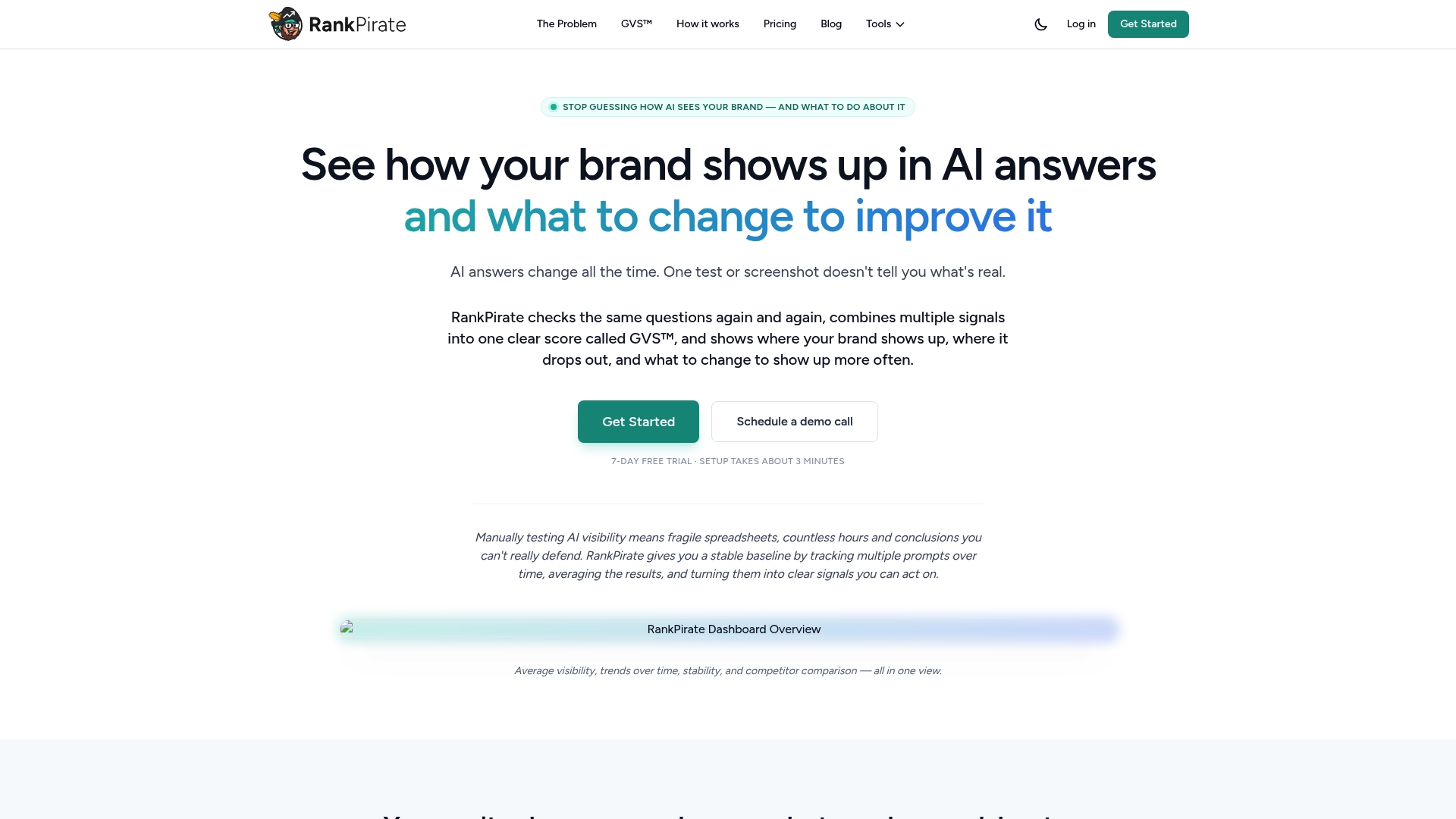
Our platform reveals exactly where your content succeeds in capturing AI visibility and where competitors outrank you. Discover why AI search matters for brand visibility in 2026 and learn which content types AI models prefer to cite. Access our comprehensive guide to boost AI brand presence with proven tactics that align your content strategy with how AI systems evaluate and recommend brands.
Frequently asked questions
What is the difference between AI-generated text and visual content?
Text content uses language models like GPT-4 to create blogs, ads, emails, and social posts by predicting word sequences based on training data. Visual content employs generative models like DALL-E or Midjourney to create images, graphics, and illustrations from text descriptions. Text AI excels at explaining concepts and providing information, while visual AI captures attention and communicates ideas instantly. Each targets different cognitive processes, with text engaging analytical thinking and visuals triggering emotional responses.
How does a hybrid AI-human workflow improve content quality?
AI provides speed and scale by generating drafts in minutes rather than hours, while humans add emotional nuance, fact-checking, and strategic alignment with brand goals. Hybrid content produces higher ROI, better engagement, and fewer errors compared to pure AI output. Human oversight catches AI hallucinations, ensures cultural sensitivity, and injects personality that resonates with your specific audience. This collaboration combines the best of both approaches while mitigating their individual weaknesses.
Which AI content types are best for increasing website traffic?
Prioritize high-quality AI-assisted blogs optimized for search intent, SEO-focused ad copy that drives qualified clicks, and personalized data reports that earn backlinks from industry publications. Text-based content combined with data-driven personalization drives substantial traffic increases when edited by humans for accuracy and depth. Interactive content like quizzes and calculators also boosts traffic by providing utility that encourages sharing. Hybrid approaches consistently outperform pure AI content, with human-edited AI blogs generating 34% more organic traffic. Learn more about AI search and traffic to optimize your content strategy.
How do I measure ROI from different AI content types?
Track production costs including AI tool subscriptions, human editing time, and distribution expenses, then compare against revenue attributed to each content type through analytics platforms. Assign monetary values to conversions, leads, and traffic increases to calculate return on investment. Use UTM parameters to track which content types drive the most valuable actions, and implement multi-touch attribution to understand how different formats contribute throughout the customer journey. Test AI content types in controlled experiments, measuring performance against human-only content and pure AI content to identify your optimal hybrid ratio.
Can AI-generated content rank well in traditional search engines?
Yes, when AI content receives proper human editing and provides genuine value to searchers. Search engines evaluate content quality, relevance, and user satisfaction rather than production method. AI-assisted content that answers search intent comprehensively, includes original insights, and demonstrates expertise can rank as well as human-written content. However, thin AI content lacking depth or originality typically underperforms. Focus on using AI to enhance research and drafting efficiency while relying on human editors to ensure accuracy, add unique perspectives, and optimize for search intent.