Main types of AI search engines marketers must know

Marketers who ignore the differences between AI search engines are essentially flying blind. AI search queries are up 340% year over year, and projections suggest 70% of all searches will be AI-generated by 2027. That kind of growth means the engine you optimize for today directly shapes whether your brand gets cited tomorrow. This guide breaks down every major type of AI search engine, compares real-world examples, and gives you a clear framework for aligning your strategy to the right platforms.
Table of Contents
- What makes an AI search engine distinct?
- The 10 main types of AI search engines
- Comparing popular AI search engines
- How AI search engines structure queries and ranking
- AI search engine optimization strategies for marketers
- Enhance your brand’s AI search strategy
- Frequently asked questions
Key Takeaways
| Point | Details |
|---|---|
| Know the engine types | Understanding the ten main types of AI search engines unlocks smarter marketing strategies. |
| Prioritize earned media | AI search engines prefer authoritative, third-party content when choosing citations for answers. |
| Adopt GEO practices | Generative Engine Optimization now joins SEO as a must for digital visibility in AI-powered results. |
| Tailor for each platform | Each AI engine structures and ranks responses differently so optimization cannot be one-size-fits-all. |
| Track and adapt visibility | Brands must monitor where and how they appear across different AI search ecosystems to stay found. |
What makes an AI search engine distinct?
To understand which engines to prioritize, it is key to know what truly sets AI search apart from traditional web search. Classic search engines match keywords to a static index and return a list of links. AI search engines do something fundamentally different: they synthesize, reason, and generate answers.
The core technologies powering this shift include:
- Retrieval-Augmented Generation (RAG): The engine pulls live data from the web and feeds it into a language model to generate a grounded answer.
- Large Language Models (LLMs): These models understand context, intent, and nuance, not just keyword frequency.
- Semantic and vector search: Instead of matching exact words, the engine matches meaning, so a query about “best project tools” surfaces results about productivity software even without that exact phrase.
- Agentic search: Multi-step workflows where the engine breaks a complex query into sub-tasks, runs them in parallel or sequence, and synthesizes a final answer.
These technical capabilities of AI search represent a complete departure from the link-list model. For marketers, this means your content needs to be structured for synthesis, not just for clicks. Understanding why AI search matters for brand visibility is the first step toward building a presence that actually sticks.
The 10 main types of AI search engines
Knowing the mechanics, let’s break down each main type you will encounter in the AI search ecosystem. AI search engines fall into distinct categories based on use case and audience, and each one demands a different optimization approach.
- General-purpose: Perplexity, Google AI Overviews. These handle broad queries and are the highest-traffic entry points for brand discovery.
- Enterprise/business-focused: Built for internal knowledge retrieval, workflow automation, and B2B research. Think Microsoft Copilot integrated into workplace tools.
- Academic/research: Consensus and Elicit pull from peer-reviewed literature. Critical for brands in health, finance, or any evidence-heavy vertical.
- Privacy-focused: Brave Search and DuckDuckGo AI prioritize user anonymity. Growing fast among tech-savvy audiences who reject tracking.
- Developer-oriented: Phind is built for code search and technical documentation. Relevant if your brand targets developers or sells dev tools.
- Conversational/chat: ChatGPT, Gemini, Claude. These handle open-ended dialogue and are increasingly used for product research and vendor comparison.
- Multimodal: Engines that accept text, image, and video inputs. Google Lens and GPT-4o fall here. Visual search is expanding fast in retail and e-commerce.
- Semantic search: Focuses on meaning over keywords. Powers many enterprise site search tools and internal knowledge bases.
- Vector search: Uses mathematical embeddings to find conceptually similar content. The backbone of many RAG systems.
- Specialized vertical: Local, shopping, medical, and legal engines. These serve high-intent queries in regulated or location-specific contexts.
Pro Tip: Check which engines regularly index your industry’s top publications and forums. If Perplexity pulls heavily from Reddit and niche trade sites in your space, that is where your earned media efforts should focus. Staying current on AI-driven marketing trends helps you spot which engine types are gaining traction in your vertical before your competitors do. Also watch for AI bias in search, since some engines systematically favor certain source types over others.
Comparing popular AI search engines
With a clear view of each type, let’s look at standout examples and how their strengths shift strategy for marketers.
| Engine | Type | Top use case | Citation quality | Privacy impact | Marketing opportunity |
|---|---|---|---|---|---|
| Perplexity | General-purpose | Research queries | High, sourced | Medium | Earn citations in indexed sources |
| Google AI Overviews | General-purpose | Local and shopping | Medium | Low | Structured data and local SEO |
| Consensus | Academic | Evidence-based claims | Very high | Low | Publish in indexed journals |
| Brave Search | Privacy-focused | Privacy-first audiences | Medium | Very high | Independent web presence |
| Gemini | Hybrid/conversational | Multimodal research | High | Medium | Google ecosystem integration |
| ChatGPT | Conversational | Vendor comparison | Medium | Medium | Reddit, Bing, and forum presence |
| Phind | Developer | Code and tech queries | High | Low | Developer docs and GitHub presence |
Perplexity stands out for research-heavy queries because it surfaces citations directly in the answer. Consensus is the go-to for academic credibility. Brave rewards brands with a strong independent web footprint. Gemini benefits from deep Google ecosystem integration, making it powerful for brands already investing in structured data.
As one multi-platform optimization expert put it: “No one engine dominates share. Brands that win in AI search spread authority across platforms rather than betting on a single channel.”
Choosing the right engine type for your scenario matters. For product research, general-purpose AI engines are your priority. For local intent, Google still leads. For citation-seeking audiences, Perplexity and Consensus are where you need to appear. For privacy-first outreach, Brave and DuckDuckGo are the right targets. Notably, 85.7% of companies are invisible in AI search, which means most brands have not yet optimized for any of these platforms. Understanding AI response types helps you tailor content to match what each engine actually surfaces.
How AI search engines structure queries and ranking
Understanding examples, now see how engines decide which answers to show. This is critical for marketers aiming to be cited rather than ignored.
There are three core engine approaches: training-first (Claude), search-first (Perplexity), and hybrid (Gemini). Training-first engines rely primarily on their pre-trained knowledge base, which means freshness matters less but authority and depth matter more. Search-first engines pull live web data on every query, so recency and indexability are critical. Hybrid engines blend both, rewarding brands that maintain both evergreen authority and fresh content.

Agentic search structures add another layer. Parallel workflows run multiple sub-queries simultaneously for breadth. Sequential workflows chain steps for depth and accuracy. Hybrid agentic systems do both, which is why some AI answers feel remarkably thorough.
Here are the key ranking factors by engine type:
- Freshness: Search-first engines like Perplexity weight recent content heavily. Update your core pages regularly.
- Authority: All engine types favor sources with strong backlink profiles and third-party validation.
- Semantic match: Engines reward content that answers the full intent of a query, not just the surface keywords.
- E-E-A-T signals: Experience, expertise, authoritativeness, and trustworthiness remain central, especially for training-first engines.
- Multi-source synthesis: Brands cited across multiple independent sources are more likely to appear in synthesized answers.
AI search shows a clear bias toward authoritative, third-party sources, which means earned media is not optional. It is the primary currency of AI visibility.
Pro Tip: Monitor which engine structures favor earned media in your niche. If your brand appears in a trade publication that Perplexity consistently indexes, that single placement can drive repeated AI citations across thousands of queries. Review the AI search optimization strategies that align with each engine’s ranking logic.
AI search engine optimization strategies for marketers
Now that you understand how engines rank, here is how to ensure your brand is found, cited, and chosen across every AI search type.
Generative Engine Optimization (GEO) is the framework replacing traditional SEO for AI-driven environments. Where SEO focused on ranking pages, GEO focuses on getting your brand synthesized into AI answers. The two are complementary, but GEO requires a different content architecture.
Here are the top five moves to implement now:
- Schema markup: Structured data helps AI engines parse your content accurately. Use FAQ, HowTo, and Organization schema wherever relevant.
- Authority building: Earn mentions and citations in publications that AI engines index. For Perplexity, that often means Reddit threads and niche trade sites. For ChatGPT, Bing-indexed content carries weight.
- Freshness cadence: Publish and update content consistently. Search-first engines penalize stale pages by simply not pulling them.
- Earned media targeting: Identify which third-party sources each engine favors in your vertical and pursue placements there deliberately.
- Platform-specific targeting: GEO strategies require you to match your content distribution to the source preferences of each engine, not just publish broadly.
As one AI search strategist noted: “Track AI answer monitoring for continual presence. A brand that appears in AI answers today can disappear tomorrow if a competitor earns a stronger citation profile.”
One important warning: AI search reduces direct clicks to your site. But brands that earn citations build long-term authority that compounds over time. The full AI optimization checklist covers every tactic in detail, from schema to multi-platform monitoring.
Enhance your brand’s AI search strategy
Ready to put your knowledge into action? Knowing the types of AI search engines is only half the battle. The other half is tracking where your brand actually shows up, and where it drops out entirely.
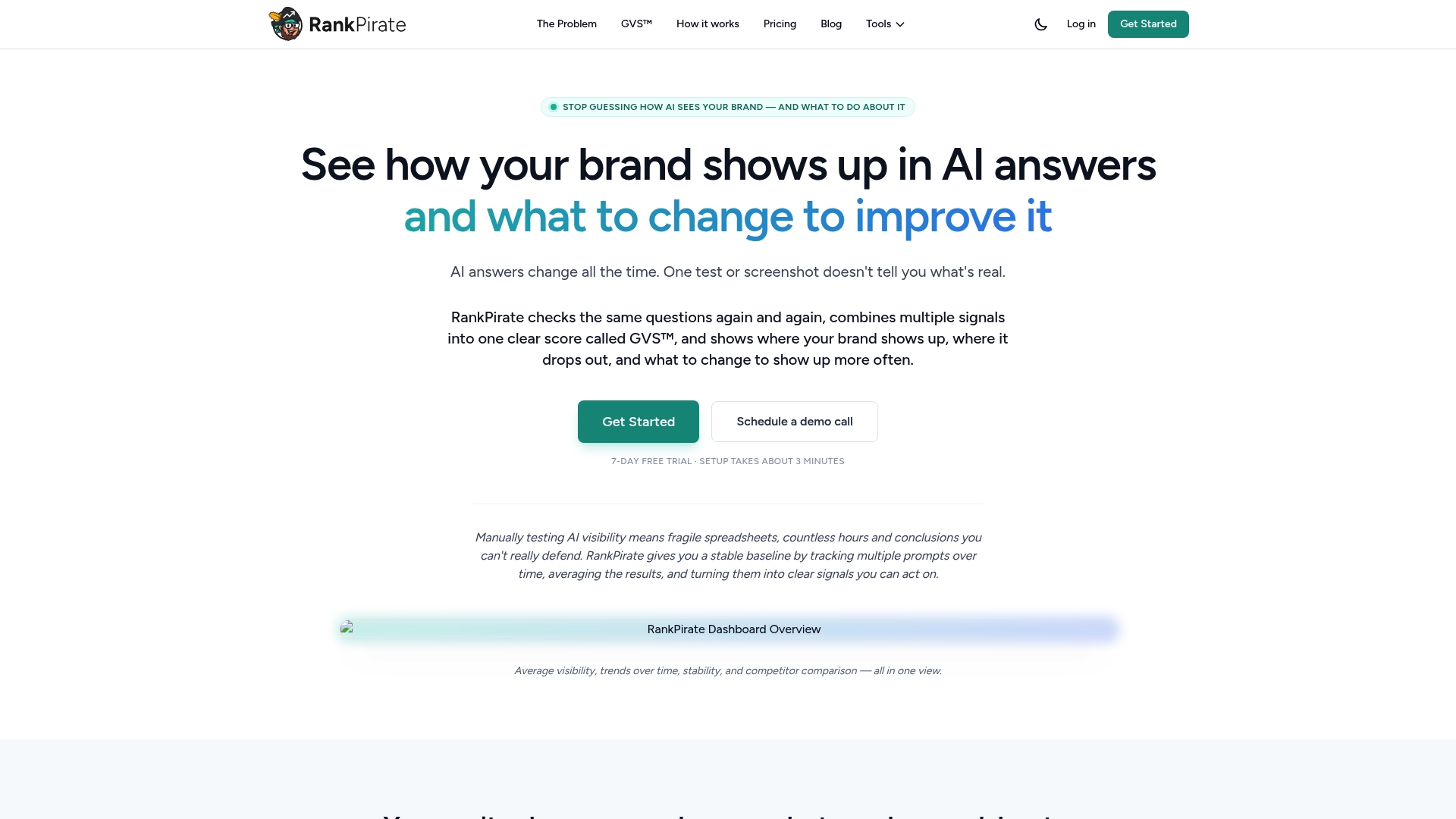
RankPirate’s platform automates exactly that process. Instead of manually checking ChatGPT, Gemini, and Perplexity with spreadsheets and screenshots, you get a single GVS™ score that reflects your brand’s stable, long-term AI visibility across all major engines. Try the free AI visibility checker to see whether AI answers mention your brand today. Read the guide to boosting AI presence for a step-by-step playbook, or revisit why AI search matters if you need to build the internal case for investing in AI visibility now.
Frequently asked questions
What are the most important types of AI search engines for marketers to monitor?
Focus on general-purpose, conversational, and academic engines, as these drive the majority of research queries and brand discovery moments across the buying journey.
How do AI search engines decide which brands and content to cite?
They favor authoritative third-party sources, recent content, and well-structured data. GEO strategies like authority building and machine-readable formatting matter more than traditional keyword optimization.
Is traditional SEO still important with the rise of AI search?
Yes, traditional SEO remains a foundation, but marketers must layer GEO on top to win citations in AI responses. GEO complements traditional SEO rather than replacing it entirely.
What is the biggest visibility risk in AI-driven search?
85.7% of brands are invisible in AI search results because they have not optimized for the source preferences and structural requirements of AI engines.
Can the same strategy work for all types of AI search engines?
No. Training-first, search-first, and hybrid engines each structure data and favor sources differently, so your optimization approach must be tailored to each engine type.