What is AI bias: impact on marketing and SEO in 2026

AI systems powering your marketing campaigns and SEO strategies aren’t as neutral as they seem. Hidden biases in training data and model design create systematic errors that skew ad targeting, reduce brand visibility for certain audiences, and compromise content relevance. For digital marketers and SEO strategists, understanding AI bias isn’t optional anymore. It directly affects campaign performance, audience reach, and long-term brand equity. This guide explains how AI bias arises, its tangible impact on marketing outcomes, the complexities of detection, and practical strategies to audit and reduce bias in your AI-driven workflows.
Table of Contents
- Key takeaways
- What is AI bias and how does it arise?
- The impact of AI bias on digital marketing and SEO
- Nuances and challenges in detecting and mitigating AI bias
- Practical strategies for digital marketers to audit and reduce AI bias
- Optimize your AI-driven marketing with RankPirate
- Frequently asked questions
Key Takeaways
| Point | Details |
|---|---|
| Bias sources | AI bias arises from training data, design choices, and deployment feedback loops that create systematic errors. |
| Three bias types | Data bias, algorithmic bias, and interaction bias each contribute to unfair outcomes in marketing. |
| Marketing and SEO impact | Biased outputs can reduce reach, waste budgets, and damage brand equity in campaigns and search results. |
| Audit and reduce bias | Auditing data diversity, testing across scenarios, and using bias reducing prompts are practical steps to improve fairness and SEO results. |
What is AI bias and how does it arise?
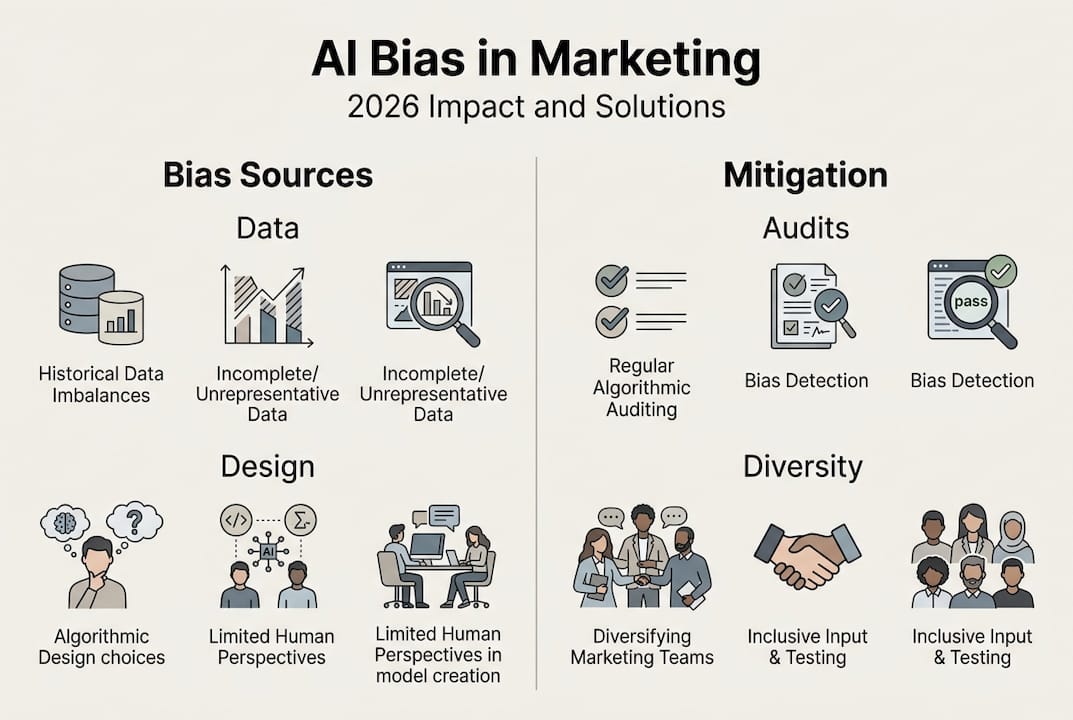
AI bias refers to systematic, repeatable errors in artificial intelligence outputs that produce unfair or skewed results for certain groups. Unlike random mistakes, these errors stem from three primary sources: the data used to train models, the design choices engineers make during development, and the feedback loops created when AI systems interact with real users. Each source introduces distinct problems that compound over time.
Biased training data, model design choices, and deployment feedback loops create the foundation for unfair AI outcomes. Historical data often reflects societal inequities, prejudices, and underrepresentation. When AI models learn from this data, they absorb and perpetuate these patterns. A marketing AI trained primarily on data from one demographic will struggle to understand and serve others effectively. Design flaws emerge when engineers make assumptions about user behavior, prioritize certain metrics over fairness, or fail to test across diverse scenarios.
The garbage-in-garbage-out principle explains why societal inequities embedded in data drive bias propagation. If your training dataset contains 80% content from one geographic region, the AI will naturally favor that region’s language patterns, cultural references, and consumer behaviors. Deployment feedback loops amplify initial biases. When an AI system makes biased recommendations, users interact primarily with those recommendations, generating new data that reinforces the original bias.
Three main bias categories affect digital marketing:
- Data bias: Incomplete, unrepresentative, or historically skewed datasets that exclude important audience segments
- Algorithmic bias: Model design choices that prioritize certain outcomes or optimize for metrics that disadvantage specific groups
- Interaction bias: User behavior patterns that reinforce initial biases through engagement data and feedback signals
Research shows these bias sources interact in complex ways. A model trained on biased data makes biased predictions. Users interact with those predictions, creating new biased data. The cycle continues unless deliberately interrupted.
Pro Tip: Audit your AI training datasets before deployment. Check for demographic representation, geographic diversity, and temporal balance. If your data skews heavily toward any single group or time period, your AI outputs will reflect that imbalance.
Understanding these mechanisms helps marketers identify where bias enters their systems. The free AI visibility checker helps you see how AI answers currently mention your brand, so biased or missing recommendations are easier to spot before you scale tracking.
The impact of AI bias on digital marketing and SEO
AI bias creates measurable damage to marketing performance and SEO outcomes. When AI systems make decisions about ad targeting, content recommendations, or search rankings, biased models systematically disadvantage certain audiences while over-serving others. This isn’t just an ethical concern. It’s a business problem that reduces reach, wastes budget, and damages brand reputation.

Biased AI models cause disproportionate ad targeting and SEO penalties that particularly affect underrepresented groups. An ad targeting algorithm trained on biased data might show high-value product ads primarily to one demographic while showing lower-value offers to others, regardless of actual purchasing intent or capacity. This wastes advertising spend on poorly matched audiences while missing qualified prospects entirely.
SEO suffers when AI-generated content reflects training data biases. Search engines increasingly use AI to evaluate content quality and relevance. If your AI content creation tools produce outputs that ignore or misrepresent certain audiences, search algorithms may rank that content lower for those segments. Brands lose visibility precisely where they need to grow.
McKinsey research highlights AI’s potential to deliver $1.3 trillion in marketing value, but warns that reinforcing stereotypes through biased algorithms risks alienating audiences and damaging long-term brand equity.
Specific marketing impacts include:
- Reduced conversion rates: Mismatched targeting based on stereotypical assumptions rather than actual user intent and behavior
- Brand safety risks: AI-generated content that inadvertently excludes or offends audience segments through biased language or imagery
- Competitive disadvantage: Competitors using less biased systems capture audiences your AI overlooks or misunderstands
- Compliance exposure: Biased targeting may violate fair advertising regulations in certain jurisdictions or industries
The visibility problem extends beyond traditional search. AI answer engines like ChatGPT, Gemini, and Claude increasingly influence purchase decisions. When these systems exhibit bias, brands serving diverse audiences face systematic exclusion from AI-generated recommendations. A study of generative AI found regressive gender stereotypes embedded in outputs, demonstrating how training data biases persist even in advanced models.
Digital marketers must recognize that AI bias isn’t theoretical. It affects which audiences see your ads, how search engines rank your content, and whether AI assistants recommend your brand. The AI brand presence guide explains strategies for maintaining visibility across biased AI systems, while the AI SEO checklist provides actionable steps to audit and improve AI-driven search performance.
Understanding these impacts is the first step. The next challenge is detecting and addressing bias in your own marketing AI systems.
Nuances and challenges in detecting and mitigating AI bias
Identifying and fixing AI bias proves far more complex than simply removing problematic data. Multiple bias types interact, mitigation efforts can backfire, and trade-offs between fairness and accuracy create difficult decisions. Digital marketers need sophisticated approaches that acknowledge these complexities rather than pursuing simplistic solutions.
Interaction bias occurs when humans overtrust AI recommendations and stop questioning outputs. Marketers using AI content tools may accept biased suggestions without critical review, amplifying the bias through publication and promotion. This creates a dangerous feedback loop where biased content performs poorly, but marketers attribute the failure to other factors rather than examining the AI’s underlying assumptions.
Recency bias affects AI search and content recommendation systems. Models trained on recent data may favor newer content regardless of quality or relevance, disadvantaging established brands with strong historical performance. For SEO, this means constantly producing fresh content to maintain visibility, even when existing content better serves user needs.
Tool selection bias emerges from choosing specific AI models or platforms. Large language models exhibit different biases based on their training data and design. A model trained primarily on English-language sources will struggle with multilingual marketing. One optimized for B2C consumer behavior may misunderstand B2B decision-making processes.
Princeton research reveals that targeted debiasing worsens some biases in 31.5% of cases. Attempting to fix one type of bias can inadvertently amplify others. For example, adjusting a model to improve gender representation might reduce accuracy for age-based targeting. This spillover harm makes bias mitigation a delicate balancing act rather than a straightforward fix.
| Bias Type | Common Mitigation | Pros | Cons |
|---|---|---|---|
| Data bias | Diversify training datasets | Improves representation | Expensive, time-consuming, may reduce accuracy |
| Algorithmic bias | Adjust model parameters | Fast implementation | Risk of spillover harm to other metrics |
| Interaction bias | Human oversight protocols | Catches errors before publication | Slows workflow, requires trained reviewers |
| Recency bias | Temporal data balancing | Maintains historical context | May miss emerging trends |
| Tool selection bias | Multi-model testing | Identifies model-specific weaknesses | Increases complexity and cost |
Prompting methods often prove more effective than retraining entire models. Carefully designed prompts can guide AI toward fairer outputs without the expense and risk of model modification. This makes prompt engineering a critical skill for marketers working with AI content tools.
UNESCO reports persistent regressive gender stereotypes in generative AI despite years of debiasing efforts. This highlights how deeply embedded biases resist simple fixes. Marketers must adopt continuous monitoring rather than one-time corrections.
Pro Tip: Never rely on a single bias mitigation technique. Combine diverse training data, ethical prompt design, and human review to create multiple layers of protection against biased outputs.
The AI search brand visibility guide explains how bias affects brand presence in AI-generated answers and recommendations. Understanding these detection challenges prepares marketers to implement practical solutions that acknowledge complexity while delivering measurable improvements.
Practical strategies for digital marketers to audit and reduce AI bias
Reducing AI bias requires systematic approaches that combine technology, process, and human judgment. Digital marketers can implement practical strategies today that improve fairness, maintain accuracy, and enhance SEO performance. These methods work across content creation, ad targeting, and search optimization.
Regular auditing forms the foundation of bias reduction. Auditing AI content and using ethical prompting prevents audience alienation and SEO penalties while supporting E-E-A-T principles. Establish a review cadence that examines AI outputs before publication, looking specifically for representation gaps, stereotypical language, and audience exclusion.
Step-by-step bias auditing process:
- Baseline assessment: Document current AI outputs across different audience segments, noting representation patterns and language choices
- Demographic analysis: Test how AI responds to prompts mentioning different demographics, comparing output quality and relevance
- Competitive benchmarking: Compare your AI-generated content against competitors and human-created content for bias indicators
- User feedback integration: Collect and analyze audience responses to identify bias blind spots your internal review missed
- Metric tracking: Monitor engagement rates, conversion rates, and SEO performance across audience segments to detect systematic disparities
- Iterative refinement: Adjust prompts, datasets, and review processes based on audit findings, then re-test to measure improvement
Diverse, inclusive datasets improve model fairness from the ground up. When training or fine-tuning AI systems, prioritize data sources that represent your full target audience. This includes geographic diversity, demographic representation, and behavioral variety. A marketing AI trained only on data from major metropolitan areas will fail in rural markets.
Ethical prompt design influences AI output quality significantly. Structure prompts to explicitly request inclusive language, diverse examples, and balanced perspectives. Instead of “Write an ad for our product,” use “Write an ad that appeals to diverse audiences including [specific segments], avoiding stereotypical assumptions about [relevant characteristics].” This guidance helps AI systems produce fairer outputs without model retraining.
Combine human review with automated bias detection tools. Humans catch context-dependent bias that automated tools miss, while automation scales the review process beyond what manual checking allows. Train your marketing team to recognize common bias patterns: stereotypical imagery, exclusionary language, assumptions about audience capabilities or interests based on demographics.
Common pitfalls to avoid:
- Assuming AI neutrality without verification
- Accepting AI outputs without critical review
- Using homogeneous training data
- Optimizing solely for engagement metrics without fairness considerations
- Implementing one-time fixes instead of continuous monitoring
- Ignoring user feedback about representation and inclusivity
Transparency and continuous monitoring sustain long-term improvements. Document your bias mitigation efforts, share them with stakeholders, and establish regular review cycles. AI models drift over time as they encounter new data, so bias can reappear even after successful mitigation.
Pro Tip: Embed E-E-A-T principles (Experience, Expertise, Authoritativeness, Trustworthiness) in your AI workflows by having subject matter experts review AI outputs for accuracy and appropriateness before publication. This human layer catches bias while improving overall content quality.
The AI prompt analysis guide provides detailed frameworks for designing prompts that minimize bias introduction. The AI search optimization checklist includes specific audit steps for evaluating bias in AI-generated SEO content. For deeper understanding of how AI systems evaluate brands, review AI visibility explained.
Implementing these strategies requires commitment and resources, but the payoff extends beyond fairness. Less biased AI systems reach broader audiences, perform better across diverse segments, and build stronger brand equity over time.
Optimize your AI-driven marketing with RankPirate
Navigating AI bias while maintaining strong SEO performance and brand visibility requires specialized tools and expertise. RankPirate helps digital marketers monitor how AI systems represent their brands across different prompts, audiences, and contexts. Our platform tests your brand’s presence in AI-generated answers from ChatGPT, Gemini, and Claude, revealing where bias might be limiting your visibility.
Try the free AI visibility checker to see how AI answers currently mention your brand, including biased or missing recommendations. The AI SEO checklist provides actionable steps to audit your AI-driven content for fairness and effectiveness. Our AI brand presence guide explains strategies for maintaining visibility even when AI systems exhibit bias. RankPirate’s GVS™ score aggregates your AI visibility across multiple models and prompts, giving you a clear, actionable metric for tracking improvements over time.
Frequently asked questions
What is AI bias?
AI bias means systematic, repeatable errors in AI outputs that produce unfair results for certain groups. It arises from biased training data, flawed model design, or deployment feedback loops. Unlike random mistakes, AI bias creates consistent patterns of disadvantage that affect decision-making, content relevance, and recommendation quality in marketing applications.
How does AI bias affect digital marketing campaigns?
Bias causes ads to target stereotypical or limited audience segments, reducing campaign effectiveness and wasting budget. Brands lose visibility among underrepresented groups who never see relevant ads or content. This leads to lower conversion rates, missed revenue opportunities, and potential brand reputation damage when audiences recognize exclusionary patterns.
What are effective ways to reduce AI bias in SEO?
Regularly audit AI-generated content for fairness, representation gaps, and stereotypical language before publication. Use ethical prompt design that explicitly requests inclusive perspectives and diverse examples. Diversify training datasets to represent your full target audience. Combine automated bias detection tools with human expert review to catch context-dependent issues automation misses.
Can AI bias ever be completely eliminated?
Complete elimination remains difficult due to complex societal factors embedded in training data and inherent trade-offs between fairness and accuracy. The goal is minimizing bias impact while maintaining model performance. Continuous monitoring and iterative refinement work better than pursuing perfect solutions. Focus on measurable improvement across audience segments rather than absolute bias elimination.