Understanding AI responses: A guide for digital marketers

Ask three AI models the same question and you’ll get three different answers. Test the same prompt twice in ChatGPT and the results shift. This inconsistency frustrates marketers trying to optimize for AI search, but it’s not a bug. It’s how these systems work. Understanding the mechanics behind AI-generated search responses transforms confusion into strategy. This guide breaks down how AI creates responses, why variability matters, and what digital marketers must do to capture visibility in this unpredictable landscape.
Table of Contents
- Key takeaways
- How AI generates responses in search
- Decoding AI response variability and pattern focus
- Optimizing content and brand presence for AI responses
- Managing AI limitations and leveraging human oversight
- Boost your brand’s AI visibility with RankPirate solutions
- Frequently asked questions
Key Takeaways
| Point | Details |
|---|---|
| Pattern focus | Exact wording varies across AI outputs, so marketers should track recurring concepts and structures rather than chasing specific phrases. |
| GEO framework | Apply the GEO framework Generation, Entity, Order to prioritize answer ready content, schema markup, brand authority, and clear entity relationships. |
| Schema and structure | Schema markup helps AI models understand page structure and locate concise answers. |
| Brand authority | High quality citations and brand mentions strengthen credibility signals that guide AI responses. |
| Human oversight | Human oversight remains essential for edge cases and strategic decisions beyond automated outputs. |
How AI generates responses in search
AI responses in search are generated by Large Language Models through probabilistic synthesis. These systems don’t retrieve pre-written answers from a database. They construct responses word by word based on statistical patterns learned from training data. When you ask a question, the model predicts the most likely next word, then the next, building a coherent response through billions of probability calculations.
Retrieval Augmented Generation (RAG) adds another layer. LLMs learn from vast data and use RAG to ground responses in real-time web content. The system searches current information, retrieves relevant passages, and weaves them into generated text. This combination of trained knowledge and live retrieval creates more accurate, timely answers than pure generation alone.
The training process shapes everything. Models consume massive text corpora, learning language patterns, facts, and relationships between concepts. They develop broad knowledge but no perfect memory of specific sources. When generating responses, they synthesize information rather than quote directly, which explains why you see conceptual consistency but linguistic variation across outputs.
Key characteristics of AI response generation:
- Probabilistic word-by-word construction creates natural variability
- RAG integration grounds responses in current web content
- Training data breadth enables diverse topic coverage
- Synthesis approach produces paraphrased rather than quoted information
- Real-time retrieval introduces additional response variation
This architecture means uncertainty is built into every response. The same prompt can trigger different retrieval results, alternative word choices, or varied information synthesis. Understanding this helps marketers recognize why AI search matters for brand visibility and why traditional SEO approaches fall short.
Pro Tip: Track which concepts and entities appear consistently across multiple AI responses to your target queries. These patterns reveal what the model considers authoritative and relevant, guiding your content optimization priorities.
Decoding AI response variability and pattern focus
Responses exhibit less than 1% chance to show identical lists from the same prompt. Order consistency drops even lower. This extreme variability makes exact phrase tracking worthless for AI optimization. Marketers who chase specific wording waste resources on an impossible target.

The solution lies in pattern recognition. While exact outputs vary, structural and conceptual patterns maintain about 75% consistency. The same brands, topics, and information types appear repeatedly, just expressed differently. Smart marketers track these patterns rather than specific phrases.
GEO (Generation, Entity, Order) provides a framework for pattern-based optimization:
- Prioritize answer-ready content that directly addresses common questions
- Implement schema markup to help AI models understand your content structure
- Build brand authority through high-quality citations and mentions
- Establish clear entity relationships between your brand and relevant topics
- Maintain content recency with regular updates and fresh information
- Use inverted pyramid structure with conclusions first
- Create original research that earns citations from authoritative sources
- Optimize for semantic relevance rather than keyword density
- Build comprehensive topic coverage that demonstrates expertise
- Monitor competitor patterns to identify visibility gaps
Comparing approaches reveals why patterns matter:
| Approach | Tracking Method | Success Rate | Strategic Value |
|---|---|---|---|
| Exact phrase matching | Monitor specific word sequences | Less than 1% | Minimal, wastes resources |
| Pattern recognition | Track entity mentions and concepts | 75% consistency | High, guides optimization |
| Order tracking | Monitor list position | Less than 0.5% | None, too variable |
| Conceptual presence | Measure topic association | 70-80% stability | Maximum, actionable insights |
This data shows why monitoring AI answers boosts brand visibility. You’re not trying to force specific outputs. You’re building consistent conceptual associations that surface across varied expressions.
Focus areas for pattern analysis:
- Entity co-occurrence (which brands appear together)
- Topic clustering (how concepts group in responses)
- Information hierarchy (what details appear first)
- Source attribution patterns (which sites get cited)
- Question-answer alignment (how queries map to responses)
Pro Tip: Conduct quarterly pattern audits instead of daily phrase checks. Aggregate data over 50-100 prompts to identify reliable trends. This approach surfaces actionable insights while filtering out meaningless variation.
Optimizing content and brand presence for AI responses
The 10-step GEO framework translates pattern insights into concrete optimization tactics. Optimization methodologies prioritize answer-ready content, schema, and brand authority across structured implementation phases. Each step builds on the previous, creating cumulative visibility improvements.
Core optimization tactics in priority order:
- Structure content with direct answers in opening paragraphs
- Deploy schema markup for articles, products, and organizations
- Earn citations from authoritative industry publications
- Establish clear brand-topic entity relationships through consistent messaging
- Update content quarterly to maintain recency signals
- Create original research studies that generate natural backlinks
- Build comprehensive resource hubs that demonstrate topic expertise
- Optimize semantic relevance through natural language and related concepts
- Monitor competitor visibility patterns to identify gaps
- Test prompt variations to understand coverage across query types
Performance data reveals concentration at the top:
| Brand Tier | AI Mention Share | Average Citations | Visibility Score |
|---|---|---|---|
| Top 3 brands | 61-78% | 12-18 per query | 85-95 |
| Brands 4-10 | 18-32% | 4-8 per query | 55-75 |
| Brands 11-20 | 4-9% | 1-3 per query | 25-45 |
| Beyond top 20 | Less than 3% | Less than 1 | Below 20 |
Empirical benchmarks show top 3 brands capture the majority of AI visibility. This concentration means breaking into top mentions requires aggressive optimization. Original research provides the fastest path, boosting citations more than 3x compared to curated content.
Off-page signals matter as much as on-page optimization. AI models weight authoritative citations heavily when constructing responses. A single mention in a respected industry publication can shift your brand into consideration sets across dozens of related queries. Focus on earning these citations through:
- Publishing proprietary research and data studies
- Contributing expert commentary to journalist requests
- Speaking at industry conferences that generate coverage
- Partnering with established brands for co-marketing initiatives
- Building relationships with influential industry analysts
The AI search optimization checklist provides detailed implementation steps for each tactic. Start with answer-first content restructuring and schema deployment for quick wins, then layer in citation-building and original research for sustained growth.
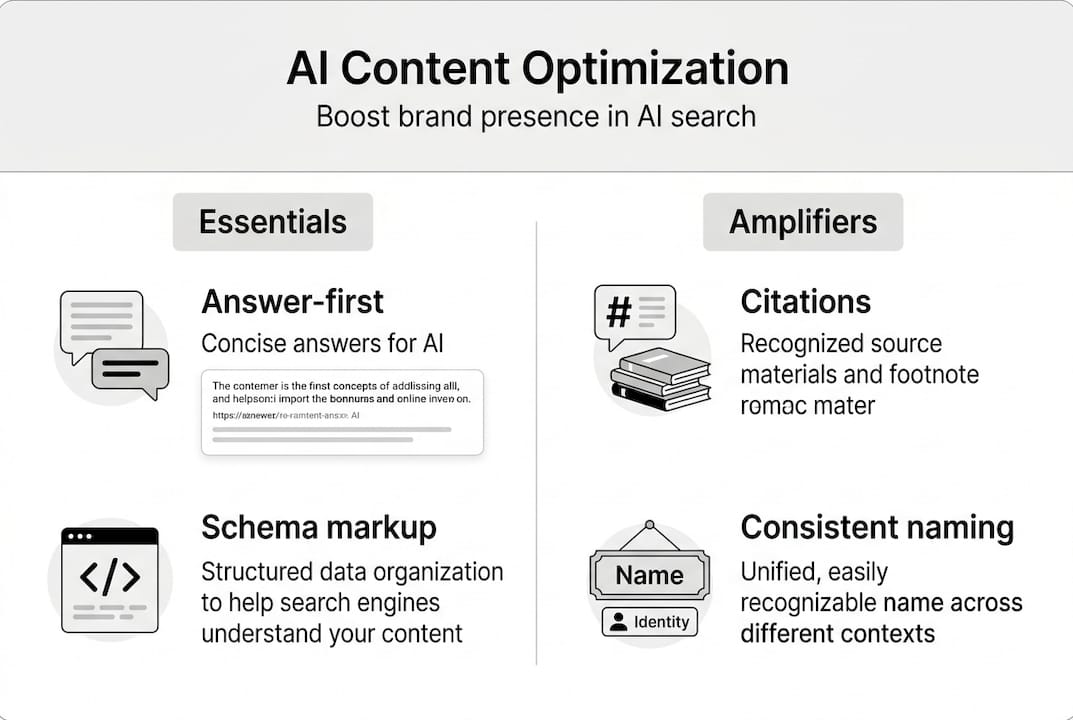
Pro Tip: Maintain consistent brand naming and descriptor phrases across all digital properties. AI models build entity understanding from repeated exposure to identical patterns. Variations in how you describe your brand dilute recognition and reduce mention probability. Create a guide to boost AI brand presence for your team to ensure messaging consistency.
Managing AI limitations and leveraging human oversight
AI models improvise when faced with edge cases, producing errors that undermine marketing credibility. Common failure scenarios include:
- Safety-critical queries where incorrect advice causes harm
- Jurisdiction-specific questions requiring precise legal knowledge
- Ambiguous prompts with multiple valid interpretations
- Rapidly evolving topics where training data lags current reality
- Niche technical subjects with limited training examples
- Brand comparisons requiring nuanced competitive understanding
These limitations create serious risks for marketers who deploy AI content without verification. LLMs improvise in edge cases leading to errors in specialized domains. A shocking 52% of social media AI content fails quality checks, yet many marketers publish without human review.
“Despite 87% of marketers expressing confidence in AI-generated content, research shows 51-91% of marketing materials produced by AI contain factual errors, misleading claims, or tone mismatches that damage brand credibility.”
This confidence gap creates vulnerability. CMOs shouldn’t trust the AI confidence boom without implementing rigorous validation processes. The solution requires systematic human oversight at critical checkpoints.
Best practices for safe AI content deployment:
- Assign subject matter experts to review all AI-generated claims
- Disclose AI involvement in content creation to maintain transparency
- Add explicit clarifications for edge cases and exceptions
- Run A/B tests comparing AI content against human-written alternatives
- Implement fact-checking protocols before publication
- Monitor performance metrics to catch quality issues early
- Restrict AI use to informational content, not strategic decisions
AI struggles particularly with creative strategy and complex problem solving. These tasks require contextual understanding, stakeholder management, and strategic trade-offs that current models can’t navigate. Use AI for research synthesis, draft generation, and routine content production. Reserve strategic decisions, creative direction, and sensitive communications for human judgment.
Start AI integration in low-risk workflows where errors cause minimal damage. Test thoroughly, measure results, and expand gradually as you build confidence in specific use cases. Types of AI-generated content vary dramatically in risk level. Social media captions carry less risk than product descriptions or legal disclaimers.
The goal isn’t eliminating AI from marketing workflows. It’s deploying AI strategically where it adds value while maintaining human oversight where judgment matters. This balanced approach captures efficiency gains without sacrificing quality or credibility.
Boost your brand’s AI visibility with RankPirate solutions
Implementing GEO strategies requires consistent testing across multiple AI models and prompts. Manual tracking through spreadsheets and screenshots creates unreliable data that misses critical patterns. RankPirate automates this process, running systematic prompt tests across ChatGPT, Gemini, and Claude to measure your brand’s visibility comprehensively.
The platform aggregates results into a single AI Visibility Score that reflects stable, long-term presence rather than isolated moments. You’ll see exactly where your brand appears, where competitors dominate, and which content adjustments drive the biggest visibility gains. Try the free AI visibility checker for a quick read on how AI answers mention your brand today. Ready to improve your AI search visibility? Start with the comprehensive guide to boost AI brand presence, then track weekly with RankPirate.
Frequently asked questions
What is Retrieval Augmented Generation (RAG) in AI responses?
RAG combines trained language models with real-time web content retrieval to generate accurate, current responses. The system searches relevant information, extracts key passages, and synthesizes them into coherent answers grounded in up-to-date sources.
Why do AI responses vary so much between queries?
AI models construct responses probabilistically, predicting each word based on context and training patterns. Small variations in prompts, retrieval results, or generation parameters create different outputs. This variability is fundamental to how these systems work, not a flaw.
What are the most effective GEO optimization tactics?
Prioritize answer-first content structure, implement schema markup, and build brand authority through citations. Original research provides the fastest visibility gains, boosting citation rates more than 3x compared to curated content. Focus on consistent brand messaging across all digital properties.
What risks come from overtrusting AI-generated content?
AI models produce factual errors, misleading claims, and tone mismatches in 51-91% of marketing content despite high marketer confidence. Edge cases involving safety, jurisdiction, or ambiguity trigger improvisation and errors. Always implement human review before publishing AI-generated materials.
How should marketers test AI-generated content effectively?
Start AI integration in low-risk workflows like social media captions or blog outlines. Run A/B tests comparing AI content against human-written alternatives. Assign subject matter experts to review factual claims. Monitor performance metrics closely and expand usage gradually as you validate quality and effectiveness.