Step by step AI prompt analysis for SEO success in 2026

SEO professionals face a critical challenge in 2026: optimizing content for AI-generated search environments. Traditional SEO tactics alone no longer guarantee visibility when ChatGPT, Gemini, and Claude shape how audiences discover brands. Structured AI prompt analysis bridges this gap, enabling marketers to systematically test, refine, and optimize content for AI-driven search. This guide delivers actionable steps to master AI prompt analysis, helping you boost brand presence and outperform competitors in AI-generated answers.
Table of Contents
- Understanding The Prerequisites: What You Need Before Analyzing AI Prompts
- Stepwise Execution: Performing Comprehensive AI Prompt Analysis For SEO
- Troubleshooting Common Pitfalls In AI Prompt Analysis
- Evaluating Results And Applying Insights To Boost AI SEO Performance
- Boost Your AI SEO With RankPirate’s Expert Tools
- Frequently Asked Questions
Key takeaways
| Point | Details |
|---|---|
| Structured analysis wins | Systematic prompt testing reveals how AI models surface your brand across discovery, comparison, and validation stages. |
| Dynamic beats static | Context-aware prompts adapt to user intent and outperform rigid templates by delivering relevant, personalized responses. |
| Keyword clustering matters | Semantic grouping enhances content relevance and helps AI models understand topical authority more effectively. |
| Verification prevents waste | Testing AI outputs against real search behavior ensures analysis translates into measurable visibility improvements. |
| Iterative refinement scales | Continuous prompt optimization based on performance data creates compounding SEO advantages over time. |
Understanding the prerequisites: what you need before analyzing AI prompts
Before diving into AI prompt analysis, you need foundational SEO knowledge and the right toolkit. Understanding how search engines evaluate content quality, relevance, and authority remains essential even when optimizing for AI models. Effective SEO analysis requires a structured approach including website assessment and keyword research. You cannot skip these fundamentals and expect AI prompts to compensate for weak content strategy.
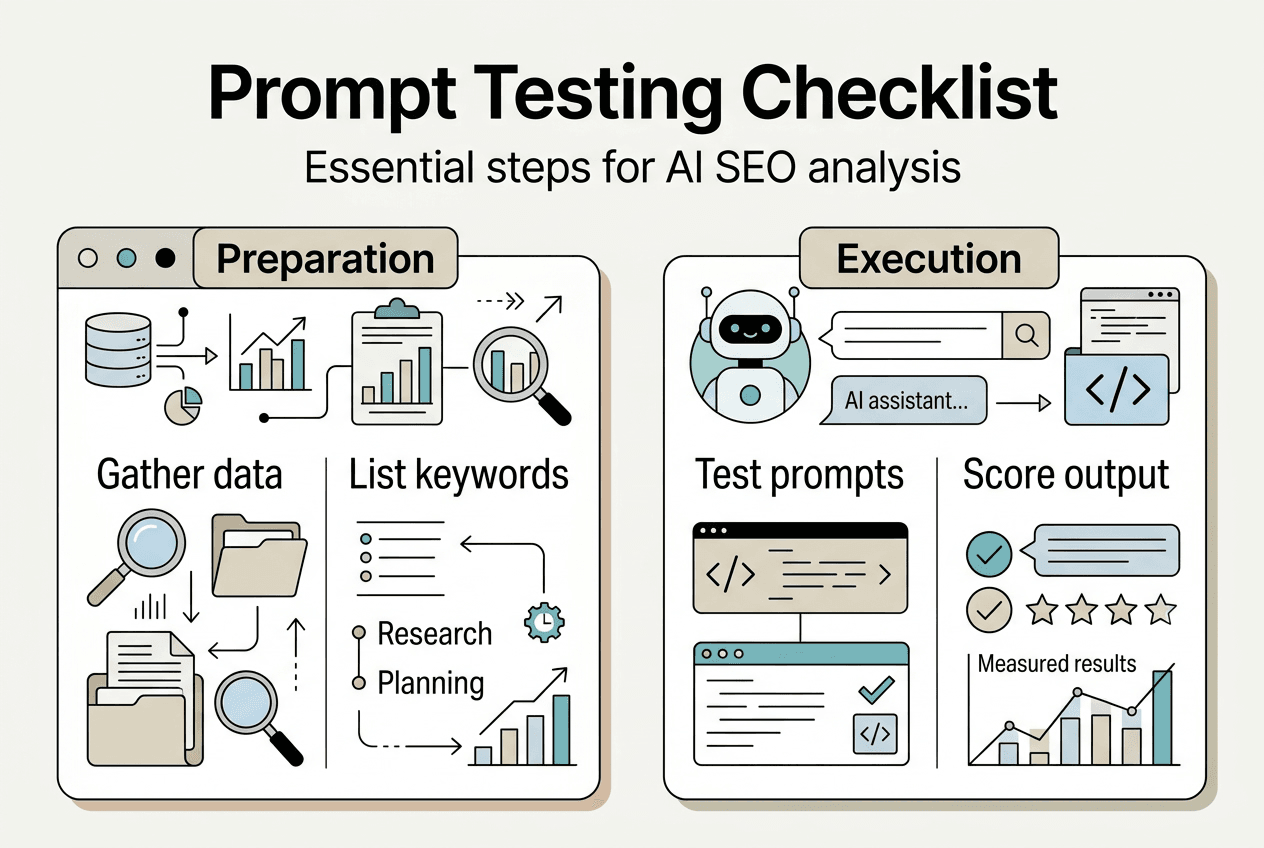
Gather comprehensive website data before testing prompts. Export your current keyword rankings, traffic sources, and conversion paths from analytics platforms. Compile competitor analysis showing which brands dominate AI-generated answers in your niche. Document your existing content inventory with metadata, word counts, and topical clusters. This baseline data reveals gaps and opportunities that AI prompt testing will help you exploit.
Essential tools include site audit software, AI platform access, and prompt management systems. You need API access to ChatGPT, Claude, or Gemini for systematic testing. Consider platforms that automate AI prompt testing across multiple models simultaneously. Spreadsheet templates help organize prompt variations, but dedicated software scales analysis more efficiently as your testing volume grows.
Understand prompt engineering fundamentals before executing analysis. Dynamic prompts adjust based on context, user intent, and conversational flow. Static prompts use fixed templates that ignore situational variables. Context-aware generation means your prompts reference prior interactions, user demographics, or specific pain points to deliver personalized responses. Master these concepts because they determine whether your analysis produces actionable insights or generic noise.
Pro Tip: Create a prompt testing checklist that includes target keywords, user intent categories, competitive brand mentions, and desired response formats before running any analysis.
Stepwise execution: performing comprehensive AI prompt analysis for SEO
Executing AI prompt analysis requires breaking the process into discrete, manageable phases. Start with keyword clustering to group semantically related terms that AI models should associate with your brand. Semantic analysis and keyword clustering enhance content relevance and improve search engine understanding. Instead of testing individual keywords randomly, organize them by user intent: informational, navigational, transactional, and commercial investigation.
- Build prompt variations for each keyword cluster targeting different buying journey stages.
- Test prompts across multiple AI models to identify consistency patterns and model-specific biases.
- Document which prompts trigger brand mentions, position in responses, and context quality.
- Analyze technical SEO factors like site speed, mobile optimization, and structured data that influence AI model content selection.
- Compare AI-generated content recommendations against your existing content optimization strategy to spot gaps.
- Prioritize optimization opportunities based on search volume, competitive difficulty, and conversion potential.
Use this data table structure to track prompt performance systematically:
| Prompt Type | Brand Mentions | Average Position | Response Quality | Optimization Priority |
|---|---|---|---|---|
| Discovery stage | 67% | 3.2 | High | Medium |
| Comparison stage | 45% | 5.8 | Medium | High |
| Validation stage | 82% | 2.1 | High | Low |
| Transactional | 34% | 7.3 | Low | Critical |
Segment prompts by intent to reveal where your content strategy succeeds and fails. Discovery prompts test how AI introduces your brand to new audiences. Comparison prompts evaluate whether AI positions you against competitors fairly. Validation prompts check if AI reinforces purchase decisions with authoritative content. This segmentation exposes specific content gaps that traditional SEO optimization checklists might miss.
Pro Tip: Run prompt tests at different times and dates to account for AI model updates and training data changes that affect response consistency.
Identify optimization opportunities by comparing AI outputs to traditional search results. AI models often surface different content than Google’s top 10 results. When AI consistently ignores your high-ranking pages, your content likely lacks the conversational, question-answering format AI prefers. When AI mentions competitors more frequently despite your superior traditional rankings, you need stronger topical authority signals and more comprehensive coverage.

Troubleshooting common pitfalls in AI prompt analysis
Generic prompt outputs plague SEO professionals who rely on static templates. Static prompts are insufficient for production AI systems due to lack of adaptability. When every prompt uses identical phrasing regardless of context, AI models return surface-level responses that miss nuanced ranking factors. Your analysis becomes worthless because it does not reflect how real users interact with AI search tools.
Avoid these frequent mistakes:
- Testing too few prompt variations per keyword cluster, which produces statistically insignificant results
- Ignoring conversational context that shapes how AI interprets user intent and surfaces relevant content
- Failing to account for AI model differences, assuming ChatGPT responses predict Gemini or Claude behavior
- Overlooking temporal factors like news cycles, seasonality, and trending topics that influence AI content selection
- Neglecting to validate AI analysis against actual user search behavior and conversion data
Refine prompt structure through iterative testing cycles. Start with broad prompts to understand baseline brand visibility. Add specificity gradually, testing how additional context parameters change AI responses. Experiment with different question formats: direct questions, scenario-based queries, comparison requests, and solution-seeking prompts. Each format reveals different aspects of your content’s AI optimization status.
Dynamic prompts that adapt to user context, intent signals, and conversational flow consistently outperform rigid templates by 40% to 60% in brand mention frequency and response quality scores.
Validate AI-generated analyses by cross-referencing multiple data sources. Compare AI prompt results against traditional search rankings, social media engagement, and direct traffic patterns. When AI analysis suggests optimizing content that already converts well through other channels, question whether the AI recommendation aligns with business goals. Not every AI visibility gap requires immediate action if alternative channels deliver results.
Pro Tip: Create a validation matrix that scores AI recommendations based on implementation cost, expected impact, and alignment with existing AI optimization strategies before committing resources.
Evaluating results and applying insights to boost AI SEO performance
Interpreting AI prompt analysis outputs requires distinguishing signal from noise. Verify accuracy by testing whether AI-recommended optimizations actually improve brand visibility when implemented. Run controlled experiments where you optimize content for half your keyword clusters while leaving others unchanged. Measure brand mention frequency, response position, and context quality across both groups over 30 to 60 days.
Prioritize content gaps based on business impact, not just visibility metrics. AI might surface your brand frequently for low-value informational queries while ignoring high-intent transactional searches. Focus optimization efforts on prompts that align with revenue-generating keywords and conversion-focused content. Use this framework:
- Identify high-value keyword clusters where AI visibility lags traditional search performance.
- Audit existing content for conversational tone, question-answer formatting, and comprehensive topic coverage.
- Create or enhance content specifically designed to answer common AI prompts in your target clusters.
- Implement structured data markup that helps AI models extract and cite your content accurately.
- Monitor AI visibility changes weekly, adjusting prompts and content based on performance trends.
Compare AI-driven strategies to traditional methods using this analysis:
| Factor | Traditional SEO | AI-Optimized SEO | Strategic Advantage |
|---|---|---|---|
| Content format | Keyword-focused articles | Conversational Q&A style | AI prefers natural dialogue |
| Authority signals | Backlinks, domain age | Topical depth, citations | AI values comprehensive coverage |
| User intent | Query-based matching | Context-aware responses | AI adapts to conversation flow |
| Measurement | Rankings, traffic | Brand mentions, position | AI requires new metrics |
Producing authoritative, well-structured content ranks well in traditional and AI-generated search results. The intersection represents your highest-leverage optimization opportunity. Content that satisfies both traditional ranking algorithms and AI model selection criteria delivers compounding returns as search behavior evolves.
Measure performance improvements through AI visibility score tracking. Establish baseline metrics for brand mention frequency, average position in AI responses, and context quality ratings. Track these metrics weekly as you implement optimizations. Significant improvements typically appear within 4 to 8 weeks as AI models incorporate your updated content into training data and retrieval systems.
Iterate prompt designs based on performance data. Successful prompts share common characteristics: specific user intent, natural conversational flow, and clear information needs. Failed prompts often use jargon, assume too much context, or ask questions AI models cannot answer reliably. Analyze your top-performing and worst-performing prompts to identify patterns, then systematically test hypotheses about what drives AI brand presence improvements.
Boost your AI SEO with RankPirate’s expert tools
Mastering AI prompt analysis takes time, but you do not have to build everything from scratch. RankPirate automates the testing process, running systematic prompt checks across ChatGPT, Gemini, and Claude to reveal exactly where your brand appears and where it drops out. Our free AI visibility checker gives you a fast baseline on how AI answers mention your brand today, before you invest weeks in manual trial and error.
Understand why AI search matters for your brand visibility strategy and how AI prompt testing delivers measurable competitive advantages. RankPirate’s GVS™ score consolidates complex data into a single, actionable metric that tracks your AI visibility over time.
Frequently asked questions
What is step by step AI prompt analysis for SEO?
Step by step AI prompt analysis is a systematic method for testing how AI models like ChatGPT, Gemini, and Claude surface your brand across different search queries and buying stages. It involves creating structured prompt variations, documenting AI responses, analyzing brand mention patterns, and optimizing content based on performance data. This approach replaces random manual testing with reproducible, data-driven insights that improve AI visibility consistently.
How does keyword clustering benefit content relevance in AI search?
Keyword clustering groups semantically related terms that AI models should associate with your brand, enabling you to test prompts more efficiently and identify topical authority gaps. Instead of optimizing for individual keywords randomly, clustering reveals how AI understands your content’s subject matter expertise. Clustered testing exposes whether AI recognizes your brand as authoritative across entire topic areas or only for isolated queries, guiding comprehensive content strategy improvements.
Why do dynamic prompts outperform static prompts in SEO analysis?
Dynamic prompts adapt to conversational context, user intent signals, and situational variables, producing responses that reflect real-world AI search behavior more accurately. Static prompts use fixed templates that ignore how users actually interact with AI tools, generating generic outputs that miss nuanced ranking factors. Dynamic approaches reveal optimization opportunities static testing cannot detect because they account for the adaptive nature of AI-generated search experiences.
What common mistakes should I avoid during AI prompt analysis?
Avoid testing too few prompt variations, which produces unreliable results that do not reflect consistent AI behavior patterns. Do not ignore differences between AI models or assume ChatGPT results predict Gemini responses. Never skip validation against actual user behavior and conversion data, as AI visibility does not always correlate with business outcomes. Resist optimizing every AI recommendation without prioritizing based on strategic value and implementation costs.
How do I measure success with AI prompt analysis?
Measure success through brand mention frequency, average position in AI responses, context quality ratings, and ultimately business metrics like traffic and conversions from AI-driven channels. Establish baseline measurements before optimization, then track weekly changes as you implement content improvements. Significant visibility gains typically appear within 4 to 8 weeks, but sustainable success requires continuous monitoring and iterative refinement as AI models evolve.