What is AI positioning? A guide to boosting brand visibility

Your brand ranks on page one of Google. Congratulations. Now ask ChatGPT who the best solution in your category is, and watch your brand disappear from the answer entirely. That gap is not a fluke. It reflects a structural shift in how people discover brands. AI-generated answers now influence buying decisions at every stage, from discovery to final validation, and traditional SEO rankings do not automatically translate into AI citations. This guide breaks down exactly what AI positioning means, how it differs from SEO, GEO, and AEO, which metrics actually matter, and what steps you can take right now to make your brand show up where it counts.
Table of Contents
- AI positioning explained: Definition and core concepts
- How AI positioning compares with SEO, GEO, and AEO
- The key metrics and signals that drive AI positioning
- AI positioning strategies: How to optimize your brand’s presence
- Why most marketers misunderstand AI positioning (and how to get ahead)
- Accelerate your brand’s AI positioning with RankPirate
- Frequently asked questions
Key Takeaways
| Point | Details |
|---|---|
| AI positioning defined | It is the practice of influencing how AI engines select and cite brands in their responses. |
| Metrics that matter | Share of voice, brand authority, and citation rates are vital AI positioning signals. |
| GEO and AEO synergy | Combining generative and answer engine techniques maximizes brand presence in AI outputs. |
| Actionable strategies | Proactive monitoring and targeted optimization boost AI-driven brand visibility. |
AI positioning explained: Definition and core concepts
AI positioning is the strategic practice of influencing how AI engines select, cite, and present your brand when responding to user prompts. It is not about ranking a web page. It is about shaping the signals, authority, and context that large language models draw on when constructing their answers.
To understand it clearly, you need to separate three related but distinct concepts:
- Generative Engine Optimization (GEO): Focuses on getting your brand cited as a source within AI-generated content. Think of it as earning a reference in an AI’s answer.
- Answer Engine Optimization (AEO): Focuses on structuring content so AI systems pull it directly as a featured answer or snippet.
- AI positioning: Operates at the brand level. It orchestrates both GEO and AEO signals to build consistent, authoritative presence across multiple AI platforms simultaneously.
As the GEO overview explains, GEO and AEO overlap with AI positioning, but the key distinction is that AI positioning emphasizes brand-level authority rather than page-level optimization.
Why does this matter for share of voice? Because AI models do not return ten blue links. They return one synthesized answer. If your brand is not embedded in the training data, cited sources, and contextual signals that model draws on, you simply do not exist in that response.
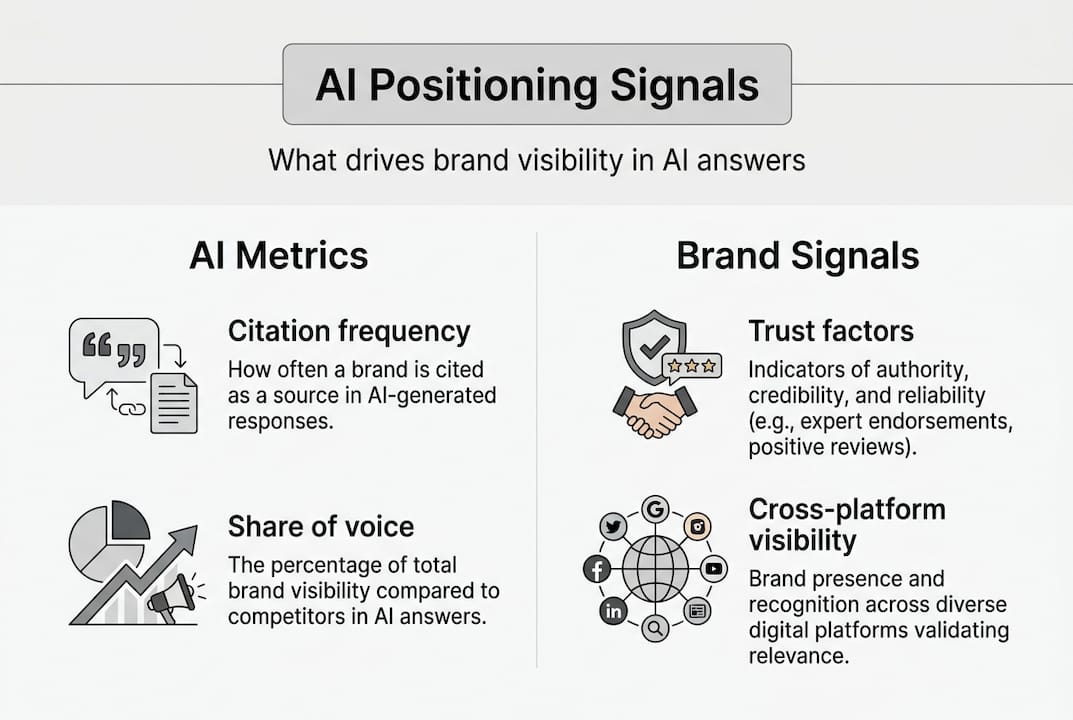
AI positioning also connects directly to brand trust. When an AI consistently names your brand in relevant answers, it signals authority to the user before they even visit your site. That kind of pre-visit credibility is something no keyword ranking can replicate.
Pro Tip: Build your Google visibility first. It remains the foundation that many AI citation systems rely on. Once that baseline is solid, tailor your content signals specifically for ChatGPT, Gemini, and Claude, since each platform weighs authority cues differently.
How AI positioning compares with SEO, GEO, and AEO
With the basics covered, let’s clarify how AI positioning stands apart from and complements familiar optimization strategies.
SEO is still foundational. Without strong domain authority and indexed content, your chances of appearing in AI citations drop significantly. But SEO alone is not enough. It was designed for a world where users click links. AI-driven channels skip that step entirely.
| Strategy | Primary focus | Key strength | Best use case |
|---|---|---|---|
| SEO | Page ranking in search engines | Traffic and discoverability | Long-term organic growth |
| GEO | Brand citation in AI outputs | Authority signals for AI models | Getting named in AI answers |
| AEO | Direct answer extraction | Featured snippets and quick answers | Capturing zero-click queries |
| AI positioning | Brand-level AI presence | Cross-platform consistency and share of voice | Full-funnel AI visibility |
The numbers back this up. GEO tactics can boost AI visibility rates by up to 40%, making it a central strategy for any brand serious about appearing in generative outputs. Understanding the AI answer ranking factors behind these results helps you prioritize the right signals.
Not sure which approach fits your current project? Use this decision framework:
- Audit your existing Google presence. If it is weak, start with SEO before anything else.
- Identify your primary goal. Citations in AI answers point to GEO. Direct answer extraction points to AEO.
- Map your buying journey stages. Discovery, comparison, and validation each require different content types.
- Check cross-platform consistency. If your brand appears on Google but not in ChatGPT or Gemini answers, AI positioning is your gap.
- Measure share of voice trends across AI platforms to confirm which strategy is moving the needle.
For a deeper look at why AI search and visibility have become non-negotiable in 2026, the shift in user behavior tells the full story.
The key metrics and signals that drive AI positioning
Now that you see where AI positioning fits, it is time to get tactical. What actually drives AI exposure?

The metrics that matter most in AI positioning are fundamentally different from classic SEO KPIs. Backlinks and keyword rankings still play a supporting role, but they are no longer the primary levers.
| Metric | What it measures | Why it matters for AI |
|---|---|---|
| Citation frequency | How often AI answers name your brand | Direct measure of AI share of voice |
| Prompt consistency | Brand appearance across varied prompts | Signals stable authority, not one-off luck |
| Cross-platform coverage | Presence across ChatGPT, Gemini, Claude | Reflects true AI visibility breadth |
| Content trust signals | E-E-A-T, sourced claims, author authority | Influences which content AI models pull from |
| AI visibility score | Aggregated brand presence metric (e.g., GVS™) | Single benchmark for tracking progress |
Measuring SoV trends, not just classic rankings, is pivotal for AI positioning success. A brand can hold a top-three Google ranking and still have near-zero AI share of voice if its content lacks the contextual authority that AI models prioritize.
Here are the signals your brand can actively influence:
- Structured, authoritative content that answers specific questions at each buying journey stage
- Consistent brand messaging across all published channels so AI models receive coherent signals
- Third-party mentions and citations from credible industry sources
- Entity clarity so AI models can unambiguously identify and categorize your brand
- Prompt-specific content that directly addresses the questions your buyers actually ask AI tools
Use the AI optimization checklist to audit which signals you are already sending and where the gaps are. Understanding the AI-generated content types that perform best in AI answers will also sharpen your content strategy.
Pro Tip: Track brand-level data, not just page-level. A single high-performing page gives you a narrow view. Brand-level aggregation across platforms reveals your true AI share of voice and shows you exactly where you are winning or losing ground.
AI positioning strategies: How to optimize your brand’s presence
With the metrics in hand, let’s explore proven tactics to actually influence your AI presence.
Building strong AI positioning is not a one-time project. It is an ongoing practice of signal management, content alignment, and measurement. Here is a proven five-step framework:
- Establish brand entity clarity. Make sure every major platform, directory, and content source describes your brand consistently. Ambiguity confuses AI models and reduces citation frequency.
- Create prompt-mapped content. Identify the specific questions your buyers ask AI tools at each stage of the buying journey. Build content that directly and authoritatively answers each one.
- Earn third-party citations. GEO tactics directly improve the chances of being cited in generative AI outputs, making brand authority central. Pursue mentions from credible industry publications, analyst reports, and review platforms.
- Monitor cross-platform prompt consistency. Test your brand’s appearance across ChatGPT, Gemini, and Claude using varied prompts. Gaps in one platform often signal a specific content or authority deficit.
- Measure, adjust, repeat. Use an AI search optimization steps framework to track changes in citation frequency and share of voice over time.
“AI positioning is the modern playing field for brand share of voice.”
A practical example: one brand noticed it appeared consistently in ChatGPT answers for discovery-stage prompts but dropped out entirely during comparison-stage queries. The fix was not more backlinks. It was creating structured comparison content that gave AI models the specific context they needed to include the brand at that stage.
The most common mistake? Relying solely on SEO metrics and assuming cross-channel AI exposure will follow. It will not. Each AI platform has its own weighting logic, and only AI content types calibrated for those platforms will consistently earn citations.
Pro Tip: Rotate your prompt testing regularly. AI model updates can shift which brands get cited overnight. Consistent monitoring catches those drops before they become long-term visibility losses.
Why most marketers misunderstand AI positioning (and how to get ahead)
Here is the uncomfortable reality: most brands are treating AI positioning like it is just SEO with a new name. They optimize a few pages, add some FAQ schema, and assume the AI citations will follow. They will not.
The core misunderstanding is treating AI positioning as a content tactic rather than a brand strategy. SEO rewards individual pages. AI positioning rewards brand-level authority built consistently across every signal an AI model can access. Copy-pasting old SEO playbooks into this new environment produces predictable results: your competitors get cited, and you do not.
The silent gap in 2026 is AI share of voice measurement. Most marketing teams still do not track it. They report on rankings and traffic while their brand quietly disappears from the AI answers their buyers are reading every day. That gap compounds over time.
The mindset shift that actually moves the needle is this: stop optimizing for clicks and start optimizing for citations. An AI citation that drives zero direct clicks can still shape a buyer’s perception before they ever visit your site. That influence is real, measurable, and growing. Brands that invest in advanced GEO insights now will hold a structural advantage that late movers will struggle to close.
Accelerate your brand’s AI positioning with RankPirate
Understanding AI positioning is one thing. Measuring and improving it consistently is where most teams hit a wall.
RankPirate automates the entire process of tracking how your brand appears across ChatGPT, Gemini, and Claude, aggregating everything into a single GVS™ score so you always know where you stand. Instead of manual spreadsheets and guesswork, you get reliable, scalable data that shows exactly where your brand drops out and what to fix. Explore the boost brand presence guide for a step-by-step walkthrough, or try the free AI visibility checker to see how AI answers mention your brand today.
Frequently asked questions
What is the main benefit of AI positioning for brands?
AI positioning increases your brand’s chances of being cited in AI-generated answers, building visibility and credibility at the exact moment buyers are forming decisions. Unlike SEO, it works before a user ever clicks a link, shaping perception through AI-cited brand authority.
How is AI positioning different from SEO?
SEO influences where your pages rank for users browsing search results. AI positioning determines whether your brand appears in AI-generated responses across platforms like ChatGPT and Gemini, where brand-level authority matters more than individual page rankings.
Which metrics best indicate strong AI positioning?
Share of voice, citation frequency in AI answers, and cross-platform AI visibility scores are the most reliable indicators. Tracking SoV trends over time gives you a far more accurate picture than any single ranking metric.
Are GEO and AEO required for AI positioning success?
Both strategies contribute meaningfully. GEO drives brand citations in generative outputs, while AEO captures direct answer placements. Optimal AI positioning blends both approaches rather than treating them as alternatives.