How to benchmark AI performance for marketing success

Choosing the right AI tool for your marketing stack without a clear performance baseline is like hiring a copywriter without reviewing their portfolio. You might get lucky, but you’re more likely to waste budget and miss opportunities. Marketers and business owners who skip structured benchmarking end up with AI tools that sound impressive in demos but underperform on real tasks like content generation, SEO optimization, and brand visibility. Key methodologies for benchmarking AI performance include standardized benchmarks, evaluation frameworks, and domain-specific tests that map directly to your goals. This article walks you through exactly how to benchmark AI for marketing, step by step.
Table of Contents
- Why benchmarking AI matters for marketing
- What you need: Key tools and metrics for benchmarking AI
- Step-by-step process: How to benchmark AI for your marketing needs
- Validate and interpret your results: Avoid common pitfalls
- Apply benchmarks to optimize brand visibility and marketing strategy
- Streamline benchmarking and brand visibility with RankPirate
- Frequently asked questions
Key Takeaways
| Point | Details |
|---|---|
| Select the right benchmarks | Use relevant, non-saturated or custom benchmarks for marketing-focused AI tools. |
| Validate results thoroughly | Avoid common pitfalls like benchmark saturation and always test with private datasets and human-in-the-loop feedback. |
| Apply insights strategically | Leverage benchmarking data to refine AI-driven content tactics and boost brand visibility across buying stages. |
| Monitor AI leaderboards | Stay updated on the highest-performing models to optimize your marketing strategies continually. |
Why benchmarking AI matters for marketing
AI now shapes how your brand appears in search results, answer engines, and recommendation systems. When a potential customer asks ChatGPT or Gemini for a product recommendation, the AI’s output is influenced by how well-trained and well-suited that model is for your content type. If you haven’t benchmarked the tools you’re using, you’re essentially guessing.
For marketing teams, the stakes are concrete. Poor AI tool selection leads to generic content, weak SEO performance, and brand messaging that fails to resonate. Systematic benchmarking, on the other hand, gives you a repeatable way to compare tools against your actual use cases, whether that’s writing product descriptions, generating ad copy, or improving your AI brand presence across discovery and comparison queries.
Here’s what benchmarking helps you measure:
- Content quality: Does the model produce accurate, on-brand, audience-appropriate output?
- SEO relevance: Does the model understand search intent and keyword context?
- Answer accuracy: Is the model reliable for factual claims in your niche?
- Consistency: Does performance hold up across repeated prompts and varied inputs?
- Cost efficiency: What’s the output quality per dollar spent?
When benchmarking AI tools for business, focus on use-case specific metrics and monitor leaderboards for vendor comparisons. Generic scores don’t tell you how a model performs on your specific marketing tasks.
“The brands that win in AI-driven search aren’t using the most popular model. They’re using the right model for their specific content and audience needs.”
Understanding AI trends in your category also helps you anticipate which benchmarks will matter most as models evolve. Now that we’ve established why benchmarking AI is essential, let’s outline what you need to get started.
What you need: Key tools and metrics for benchmarking AI
Before you run a single test, you need to know which benchmarks and frameworks are relevant to marketing work. Not all benchmarks are created equal, and many are designed for engineering or scientific tasks that have little bearing on content quality or brand visibility.
Public benchmarks worth knowing:
- MMLU (Massive Multitask Language Understanding): Tests knowledge across 57 subjects. Useful for gauging general reasoning and factual accuracy.
- HumanEval: Focuses on code generation. Less relevant for content marketers, but useful if you’re evaluating AI for technical documentation.
- SWE-bench: Evaluates software engineering tasks. Skip this unless your marketing involves developer-facing content.
Key methodologies include public benchmarks like MMLU, HumanEval, and SWE-bench, alongside performance metrics such as latency, throughput, and MLPerf scores. For marketing, latency matters because slow AI tools disrupt content workflows.

Evaluation frameworks to consider:
| Framework | Best for | Notes |
|---|---|---|
| EleutherAI LM Eval | General language tasks | Open source, flexible |
| HELM | Holistic model comparison | Covers accuracy, fairness, efficiency |
| BIG-bench | Diverse reasoning tasks | 200+ tasks, good for edge cases |
| MLPerf | Hardware and inference speed | Strict reproducibility rules |
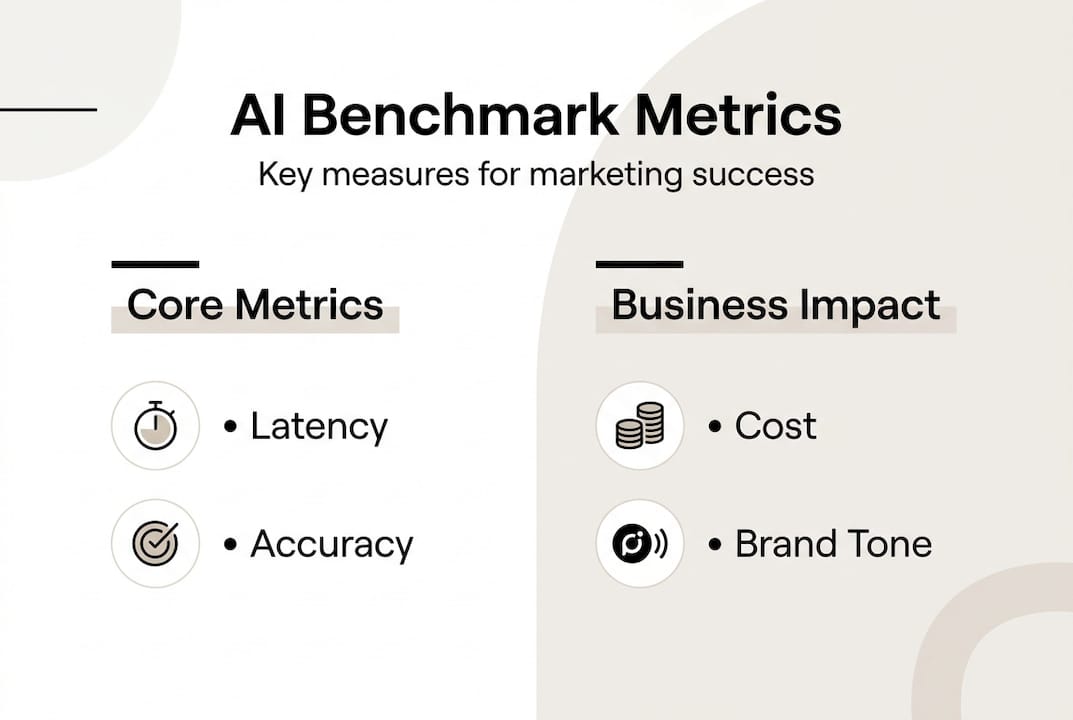
Beyond frameworks, track these core performance metrics for every AI tool you evaluate: response latency, output throughput, cost per 1,000 tokens, factual accuracy rate, and brand tone consistency. The Stanford AI Index tracks these trends annually and is a reliable reference for understanding how models are progressing.
For content-specific evaluation, build a custom golden set: a curated collection of 20 to 50 prompts that reflect your actual marketing tasks. Test each AI tool against this set and score outputs manually or with a rubric. This is far more useful than relying on public leaderboard scores alone.
Pro Tip: Focus on benchmarks that reflect your marketing discipline. If you produce long-form SEO content, test for coherence, keyword integration, and factual accuracy. If you run paid social, test for headline variation quality and call-to-action clarity. Explore AI content types to identify which formats matter most for your strategy.
With your toolkit and metrics ready, let’s move to the step-by-step process for benchmarking.
Step-by-step process: How to benchmark AI for your marketing needs
A structured process prevents you from drawing conclusions from incomplete data. Follow these steps to run a benchmarking cycle that produces actionable results.
- Define your marketing use cases. List the specific tasks you need AI to perform: blog drafts, meta descriptions, social captions, email subject lines, or product copy. Be specific. “Content creation” is too broad.
- Select relevant benchmarks and frameworks. Match your use cases to appropriate benchmarks. For factual accuracy, MMLU is a starting point. For workflow speed, check MLPerf inference scores.
- Build your test dataset. Create 30 to 50 prompts that mirror real tasks. Include edge cases: ambiguous briefs, niche topics, and brand-specific terminology.
- Run multiple test rounds. Single-run results are unreliable. Run each prompt at least five times per model to account for output variability.
- Measure and record results. Track accuracy, latency, tone consistency, and cost per output. Use a spreadsheet or dedicated tool to log everything.
- Compare models side by side. Use a comparison table to visualize performance gaps.
| Model | MMLU score | Avg. latency | Cost per 1K tokens | Brand tone score |
|---|---|---|---|---|
| GPT-4o | 88.7% | 1.8s | $0.005 | 8.2/10 |
| Claude 3 Opus | 86.8% | 2.1s | $0.015 | 8.7/10 |
| Gemini Ultra | 83.7% | 1.5s | $0.007 | 7.9/10 |
Note that MLPerf records show Llama 3.1 405B pretraining completed in 10 minutes on NVIDIA GB300 NVL72 hardware with 5,000+ Blackwell GPUs, which signals how rapidly inference speeds are improving across the board.
Pro Tip: Avoid benchmarks where top models already score above 90%. At that saturation level, score differences are statistically meaningless. Use non-saturated or custom benchmarks to detect real performance gaps. Check the AI search optimization checklist to align your benchmarking with visibility goals.
Once you’ve executed your benchmarking plan, it’s time to interpret and validate your results.
Validate and interpret your results: Avoid common pitfalls
Raw benchmark scores can mislead you if you don’t know what to look for. Several traps catch even experienced marketers off guard.
Common benchmarking pitfalls:
- Benchmark saturation: When scores exceed 90%, differences between models become noise, not signal. Scores above 90% are less meaningful for distinguishing real-world performance.
- Data contamination: Some models are trained on benchmark datasets, inflating their scores artificially. Always validate on private or custom tasks.
- Overfitting to benchmarks: A model that scores well on MMLU may still produce mediocre marketing copy. Public scores don’t guarantee task-specific quality.
- Ignoring statistical noise: One test run proves nothing. Use statistical significance testing to confirm that performance differences are real.
- Skipping human review: Quantitative scores miss tone, creativity, and brand fit. Always include a human-in-the-loop review step.
Benchmarks also have structural limitations. As noted by researchers, benchmarks reflect lab conditions, not real-world deployment. A model that performs well in controlled tests may behave differently when handling your actual audience’s queries.
“No single benchmark suffices. Combine categories for robust evaluation.”
This is especially true for AI marketing trends where model behavior shifts as new versions release. Build a mix of quantitative benchmarks, custom golden set tests, and qualitative human review into every evaluation cycle. With your benchmarking results verified, let’s consider how to apply your findings to optimize marketing outcomes.
Apply benchmarks to optimize brand visibility and marketing strategy
Benchmarking data is only valuable if it drives decisions. Here’s how to translate scores into strategy.
Use benchmark insights to:
- Select the right model for each task. A model with high factual accuracy but slow latency might be ideal for research-heavy content but wrong for real-time chatbot responses.
- Identify content gaps. If your chosen model scores poorly on niche topic accuracy, you know where human editing or supplemental sources are needed.
- Optimize prompts for visibility. Brands that systematically test and refine AI prompts see measurable gains. In 2026, brands using benchmarked AI prompt optimization reported a 78% lift in visibility across AI-driven search results.
- Monitor leaderboards for vendor decisions. LMSYS Arena and MLPerf leaderboards update regularly and give you a real-time view of which models are improving fastest.
- Align model selection with buying journey stages. Different stages, discovery, comparison, and validation, require different AI strengths. Match your model’s benchmarked capabilities to the stage where it will be deployed.
Benchmarking also protects your budget. When you can show leadership that Model A outperforms Model B on your specific tasks at half the cost, procurement decisions become data-driven rather than vendor-driven.
Streamline benchmarking and brand visibility with RankPirate
Manual benchmarking gets you started, but it doesn’t scale. Tracking how your brand appears across ChatGPT, Gemini, and Claude at every buying journey stage requires automation, consistency, and a single source of truth.
RankPirate.io automates exactly this process. The platform runs repeated prompt-based checks across discovery, comparison, and validation queries, then aggregates results into the GVS™ (AI Visibility Score) so you can see stable, long-term trends rather than one-off snapshots. You can start with the free AI visibility checker for a quick snapshot of how AI answers mention your brand, use AI prompt testing tools to identify where your brand drops out of AI responses, and follow the SEO checklist for AI answers to close the gaps benchmarking reveals. For marketers ready to move beyond spreadsheets and screenshots, RankPirate turns benchmarking into a repeatable, scalable competitive advantage.
Frequently asked questions
What is the most important metric when benchmarking AI for marketing?
Accuracy is the starting point, but latency, cost, and robustness matter just as much for content and SEO workflows. Performance metrics extend well beyond accuracy to include speed and cost efficiency.
Are public AI benchmarks like MMLU and SWE-bench still useful for marketers?
They provide a useful baseline, but custom benchmarks are more reliable for detecting meaningful differences in marketing-specific tasks where public scores are often saturated.
How often should I benchmark AI tools for my business?
Benchmark every time a major model update releases, and run a full cycle quarterly. Track leaderboards continuously because AI models master new benchmarks faster than most teams expect.
What are common mistakes marketers make when benchmarking AI?
Comparing scores across saturated benchmarks, ignoring statistical noise, and skipping private task validation are the most frequent errors. Always validate with custom tasks that reflect your real marketing work.
Does benchmarking AI help with improving brand visibility in search results?
Yes. Benchmarking tells you which models deliver better content performance and search visibility at each buying journey stage. Use-case specific metrics are the key to connecting model performance to brand visibility outcomes.