How content drives AI answer visibility for marketers

Most marketers assume AI models generate answers from thin air, but the reality is far different. Every AI response depends on retrieving and processing real web content before generating an answer. The quality, structure, and freshness of your content directly determines whether AI engines cite your brand or ignore it entirely. Understanding this fundamental relationship unlocks powerful strategies to boost your visibility in AI-generated answers and capture attention in an increasingly AI-driven search landscape.
Table of Contents
- Key takeaways
- Understanding how AI answers rely on content
- Techniques to optimize content for AI answer visibility
- Nuances and challenges in content’s role for AI-generated answers
- Applying content strategies to boost AI visibility and brand authority
- Explore tools to amplify your AI visibility strategy
- What is the role of content quality in AI-generated answers?
Key Takeaways
| Point | Details |
|---|---|
| RAG drives visibility | AI responses rely on retrieving relevant content through Retrieval Augmented Generation before generating an answer, so being retrievable increases citations. |
| Content quality matters | Depth, accuracy, and demonstrated expertise boost retrieval likelihood and AI citation of your material. |
| Structured content helps | Clear headings, schema markup, and logical organization improve AI ability to find and use your content. |
| Answer first formats | Placing the direct answer at the start signals relevance and increases the chance of being used by AI systems. |
| Freshness and EEAT signals | Recent updates and credible indicators such as experience and authoritativeness raise trust and citation rates. |
Understanding how AI answers rely on content
AI models don’t conjure answers from imagination. They use Retrieval-Augmented Generation (RAG), where content is retrieved from the web based on relevance before generation, making high-quality, structured content crucial for visibility. This process transforms how marketers should think about content creation. When someone asks ChatGPT or Gemini a question, the model first searches for relevant web content, converts it into vector embeddings, and then generates a response based on that retrieved information.
Vector embeddings represent your content as mathematical coordinates in semantic space. AI models compare these coordinates to find content that matches the query intent most closely. This means semantic relevance matters more than exact keyword matching. Your content needs to answer the underlying question comprehensively, not just include specific phrases.
“RAG systems retrieve relevant documents from large corpora and use them to augment the generation process, significantly improving factual accuracy and reducing hallucinations in AI responses.”
The RAG process prioritizes several content attributes that determine retrieval success:
- Quality signals including depth of explanation, accuracy, and expertise demonstration
- Recency factors showing when content was published or last updated
- Structural clarity through proper heading hierarchy, schema markup, and logical organization
- Semantic matching between query intent and content purpose
Many marketers mistakenly believe AI models simply invent answers based on training data. This misconception leads to neglecting content optimization. In reality, your AI search brand visibility depends almost entirely on whether your content gets retrieved during the RAG process. No retrieval means no citation, regardless of how well-known your brand might be.
The retrieval phase acts as a gatekeeper. If your content doesn’t pass this initial selection, the generation phase never considers your information. This makes understanding RAG mechanics essential for any marketer serious about AI visibility.
Techniques to optimize content for AI answer visibility
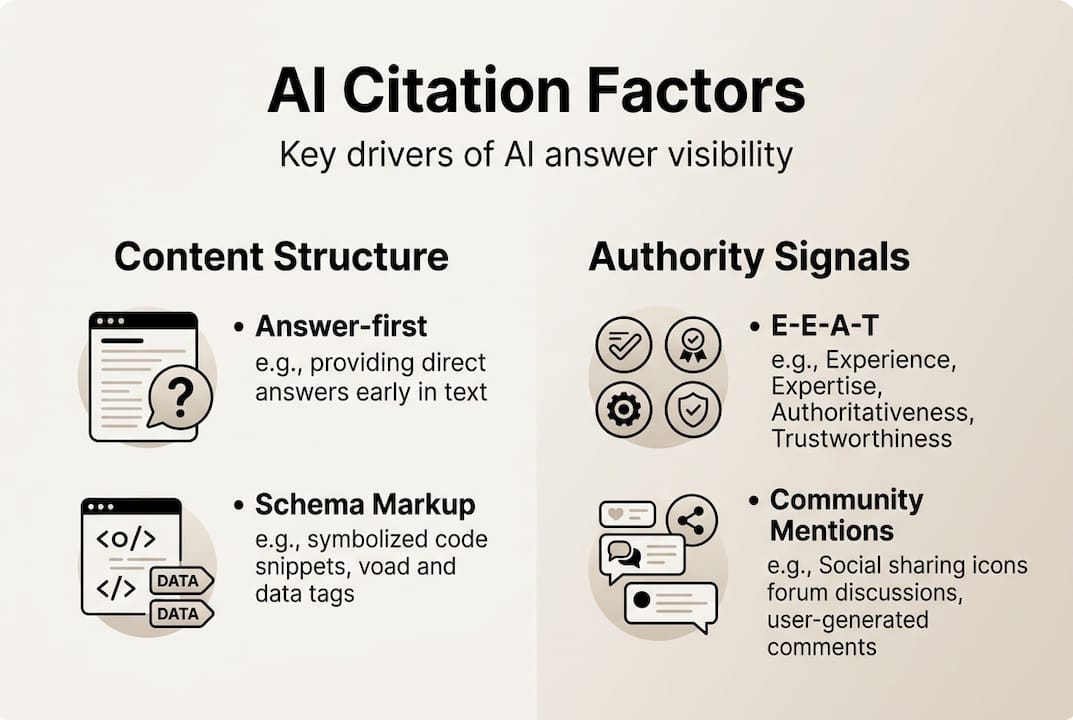
Once you understand RAG mechanics, specific optimization techniques become clear. Answer Engine Optimization (AEO) methodologies include structuring content with schema markup (FAQ, HowTo), answer-first formats, E-E-A-T signals, and freshness to increase citation likelihood in AI responses. These aren’t theoretical concepts but proven strategies backed by measurable results.
Answer-first formatting places the direct answer in the opening paragraph before diving into supporting details. This structure mirrors how AI models prefer to extract information. When your content immediately answers the query, retrieval systems recognize it as highly relevant. Traditional blog structures that build suspense or delay the answer perform poorly in AI retrieval.

E-E-A-T signals (Experience, Expertise, Authoritativeness, Trustworthiness) provide crucial credibility markers. AI models evaluate these signals through author credentials, citation patterns, domain authority, and content depth. Demonstrating genuine expertise through detailed explanations, case studies, and proprietary research significantly boosts retrieval likelihood.
| Content structure | Citation increase | Implementation difficulty |
|---|---|---|
| FAQ schema markup | 67% | Low |
| Answer-first format | 43% | Low |
| HowTo schema | 52% | Medium |
| E-E-A-T optimization | 38% | High |
| Fresh updates (quarterly) | 220% | Medium |
Schema markup provides machine-readable context that RAG systems prioritize. FAQ and HowTo schemas explicitly tell AI models what questions your content answers and how processes work. Implementing these schemas takes minimal effort but delivers substantial visibility gains.
Follow this AI search optimization checklist for systematic improvement:
- Audit existing content for answer-first structure and restructure opening paragraphs
- Add FAQ or HowTo schema markup to relevant pages using JSON-LD format
- Update content quarterly with fresh statistics, examples, and insights
- Strengthen E-E-A-T signals through author bios, citations, and detailed explanations
- Structure content with clear H2 and H3 headings that match common query patterns
- Include bullet points and tables for scannable, extractable information
Pro Tip: Prioritize community mentions and discussions around your brand on platforms like Reddit, Quora, and industry forums. AI models increasingly value these authentic signals, and brands with strong community presence see 4-7x higher citation rates in conversational AI responses.
Content freshness deserves special attention. AI models strongly favor recently updated content, with content optimization for AI answers showing that quarterly updates boost citations by 3.2x compared to stale material. This doesn’t mean rewriting everything, but adding new statistics, updating examples, and refreshing outdated information signals ongoing relevance.
The AI answer ranking factors that matter most combine structural clarity with substantive depth. Superficial content rarely gets retrieved, even with perfect schema markup. Your content must genuinely answer questions comprehensively while making that information easily extractable through proper formatting.
Nuances and challenges in content’s role for AI-generated answers
Despite optimization efforts, AI content retrieval faces significant challenges. LLMs struggle with conflicts, hallucinations in edge-case scenarios, citation failures; mitigated by explicit structure, human oversight, semantic anchoring. Understanding these limitations prevents overconfidence in AI visibility strategies and highlights where human intervention remains essential.
Edge cases occur when queries involve ambiguous terminology, conflicting information across sources, or rapidly evolving topics. AI models sometimes hallucinate answers by combining incompatible information or filling gaps with plausible-sounding but inaccurate details. GPT-4o exhibits hallucination rates around 3-8% depending on query complexity, with edge cases pushing this higher.
“In edge-case scenarios involving conflicting how-to instructions, GPT-4o produced hallucinated steps in 12% of responses, demonstrating the critical need for explicit content structure and semantic anchoring to guide accurate retrieval and generation.”
The Matthew effect compounds these challenges. AI models disproportionately cite already-popular sources, creating a visibility gap where lesser-known brands struggle to break through even with superior content. This effect stems from training data biases and retrieval algorithms that favor frequently cited domains. Breaking this cycle requires exceptional content quality combined with strategic visibility building.
Conflicts between AI and human citation preferences create another complexity. Humans often prefer concise, actionable answers, while AI models sometimes favor longer, more detailed sources during retrieval. This mismatch means content optimized for human readers may underperform in AI retrieval, requiring careful balance.
Common pitfalls that undermine AI visibility include:
- Overly promotional language that reduces perceived objectivity and trustworthiness
- Lack of clear heading structure making content difficult for AI to parse and extract
- Outdated statistics and examples signaling stale, potentially unreliable information
- Missing schema markup that forces AI to guess at content structure and purpose
- Thin content that answers questions superficially without substantive depth
Mitigation strategies center on explicit structure and human oversight. Semantic anchoring uses clear, unambiguous terminology consistently throughout content, reducing AI confusion. When discussing complex topics, define terms explicitly and use them consistently rather than relying on synonyms or implied context.
Human-in-loop review catches AI citation errors before they propagate. Monitoring how AI models cite your content reveals patterns of misinterpretation or selective quoting. This feedback loop enables targeted improvements to problematic sections. The AI answer ranking explanation shows how iterative refinement based on actual AI behavior outperforms theoretical optimization.
Explicit structure means stating relationships and hierarchies directly rather than implying them through context. Use transition phrases like “in contrast” or “as a result” to signal logical connections. Number sequential steps clearly. Label examples, case studies, and supporting evidence explicitly so AI models correctly categorize information during retrieval.
Applying content strategies to boost AI visibility and brand authority
Translating understanding into action requires systematic implementation. Follow this sequence to align content with AI visibility goals:
- Audit your existing content library to identify high-potential pages for AI optimization based on topic relevance and current traffic
- Implement answer-first restructuring on priority pages, placing direct answers in opening paragraphs
- Add appropriate schema markup (FAQ, HowTo, Article) using JSON-LD format to enhance machine readability
- Establish a quarterly content refresh schedule to maintain freshness signals that AI models prioritize
- Build E-E-A-T signals through author credentials, expert quotes, proprietary research, and comprehensive citations
- Monitor AI citation performance using prompt testing to identify which content gets retrieved and cited
- Iterate based on actual AI behavior, strengthening sections that get partially cited and restructuring overlooked content
Content marketers targeting LLMs show 67% now consider AI models a primary audience, with brand search volume correlating 0.334 with citations, outperforming backlinks, and 81% expressing positive sentiment about content strategies in the AI era. This shift reflects growing recognition that AI visibility requires dedicated optimization, not just traditional approaches.
| Ranking factor | Correlation with AI citations | Traditional value |
|---|---|---|
| Brand search volume | 0.334 | Medium |
| Backlink count | 0.287 | High |
| Content freshness | 0.412 | Low |
| Schema markup presence | 0.389 | Low |
| Domain authority | 0.301 | High |
This data reveals important differences between traditional ranking and AI citation factors. Content freshness and schema markup matter far more for AI visibility than traditional approaches, while backlinks and domain authority play smaller roles. This inversion requires rethinking content investment priorities.
Proprietary research and original data provide powerful differentiation. AI models strongly favor unique insights unavailable elsewhere, making original research a high-leverage investment. Surveys, case studies, and experimental results give your content citation advantages that competitors can’t easily replicate.
Community mentions amplify visibility through authentic social proof. Active participation in relevant online communities, thoughtful responses to questions, and genuine relationship building create natural mentions that AI models recognize as trust signals. This organic approach outperforms artificial link building or promotional tactics.
Pro Tip: Use semantic anchoring by consistently defining key terms and concepts at first mention, then using those exact terms throughout your content. This reduces AI confusion during retrieval and ensures your content gets correctly categorized and cited for relevant queries.
The positive marketer sentiment around AI-focused content strategies stems from measurable results. Brands implementing systematic AI optimization see citation rates improve 2-5x within six months. This visibility translates to increased brand awareness, higher consideration rates, and improved conversion as prospects encounter your brand repeatedly in AI-generated answers throughout their research journey.
Balancing optimization for both AI and human audiences requires strategic thinking. Prioritize human readability and value delivery first, then layer in AI-specific optimizations like schema markup and answer-first structure. Content that serves neither audience well fails completely, while content optimized exclusively for AI often feels robotic to human readers.
Tracking AI search brand visibility over time reveals trends and opportunities. Consistent monitoring shows which content types, topics, and structures perform best for your specific brand and audience. This data-driven approach replaces guesswork with actionable insights that compound over time.
Explore tools to amplify your AI visibility strategy
Executing comprehensive AI content strategies requires specialized tools and systematic testing. RankPirate automates the complex process of monitoring how AI models cite your brand across hundreds of prompts and buying journey stages. The platform tests your visibility in ChatGPT, Gemini, and Claude responses, aggregating results into a single GVS™ score that tracks performance over time.
Rather than manually testing prompts and taking screenshots, RankPirate provides scalable, reliable data on where your brand appears, where it drops out, and what content adjustments drive improvement. The platform tracks competitors simultaneously, revealing visibility gaps and opportunities. Use the free AI visibility checker for a quick baseline, then expand with RankPirate tracking across discovery, comparison, and validation stages for full customer-journey coverage.
Pro Tip: Integrate RankPirate’s prompt testing into your content workflow by checking AI visibility before and after major content updates. This direct feedback loop shows which optimizations actually improve citations versus theoretical improvements that don’t translate to real AI behavior.
Combining expert boost AI brand presence guide strategies with automated monitoring creates a powerful system for sustained visibility growth. The AI search optimization checklist provides step-by-step implementation guidance, while RankPirate measures actual results in real AI responses. This combination of strategy and measurement eliminates guesswork and accelerates improvement.
What is the role of content quality in AI-generated answers?
What is the role of content quality in AI-generated answers?
High-quality content ensures AI models retrieve accurate, relevant information during the RAG process, directly increasing citation likelihood. Quality signals include depth of explanation, factual accuracy, proper citations, and demonstration of genuine expertise. AI models evaluate these factors during retrieval to select the most trustworthy sources for answer generation.
How does schema markup affect AI answer ranking?
Schema markup helps AI engines understand content structure and purpose, boosting citation chances by up to 67% according to recent studies. FAQ and HowTo schemas explicitly label questions and answers, making extraction trivial for AI models. This machine-readable context gives properly marked content significant advantages during the retrieval phase of answer generation.
Why is human oversight important in AI content strategies?
Humans correct AI errors, ensure compliance with sensitive topics, and stabilize semantic anchoring for reliability. AI models still hallucinate in edge cases, misinterpret ambiguous content, and sometimes cite information out of context. Human review catches these issues before they undermine brand credibility and enables iterative improvements based on actual AI behavior patterns.
What types of content are most favored by AI answer engines?
Structured formats like FAQ, HowTo, and answer-first content with strong E-E-A-T signals perform best in AI retrieval systems. Content that places direct answers upfront, uses clear heading hierarchies, includes schema markup, and demonstrates genuine expertise gets retrieved and cited far more frequently. Tables, bullet points, and explicit structure further improve extraction and citation rates.
How can marketers leverage community mentions for AI visibility?
Community mentions can increase AI visibility 4-7x by providing authentic signals that AI models increasingly value. Active participation in Reddit, Quora, industry forums, and social platforms creates natural brand mentions in conversational contexts. AI models recognize these organic discussions as trust signals, particularly when multiple independent sources mention your brand in relevant contexts.