Why AI answers matter: boost brand visibility in 2026

Securing the top spot on Google used to feel like winning the visibility game. That assumption is now dangerously outdated. AI-generated answers are intercepting user intent before a single click happens, and brands that rely solely on traditional rankings are losing ground fast. 58.5% of Google searches now end without a click, meaning your number-one ranking may be delivering far less exposure than you think. This article breaks down exactly how AI answers work, why they matter more than rankings, and what you can do right now to stay visible.
Table of Contents
- How AI answers are changing search behavior
- Why AI citations matter more than top rankings
- The mechanics of AI answer optimization
- AI content vs. human-first strategy: What works now?
- Measuring and improving your brand’s AI visibility
- Take the next step: Tools and resources for AI answer success
- Frequently asked questions
Key Takeaways
| Point | Details |
|---|---|
| Traditional SEO is not enough | AI answers capture most user attention, making citations and authority vital for brands. |
| AI citations drive brand impact | Mentions in AI-generated responses matter more than organic ranking alone. |
| Structure and authority win | Content with strong structure, clarity, and human validation outperforms pure-AI output. |
| Track your AI visibility | Benchmark, monitor, and optimize your presence in AI responses using new metrics. |
How AI answers are changing search behavior
The shift is not subtle. AI Overviews appear in roughly 50% of US queries, and analysts predict a 25% drop in traditional search volume by 2026. That is not a future problem. It is happening now, and it is reshaping how buyers discover, evaluate, and trust brands.
When a user asks an AI-powered search engine a question, they get a synthesized answer instantly. No scrolling. No clicking. No visiting your carefully optimized landing page. The AI becomes the gatekeeper, and only brands it cites get any exposure at all. You can see examples of AI-powered answers across different buying stages to understand just how much brand framing happens inside those responses.
“AI answers shape purchase intent and brand trust at the moment of search, before any website is visited.”
Here is when AI answers help or hurt your brand visibility:
- Helps: Your brand is cited as a recommended solution in a comparison query
- Helps: Your content is used to define a category or explain a concept
- Hurts: A competitor is cited and you are not mentioned at all
- Hurts: The AI summarizes your space without naming any specific brand
- Hurts: Your brand appears in a negative context due to poor sentiment signals
| Search behavior metric | Traditional SEO era | AI answer era |
|---|---|---|
| Average click-through rate | 3-5% (position 1) | Declining sharply |
| Zero-click searches | ~30% | 58.5% of all searches |
| Brand exposure point | Website visit | AI answer citation |
| Buyer trust formation | Content consumption | Instant AI synthesis |
Understanding AI answer ranking factors is now as essential as understanding keyword difficulty used to be.
Why AI citations matter more than top rankings
Here is a fact that should change how you allocate your content budget: only 38% of AI citations come from Google’s top 10 organic results. A full 44% come from positions 11 through 100. That means a brand ranking on page two or three can earn more AI visibility than a brand sitting at position one, if its content is structured and authoritative enough.
This flips the traditional SEO playbook on its head. Ranking high still matters, but it no longer guarantees citation. What AI models actually favor is content that is easy to parse, clearly attributed, and backed by credible signals. AI answers form buyer intent without clicks, which means the brands earning citations are shaping decisions invisibly.
“A brand cited in an AI answer at position 40 may have more influence than a brand ranking first with no citation.”
What AI models look for when selecting citations:
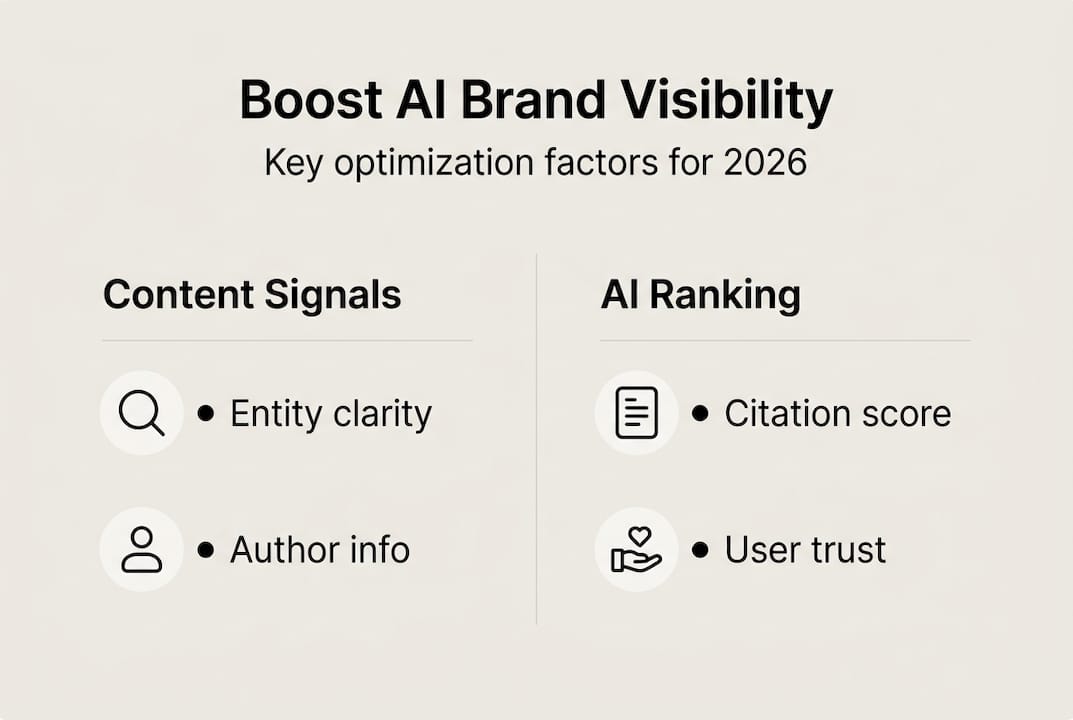
- Clear entity definition (who you are, what you do, what category you belong to)
- Structured, scannable content with headers and schema markup
- Demonstrated expertise through author credentials and sourcing
- Consistent off-site mentions on trusted third-party domains
- Content that directly answers specific questions buyers are asking
| Factor | Traditional SEO weight | AI citation weight |
|---|---|---|
| Keyword density | High | Low |
| Backlink volume | High | Moderate |
| Content structure | Moderate | Very high |
| Entity clarity | Low | Very high |
| Author authority | Low | High |
Pro Tip: Before optimizing for rankings, audit your content for entity clarity. If an AI model cannot quickly identify what your brand does and who it serves, it will not cite you, regardless of your domain authority.
Strategies for boosting AI brand presence start with this structural foundation. And understanding AI responses as a format, not just a feature, is what separates brands that get cited from those that get ignored.
The mechanics of AI answer optimization
Knowing citations matter is one thing. Earning them consistently is another. Here is a practical six-step framework for getting your content selected by AI models.
- Define your entity clearly. Every page should state who you are, what problem you solve, and what category you operate in, within the first 100 words.
- Implement structured data. Schema markup signals to AI crawlers exactly what type of content they are reading. Structured data boosts citations 3.2x compared to unstructured content.
- Add FAQ sections. Direct question-and-answer formats are highly compatible with how AI models extract and synthesize information.
- Cite credible sources. Linking to authoritative external references signals that your content meets E-E-A-T standards, which AI models weight heavily.
- Build off-site mentions. Getting cited on trusted third-party sites, industry publications, and review platforms reinforces your brand’s authority signals. Optimization mechanics consistently point to off-site credibility as a key driver.
- Write for summarization. Long-form content of 2,000 words or more earns 2.7x more citations than shorter pieces, but only when it is well-organized and scannable.
Pro Tip: In health, finance, or legal verticals, author bios with verifiable credentials are not optional. AI models in YMYL (Your Money Your Life) categories heavily weight institutional authority. A named expert with a linked profile can be the difference between citation and invisibility.
Review the AI answer ranking key factors to map these mechanics against your current content gaps.
AI content vs. human-first strategy: What works now?
Many marketing teams are tempted to scale content production with pure AI generation. The data says that is a risky move. Pure AI content ranks 23% lower, earns 61% fewer backlinks, and faces a 3.2x higher deindexation risk compared to human-written content. AI-assisted content with meaningful human editing, however, achieves near-parity with fully human content.
“The brands winning AI citations are not the ones producing the most content. They are producing the most credible content.”
The distinction matters because AI models are trained to recognize quality signals, and those signals correlate strongly with human judgment, editorial standards, and genuine expertise. Human-first hybrid content consistently outperforms pure AI output across visibility metrics.

| Content type | Ranking performance | Backlink acquisition | Deindexation risk |
|---|---|---|---|
| Pure AI generated | 23% lower | 61% fewer | 3.2x higher |
| AI-assisted, human edited | Near-parity | Near-parity | Low |
| Fully human written | Baseline | Baseline | Baseline |
What this means for your content strategy:
- Use AI to draft, research, and structure content at scale
- Always apply expert human review before publishing
- In sensitive verticals, prioritize institutional voice over generic brand voice
- Treat AI generation as a starting point, not a finished product
Browse AI content examples to see how brands are using hybrid approaches to earn consistent citations across different query types.
Measuring and improving your brand’s AI visibility
You cannot improve what you do not measure. The core metric for AI answer performance is the AI visibility score, calculated as: (brand mentions / total AI responses) x 100, tracked across platforms like ChatGPT, Perplexity, and Google AI Mode. This gives you a percentage that reflects how often your brand appears when relevant queries are run.
This is fundamentally different from CTR. A high CTR means people clicked your link. A high AI visibility score means your brand was present in the answer, shaping perception even when no click occurred. Forrester recommends reallocating 15% of your SEO budget toward AI answer optimization to reflect this shift.
Here is a practical monitoring routine:
- Define your prompt set. Identify 20 to 50 queries your buyers use at discovery, comparison, and validation stages.
- Run weekly checks. Test each prompt across at least two AI platforms and log whether your brand appears, where it appears, and in what context.
- Benchmark competitors. Track how often competitors are cited in the same prompt set. Gaps reveal where your content authority is weakest.
- Monitor sentiment. Being cited is good. Being cited positively is better. Flag any responses where your brand appears in a neutral or negative framing.
- Iterate on content. Use citation gaps to prioritize new content or restructure existing pages.
Pro Tip: Reallocate a portion of your SEO budget specifically to AI answer optimization. Even a 10 to 15% shift can produce measurable gains in citation frequency within 60 to 90 days.
Explore AI brand presence strategies to build a repeatable system around these metrics.
Take the next step: Tools and resources for AI answer success
The strategies in this article only create results when they are implemented consistently and tracked over time. That is exactly where most teams stall: the gap between knowing what to do and having a reliable system to do it.
RankPirate.io was built to close that gap. The platform automates prompt-based visibility checks across ChatGPT, Gemini, and Claude, aggregating results into a single GVS™ score so you always know where your brand stands. Start with the AI search optimization checklist to audit your current content against the citation factors covered here. If you want the strategic case for prioritizing this work, why optimize for AI lays it out clearly. And when you want a quick snapshot before full weekly tracking, the free AI visibility checker shows how AI answers mention your brand today.
Frequently asked questions
What are AI-generated answers in search?
AI-generated answers are instant, direct responses synthesized from multiple sources and delivered at the top of search results, often before any website link appears. AI Overviews appear in roughly 50% of US queries, making them a primary touchpoint in the modern buyer journey.
How do I track my brand’s AI answer visibility?
Calculate your AI visibility score by dividing brand mentions by total AI responses and multiplying by 100, then track this metric consistently across ChatGPT, Perplexity, and Google AI Mode.
Are traditional SEO efforts still important?
Yes, SEO fundamentals still support AI citation eligibility, but new metrics are required alongside them. Content structure, entity clarity, and brand authority now carry more weight than keyword rankings alone.
Is human-written content more likely to earn AI citations?
Human or hybrid content with expert review significantly outperforms pure AI content. Pure AI content faces a 3.2x higher deindexation risk and ranks 23% lower, making editorial oversight a non-negotiable part of any AI citation strategy.