Boost your brand: maximize visibility in AI answers

AI-generated answers now shape purchasing decisions before buyers ever visit a brand’s website. AI-driven answers have become a core influence on how customers discover, evaluate, and choose brands. If your brand isn’t appearing in those answers, you’re invisible at the most critical moments of the buying journey. This guide walks brand managers and digital marketing professionals through exactly what AI answer visibility means, how AI engines select brands to surface, which strategies move the needle, and how to measure progress without guesswork.
Table of Contents
- Why AI answer visibility matters for brands
- Understanding how AI selects brand answers
- Core strategies to increase your brand’s AI answer visibility
- Measurement, pitfalls, and the future of brand visibility in AI
- Why ‘quick hacks’ fail and how discipline wins AI answer visibility
- Accelerate your AI answer visibility with RankPirate
- Frequently asked questions
Key Takeaways
| Point | Details |
|---|---|
| AI answers shape buyer journeys | If your brand isn’t visible in AI-generated responses, you risk losing engagement at key decision points. |
| Hybrid strategies win | A blend of SEO, GEO, and AEO is required for maximum brand presence in AI and traditional search. |
| Consistent optimization is essential | One-off tactics fail—only ongoing, operational discipline puts your brand in the AI answer spotlight. |
| Measurement fuels improvement | Track your AI answer share, and act quickly on drops or missed opportunities for visibility. |
Why AI answer visibility matters for brands
Traditional SEO earned you a spot on a results page. AI answer visibility is something different. When a buyer asks ChatGPT, Gemini, or Claude which software to use, which brand to trust, or which product solves their problem, the AI doesn’t return a list of links. It returns a synthesized answer. Your brand either appears in that answer or it doesn’t. There’s no page two.
This shift changes the entire game for brand engagement. Consider what’s at stake:
- Discovery stage: Buyers use AI prompts to learn about categories and options. Brands not mentioned here lose awareness before the journey even starts.
- Comparison stage: AI answers summarize pros and cons. Absence here means competitors frame the narrative.
- Validation stage: Buyers confirm choices by asking AI for social proof and expert opinion. Missing here can kill a near-certain conversion.
- Post-purchase: Customers ask AI for support and recommendations. Visibility here drives loyalty and upsell.
The consequences of invisibility compound fast. A brand that doesn’t appear in AI answers loses not just clicks but trust signals, brand recall, and the authority that comes from being consistently mentioned alongside relevant topics.
“Hybrid strategies maximize visibility across classic search and LLM-driven answers, making cross-channel optimization essential for any serious brand.”
This is why why AI answers matter has become a board-level conversation. Visibility in AI-generated content directly influences brand trust, awareness, and conversion rates. Brands that appear consistently in AI answers build perceived authority faster than those relying solely on traditional search rankings. The customer doesn’t see the algorithm. They just see which brands the AI recommends, and they trust it.
Understanding how AI selects brand answers
Knowing the stakes isn’t enough. You need to understand the mechanism. AI language models don’t crawl the web in real time for every query. They synthesize responses based on patterns learned during training, combined with retrieval-augmented generation (RAG) in some systems, which pulls current web content to supplement answers.

Here’s a simplified view of what AI engines evaluate when selecting brand content:
| Factor | What it means | Why it matters |
|---|---|---|
| Content clarity | Structured, direct, jargon-free writing | AI extracts clean answers from clear content |
| Authority signals | Backlinks, mentions, domain trust | Signals the brand is a credible source |
| User intent match | Content aligned to query purpose | Increases relevance scoring |
| Entity recognition | Brand name clearly tied to a topic | Helps AI disambiguate similar brands |
| Freshness | Updated, current content | Signals ongoing relevance |
AI engines must disambiguate similar brands and prioritize relevance, authority, and clarity when constructing answers. That means a brand with a generic name and thin content will consistently lose to a competitor with a well-defined entity, strong topical authority, and content structured for extraction.
Here’s how to think about the levers you can actually control:
- Define your brand entity clearly. Ensure your brand name, category, and core value proposition appear consistently across your website, structured data, and third-party mentions.
- Build topical authority. Create content clusters around the specific problems your buyers ask AI about. Depth beats breadth.
- Structure content for extraction. Use headers, short paragraphs, and direct answers. AI systems favor content that’s easy to pull a clean quote from.
- Earn authoritative mentions. Press coverage, industry directories, and expert citations all reinforce your brand’s authority signal.
For a deeper breakdown of how these systems work, understanding AI response logic is a strong starting point for any marketing team building out their strategy.
Core strategies to increase your brand’s AI answer visibility
Strategy without structure is just hope. Here’s a practical framework for increasing your brand’s inclusion in AI-generated answers across the buying journey.
Step 1: Audit your current AI visibility. Run your target queries across ChatGPT, Gemini, and Claude. Document where your brand appears, where it drops out, and what competitors are being mentioned instead. This baseline is essential.
Step 2: Align content to the three core approaches.
| Approach | Focus | AI visibility benefit |
|---|---|---|
| SEO | Keywords, backlinks, technical health | Feeds training data and RAG retrieval |
| GEO (Generative Engine Optimization) | Structured, extractable content | Directly improves AI answer inclusion |
| AEO (Answer Engine Optimization) | Question-based, intent-driven content | Targets specific buyer queries in AI |
Hybrid SEO, GEO, and AEO approaches consistently outperform isolated tactics. Running only SEO misses the structural requirements of AI extraction. Running only AEO without domain authority limits reach. The combination is what drives compounding visibility.
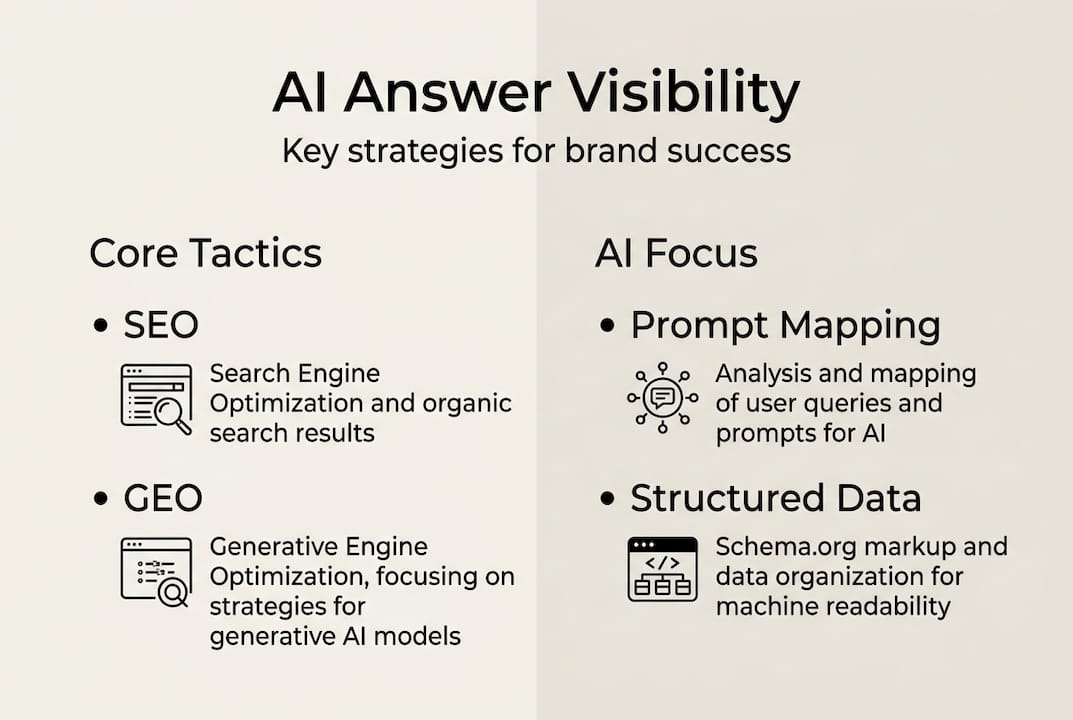
Step 3: Build prompt-targeted content. Map the exact questions your buyers ask at each journey stage and create dedicated content that answers them directly. Think in prompts, not just keywords.
Step 4: Optimize metadata and structured data. Schema markup helps AI systems understand what your brand does, who it serves, and why it’s relevant. Don’t skip this.
Pro Tip: Before publishing any new content, test it by pasting the key section into an AI prompt and asking the model to summarize your brand’s position. If the summary is vague or wrong, the content needs sharper entity signals.
Step 5: Monitor and iterate. AI answer inclusion is not static. Competitors improve, models update, and buyer queries evolve. Consistent monitoring through improving AI answers and AI answer content optimization practices keeps your strategy current.
Measurement, pitfalls, and the future of brand visibility in AI
You can’t improve what you don’t measure. For AI answer visibility, the right KPIs look different from traditional search metrics.
Key metrics to track:
- AI answer share: How often your brand appears versus competitors across a defined set of target prompts
- Mention accuracy: Whether AI answers represent your brand correctly, including category, features, and positioning
- Sentiment in answers: Positive, neutral, or negative framing in AI-generated brand mentions
- Journey touchpoint frequency: How consistently your brand appears across discovery, comparison, and validation prompts
- Visibility trend over time: Whether your inclusion rate is growing, stable, or declining across model updates
The most common pitfalls that drag down visibility are predictable and avoidable:
- Inconsistent brand metadata across platforms and directories
- Outdated product descriptions or positioning that no longer matches buyer queries
- Missing structured data that leaves AI systems guessing about your brand’s category
- Thin content that lacks the depth AI systems need to extract a confident answer
- Ignoring third-party mentions, which are often the source AI systems draw from most
Pro Tip: Automate your AI answer monitoring. Manual spot-checks miss the pattern. You need to track visibility across dozens of prompts, multiple models, and repeated runs to identify real trends versus random variation. Tools that aggregate this into a single score, like the GVS™ score from RankPirate, make this scalable. Check out AI answer optimization steps for a practical workflow.
Operational discipline is what separates brands that maintain visibility through model updates from those that spike and fall. As AI systems evolve toward more personalized, dynamic answer generation, the brands with the strongest foundational signals will adapt fastest.
Why ‘quick hacks’ fail and how discipline wins AI answer visibility
Every few months, a new tactic promises to game AI answers overnight. Prompt stuffing, entity injection schemes, mass-produced FAQ pages. We’ve seen them all, and we’ve watched them fade just as fast. The uncomfortable truth is that AI systems are trained on patterns across millions of signals. A one-off tactic might move the needle briefly, but it doesn’t build the kind of consistent, multi-source authority that keeps a brand visible across model updates and shifting buyer queries.
The brands winning in AI answer visibility right now are not the ones with the cleverest hacks. They’re the ones that operationalized hybrid SEO, GEO, and AEO as a continuous practice, not a campaign. They publish structured, authoritative content consistently. They monitor their AI answer share weekly, not quarterly. They treat entity clarity as a non-negotiable foundation, not an afterthought.
The mindset shift is this: AI answer visibility is an operational discipline, not a project. Brands that treat it like a one-time optimization will always be chasing the last update. Brands that build systems around content-driven AI visibility compound their advantage over time. That’s the difference between being mentioned once and being the brand AI consistently recommends.
Accelerate your AI answer visibility with RankPirate
If you’re serious about building consistent, measurable AI answer visibility, manual tracking won’t scale. RankPirate automates the entire monitoring and optimization workflow, running repeated prompt-based checks across ChatGPT, Gemini, and Claude to show exactly where your brand appears and where it drops out.
The platform aggregates results into a single GVS™ score so your team always has a clear, comparable measure of progress. It tracks competitors, flags content gaps, and delivers actionable recommendations without the spreadsheet chaos. Whether you’re just starting your AI visibility strategy or looking to sharpen an existing one, explore the AI brand presence guide or try the free AI visibility checker to see how AI answers mention your brand today.
Frequently asked questions
How do I know if my brand appears in AI answers?
Use dedicated AI visibility monitoring tools that run repeated prompt checks across major AI platforms and track your brand’s mention rate over time. Ongoing monitoring is essential because visibility fluctuates with model updates and competitor activity.
What is the fastest way to improve brand visibility in AI-generated answers?
Focus on structured, intent-aligned content and apply hybrid SEO, GEO, and AEO practices simultaneously, since combined approaches outperform any single tactic for AI answer inclusion.
Can I optimize just one page and rank well in AI answers?
No. Sustainable visibility requires consistent, brand-wide optimization across content, metadata, structured data, and third-party mentions rather than isolated page-level efforts.
How does AI answer visibility differ from traditional SEO?
AI answer visibility depends on contextual relevance, entity clarity, and content extractability, not just keywords and backlinks. AI engines synthesize content across multiple dimensions that go well beyond traditional ranking factors.