Guide to Improving AI Answers for Maximum Brand Visibility

Marketing teams invest heavily in content, yet many brands remain invisible when AI systems generate answers. The difference between appearing in AI responses and being overlooked often comes down to deliberate content structure. Structured AEO content increases citations and zero-click visibility. This guide delivers actionable steps to optimize your content for AI systems, build authority signals, and measure your brand’s presence in AI-generated answers across platforms.
Table of Contents
- Why improving AI answers matters for marketers
- Preparing your content: What AI needs to surface your brand
- Step-by-step: Structuring content for optimal AI answers
- Building authority: Research, mentions, and E-E-A-T signals
- Verifying and measuring your AI answer impact
- Take your brand’s AI visibility to the next level
- Frequently asked questions
Key Takeaways
| Point | Details |
|---|---|
| Structure for AI comprehension | Descriptive headings and answer-first formats help AI systems cite your content. |
| Build brand authority signals | Original research, consistent entity details, and E-E-A-T boost citation chances. |
| Measure and iterate | Transparent tracking with AEO tools helps you improve and sustain visibility. |
| AEO and SEO work together | Optimizing for AI answers enhances, not replaces, your SEO efforts. |
Why improving AI answers matters for marketers
The digital landscape has shifted from traditional blue links to AI-generated answers that control discovery across search, chat, and voice platforms. When users ask questions, AI systems now provide direct responses, often without requiring clicks to external websites. This transformation fundamentally changes how brands gain visibility.
Zero-click results dominate modern search behavior. Users receive answers directly in AI summaries, reducing traditional website traffic but creating new opportunities for brand mentions and citations. These citations drive measurable business outcomes. AEO strategies convert 27% of AI traffic to leads, demonstrating clear ROI for brands that optimize for answer engines.
Answer Engine Optimization (AEO) complements rather than replaces SEO. While SEO focuses on keyword rankings and page authority, AEO targets how AI systems extract, understand, and cite your content. Both strategies work together to maximize visibility across traditional search and AI-powered platforms.
The stakes are clear:
- Brands cited in AI answers gain authority and trust without paid advertising
- Citations appear across multiple platforms simultaneously, multiplying reach
- Early adopters establish dominance before competitors recognize the opportunity
- Missing from AI answers means losing visibility to brands that structure content correctly
Understanding why AI answers matter for brands helps prioritize this work within broader marketing strategies. The conversion data proves that AI answer visibility translates directly to business growth.
Preparing your content: What AI needs to surface your brand
AI systems evaluate content differently than human readers. They scan for specific structural elements that enable quick extraction and confident citation. Understanding these requirements helps you prepare content that AI systems can easily process and reference.
Pro Tip: Think of AI systems as extremely literal readers who need explicit signals about what information matters and how it connects to your brand.
AI platforms prioritize content with these characteristics:
- Descriptive headings that clearly state the topic without clever wordplay
- Answer-first opening lines that provide direct responses in the first 40-60 words
- Short paragraphs with 3-4 sentences maximum, each focused on one concept
- Lists and tables that organize facts, statistics, and steps clearly
- Consistent brand information that matches across all digital properties
Structure content for AI comprehension using headings, answer-first format, lists, and one idea per header. This approach aligns with how retrieval-augmented generation (RAG) systems chunk and process information.

RAG systems break content into segments, evaluate relevance, and extract specific passages for citations. When your content uses clear structure, AI systems can confidently identify which segments answer specific queries. Ambiguous structure leads to being overlooked, even when your content contains valuable information.
| Content Element | AI Requirement | Impact on Citations |
|---|---|---|
| Headings | Descriptive, keyword-rich | High – enables topic matching |
| Opening sentences | Direct answer format | Critical – often cited verbatim |
| Paragraph length | 3-4 sentences maximum | Medium – improves extraction |
| Lists/tables | Structured data format | High – easy to parse and cite |
| Brand mentions | Consistent entity name | Critical – enables attribution |
| Update frequency | Current information | Medium – affects trust signals |
Exploring types of AI-generated content reveals how different formats perform across platforms. Understanding how content drives AI answer visibility provides additional context for optimization decisions.
Step-by-step: Structuring content for optimal AI answers
Implementing AI-optimized structure requires systematic changes to how you create and format content. Follow this playbook to maximize your chances of earning citations.
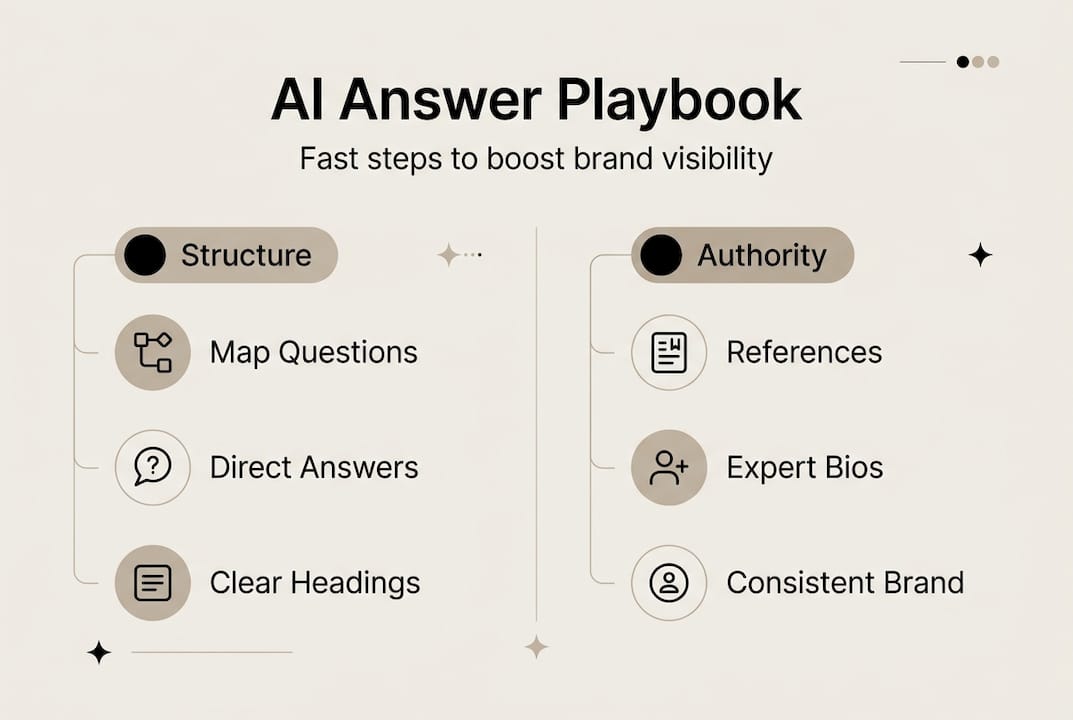
1. Map target questions your brand should answer
Identify the specific questions your audience asks throughout their buying journey. Focus on discovery, comparison, and validation stages. Create content that directly addresses these questions rather than generic topic overviews.
2. Open with direct answers
Place your core answer in the first 40-60 words of each section. AI systems heavily weight opening content when generating responses. Avoid lengthy introductions or context-setting before delivering the answer.
3. Use descriptive subheadings
One idea per header enables easy extraction by RAG systems. Each heading should clearly state what the following section covers. Avoid questions as headings unless you’re creating FAQ content.
4. Format facts as lists and tables
When presenting statistics, steps, or comparisons, use structured formats. Lists and tables signal to AI systems that this information is factual and citation-worthy. Avoid burying important data in paragraph text.
5. Maintain consistent brand naming
Use your exact brand name consistently throughout all content. Variations confuse entity recognition systems. If your brand is “Acme Marketing Solutions,” don’t alternate with “Acme” or “AMS” without establishing the relationship explicitly.
6. Add author credentials and references
Include author bios with relevant expertise. Link to authoritative sources for claims and statistics. These signals help AI systems assess content trustworthiness and increase citation confidence.
| Optimization Step | Implementation Time | Citation Impact |
|---|---|---|
| Question mapping | 2-3 hours | Foundation for all content |
| Answer-first format | 30 minutes per article | Immediate improvement |
| Descriptive headings | 15 minutes per article | High impact on extraction |
| Lists/tables | 20 minutes per article | Significant boost |
| Brand consistency | 1 hour audit + ongoing | Critical for attribution |
| Authority signals | 1 hour per article | Builds long-term trust |
Pro Tip: Start with your highest-traffic content. Optimizing existing popular pages yields faster results than creating new content from scratch.
Common pitfalls include using clever but vague headings, burying answers deep in content, and inconsistent formatting across pages. Review examples of effective AI answers to see successful implementations.
Building authority: Research, mentions, and E-E-A-T signals
Structure alone doesn’t guarantee citations. AI systems evaluate authority signals to determine which sources deserve inclusion in answers. Building these signals requires strategic effort beyond content formatting.
Publish original research and data-driven insights that other sources will reference. Unique statistics, survey results, and industry analysis establish your brand as a primary source. AI systems prioritize original data over aggregated information.
Seek mentions in respected marketing and media outlets. When authoritative sites reference your brand or content, AI systems interpret this as a trust signal. Focus on quality over quantity. A single mention in a major industry publication carries more weight than dozens of low-authority backlinks.
Build authority through original research, third-party mentions, consistent entity info, and E-E-A-T. These factors work together to establish your brand as a reliable source.
E-E-A-T (Experience, Expertise, Authoritativeness, Trustworthiness) remains crucial for AI citation decisions:
- Experience: Demonstrate firsthand knowledge through case studies and specific examples
- Expertise: Showcase credentials, certifications, and specialized knowledge
- Authoritativeness: Earn recognition from industry peers and publications
- Trustworthiness: Maintain accurate information, cite sources, and update content regularly
Keep brand and entity schema unified across all digital properties. Your website, social profiles, business listings, and content should use identical brand names, descriptions, and key details. Inconsistencies confuse entity recognition systems and dilute authority signals.
Understanding AI answer ranking factors helps prioritize authority-building efforts. Review AI answer examples to see how authoritative brands appear in responses. Recognizing why AI answers matter for visibility reinforces the importance of authority investment. Learn about AI answer aggregation to understand how systems combine multiple sources.
Verifying and measuring your AI answer impact
Optimization efforts require measurement to validate effectiveness and guide improvements. Tracking AI answer visibility differs from traditional analytics but follows systematic processes.
1. Identify target queries
List the specific questions and prompts where your brand should appear. Include variations across discovery, comparison, and decision stages. Test these queries across multiple AI platforms.
2. Monitor brand citations systematically
Check AI responses for your brand mentions weekly. Document when you appear, how prominently, and in what context. Track competitors simultaneously to understand relative visibility.
3. Use AEO assessment tools
Use AEO graders and empirical benchmarks for verification and iteration. These tools evaluate content structure, authority signals, and citation-worthiness, providing actionable improvement recommendations.
4. Diagnose visibility gaps
When your brand doesn’t appear in expected answers, investigate:
- Content structure issues (missing answer-first format, vague headings)
- Brand information inconsistencies across properties
- Insufficient authority signals or outdated content
- Competitor content that better matches AI requirements
5. Iterate based on results
AEO is ongoing work, not a one-time project. AI platforms evolve their algorithms and data sources continuously. Regular testing and adjustment maintain visibility as systems change.
Key metrics to track:
- Citation frequency across target queries
- Position within AI answers (first mention vs. secondary reference)
- Context of mentions (positive, neutral, comparative)
- Competitor citation rates for benchmark comparison
- Conversion rates from AI-referred traffic
Exploring key AI ranking factors provides additional measurement context. Understanding which factors most influence your visibility helps prioritize optimization efforts.
Take your brand’s AI visibility to the next level
You’ve learned the fundamentals of structuring content, building authority, and measuring AI answer performance. Now it’s time to scale these efforts systematically across your entire content library and competitive landscape.
RankPirate automates the testing and monitoring process that makes AEO sustainable. Instead of manually checking dozens of queries across multiple AI platforms, the platform runs systematic prompt tests across ChatGPT, Gemini, and Claude. It tracks your brand’s visibility over time, compares your performance against competitors, and identifies exactly where you’re gaining or losing ground.
The free AI visibility checker shows how ChatGPT and Perplexity currently mention your brand, so you can spot gaps before you invest in full weekly tracking. Combined with RankPirate visibility scoring and trend analysis, you get clear direction on which content needs optimization and which strategies deliver results.
Ready to boost AI brand presence with systematic monitoring and actionable insights? Start measuring your current visibility to establish a baseline, then implement the optimization strategies from this guide while tracking improvements in real time.
Frequently asked questions
What is the most important content structure for AI answers?
The answer-first format with descriptive headings and concise paragraphs is most effective. Place your core answer in the first 40-60 words of each section.
How can I track my brand’s mentions in AI-generated answers?
Use AEO graders and answer monitoring tools to measure visibility and citations across platforms. Test target queries weekly and document when and how your brand appears.
Do I need to update content regularly for better AI answer performance?
Yes, updating content and maintaining consistent brand information ensures ongoing AI visibility. AI systems prioritize current information and penalize outdated content.
Does AEO replace traditional SEO?
No, AEO complements SEO by focusing on answer and intent optimization, not just keywords. Both strategies work together to maximize visibility across traditional search and AI platforms.